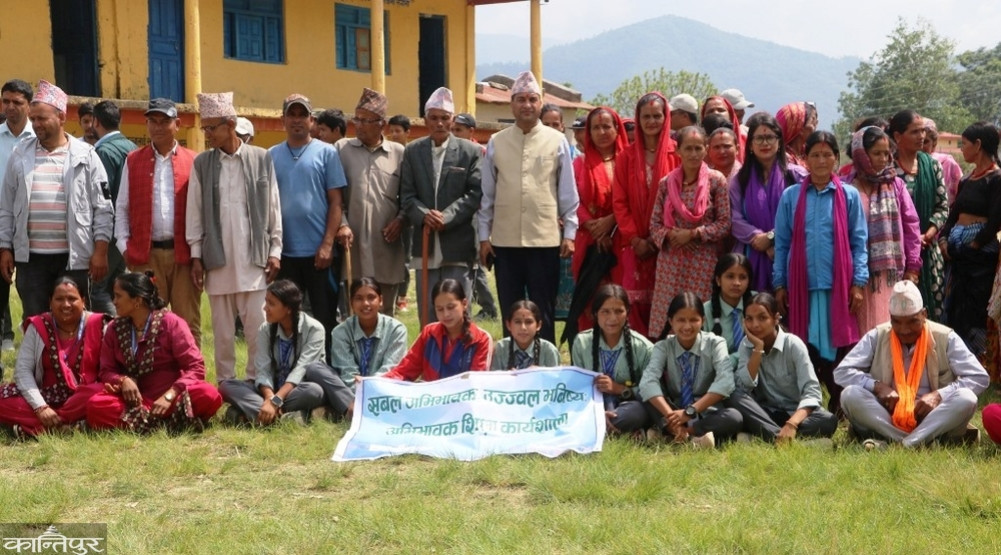
Navadurga Rural Municipality of Dadeldhura has emphasized the overall development of students by including parents in the classroom for educational improvement.
We use Google Cloud Translation Services. Google requires we provide the following disclaimer relating to use of this service:
This service may contain translations powered by Google. Google disclaims all warranties related to the translations, expressed or implied, including any warranties of accuracy, reliability, and any implied warranties of merchantability, fitness for a particular purpose, and noninfringement.
Dadeldhura's Navadurga Rural Municipality has started involving parents in classes with the message that they should play a role in their children's learning process in school.
A psychosocial education program targeting teachers, principals and students has been launched in seven secondary schools within the municipality to improve educational quality.
After the expected achievements were not achieved through programs such as extra classes and educational gatherings last year, the municipality has said that a new practice has been started this year with the aim of bringing about changes in the thinking and behavior of all three parties to improve the learning environment.
Dadeldhura's Navadurga Rural Municipality has started a different practice this year after concluding that even if teachers teach well in school, it is difficult to achieve the expected educational achievements if parents do not support them at home and the morale of the students is weak.
The municipality is conducting a psychosocial education program in all seven secondary schools with the aim of bringing about changes in the thinking, behavior and responsibility of all three parties, teachers, parents and students, rather than limiting school teaching to textbooks.
The municipality, which has been conducting various exercises for the past few years to improve educational quality, had organized an educational gathering last academic year by bringing teachers, parents and students on one platform. Extra classes were also conducted for students with poor learning achievement. But after those efforts did not show any improvement in the results as expected, this year, the 'Healthy Mind, Strong Student' campaign was launched focusing on psychological and behavioral aspects.
About 1,100 students, parents and teachers from all seven secondary schools are participating in the program run by the Education, Youth and Sports Department of the rural municipality. The rural municipality has stated that the objective of the program is not only to increase exam scores but also to strengthen the relationship between school, family and community and support the overall personality development of children.
In the program, students are trained on self-confidence building, goal setting, developing interest in studies, time management, stress management, positive thinking, future career choice and exam preparation. Students who are weak in studies have also been advised not to get discouraged, to take failure as a learning opportunity, and to have faith in their own abilities.
In the session conducted for parents, training was provided on understanding the emotions of children, communicating regularly with them, creating a study environment at home, providing love, respect, and encouragement, and adopting positive behavior instead of scolding, fear, and punishment. The message that the responsibility of the school is equal not only for the teacher but also for the family has been conveyed through the program.
Local Kalapati Bohora said that her understanding of the role of parents has changed after the training. ‘Earlier, I thought that education was the responsibility of the school,’ she said, ‘Now we have come to know that the environment at home, our behavior, and the time we give to children also have a great impact on their studies. Now we also pay regular attention to their studies and behavior.’
Another participant, Indradevi Bista, shared her experience that giving love and respect to children is the basis of good education. ‘Not only when sending them to school, but also after returning, we talk to them, listen to their problems and encourage them,’ she said. ‘These things used to seem normal, but now we understand that this is the basis of learning.’
Digradevi Bista of Navadurga-4 said that she has seen positive changes after the training. ‘It is not just about telling children to read, it is also necessary to understand their feelings,’ she said. ‘Now I am trying to spend more time with them and give them love and encouragement.’
Teachers have been trained on student-friendly teaching methods, teaching by understanding psychological conditions, increasing classroom participation and developing the habit of regular study even outside school hours. Priority has also been given to providing special support to students with weak learning achievement, providing regular counseling and increasing coordination with parents.
Rural Municipality Chairman Laxmi Prasad Awasthi said that educational reform will not be possible with the efforts of any one party alone. He said that school results will improve only if all three parties, teachers, parents and students, become responsible. ‘Parents should also pay equal attention to whether children have gone to school regularly, whether they have shown interest in studies, and whether they have followed discipline,’ he said. ‘Quality education is not possible by limiting the responsibility of the school to the school.’
He said that active participation of the community is necessary for quality education. He said that many parents in rural areas are busy with employment, farming and daily livelihood, so they are not able to devote enough time to their children’s studies. Some students also fall behind in their studies due to family problems, lack of confidence, social pressure and uncertainty about the future. The rural municipality has stated that psychosocial education has been put forward as the basis for educational reform to solve such problems. The rural municipality has stated that it will continue such programs by regularly evaluating learning achievements in the coming year as well.