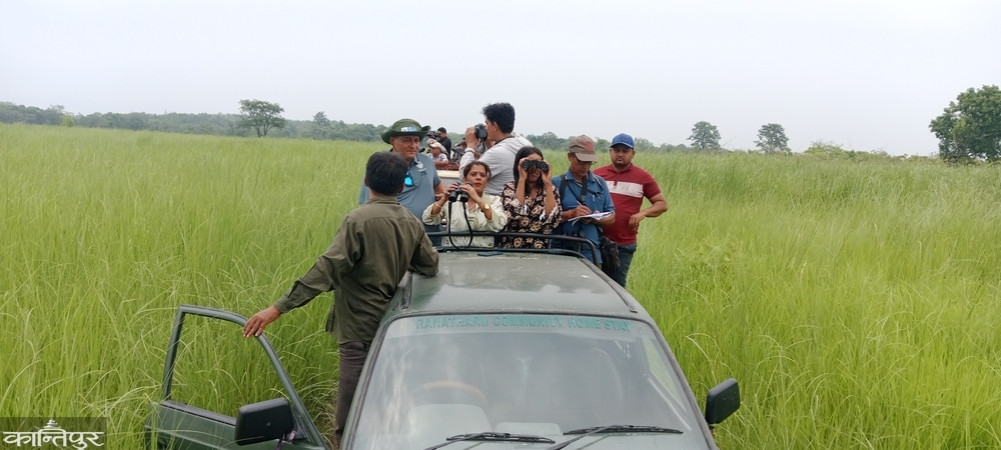
The vast grasslands of the park are the main habitat of the deer. The sight of thousands of deer grazing in the grasslands attracts tourists who come here.
We use Google Cloud Translation Services. Google requires we provide the following disclaimer relating to use of this service:
This service may contain translations powered by Google. Google disclaims all warranties related to the translations, expressed or implied, including any warranties of accuracy, reliability, and any implied warranties of merchantability, fitness for a particular purpose, and noninfringement.
Over 3,700 tourists have visited Shuklaphanta National Park in the last 9 months. Last year, from Asoj to mid-Jeshma, 3,767 domestic and foreign tourists entered the park. According to the park office, since it opened for tourists in Asoj to mid-Jeshma, this number of tourists have visited. Of which 3,325 are domestic, 316 are from SAARC countries, and 126 are other foreigners. According to the park office, 1,496 women and 2,271 men have entered the park. This year, more than 2 million rupees have been collected from tourists. The number of tourists entering the park has increased slightly compared to last year. In the last fiscal year, 3,284 tourists visited the park. Due to lack of publicity and physical infrastructure, the number of tourists visiting the park has not increased as expected. Although the number of tigers, deer, rhinos, blackbucks and other wild animals has been increasing year by year, the number of tourists has not been able to increase.
There is a lack of roads that can be used for safaris all year round and recently even elephant safaris have not been able to be operated. Due to this, safaris are closed in the park during the rainy season. Safaris have been closed as the roads deteriorate as soon as normal rains occur.
‘The number of people taking safaris has increased compared to the past. The number of nature guides has also increased, but the number of tourists has not increased,’ said Vinay Jha, the conservation officer of the park. ‘Lack of publicity is also the main reason for this.’ According to him, the number of people taking safaris has increased compared to the past. It is seen that safaris are being done in two or three vehicles daily. According to him, the number of domestic tourists has increased compared to last year. He said that tourism development in this area will accelerate only if more and more Indian tourists are brought in along with domestic tourists.
The park, which has an area of 305 square kilometers, has 43 adult tigers as per the last year's census. Shuklaphanta is also known as the park with the most tigers in a small area. According to the census conducted two years ago, there are 22 more rhinos here. Similarly, there are 23 more buffaloes and 300 more blackbucks.
The vast grasslands of the park, spread over 54 square kilometers, are the main habitat of buffaloes. The sight of thousands of buffaloes grazing in the grasslands attracts tourists who come here. This vast grassland is the main attraction for tourists.
Apart from this, areas such as Rani Tal, Sikari Tal and Baba Tal are also centers of attraction for tourists. Wild animals including tigers and buffaloes come to drink water in these lakes, so they can be easily seen.
‘The development of tourism here requires the active participation of all stakeholders,’ said Conservation Officer Jha, ‘There needs to be cooperation between the tourism board, the provincial and local levels.’ He said that the number of guides to visit Shuklaphanta has also increased recently. The number of guides is also increasing every year.
Tourists on safari in Shuklaphanta National Park. Photo: Bhawani Bhatta/Kantipur