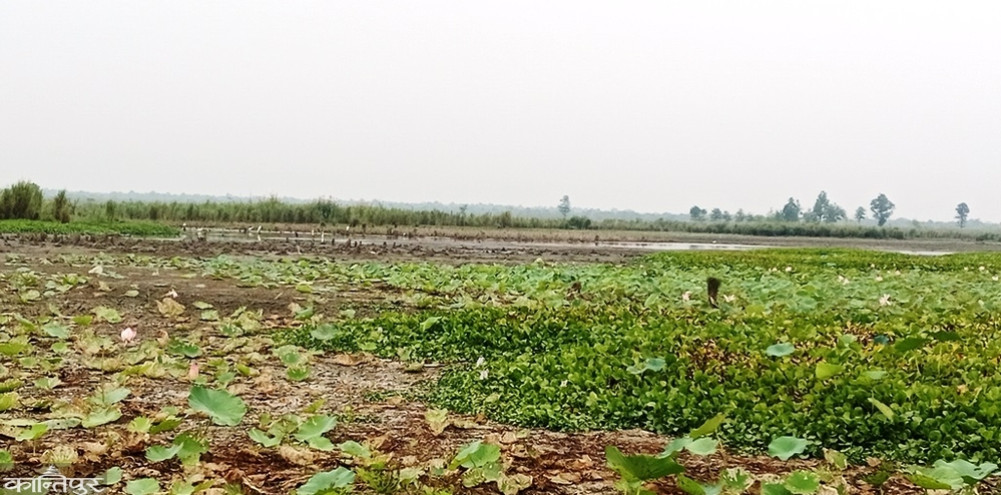
A count of 20,000 birds at Shikari Lake located within Shuklaphanta National Park has shown that some rare and special species have been spotted.
We use Google Cloud Translation Services. Google requires we provide the following disclaimer relating to use of this service:
This service may contain translations powered by Google. Google disclaims all warranties related to the translations, expressed or implied, including any warranties of accuracy, reliability, and any implied warranties of merchantability, fitness for a particular purpose, and noninfringement.
The white-tailed hawk was first seen in the Belauri municipality area of Kanchanpur three decades ago and was then seen in the Shikari Lake of Shuklaphanta National Park in 2016.
This is a very rare migratory bird in Nepal. At that time, 8 birds of this species were seen in the Shikari Lake. The small migratory bird, which is very rare in Nepal, was also found in this lake.
Birds such as the bronze grass bird and the reed warbler, which are considered rare in the world, are also seen here. The reed warbler, which is seen only in Shuklaphanta in Nepal, is also found here.
This is the main wetland area of the park, located about 30 kilometers south of Majhagaon, the entrance to Shuklaphanta National Park. This lake is considered a paradise for birds. ‘This is the main wetland area of western Nepal,’ said Hirulal Dagoura, an ornithologist at the Nepal Bird Conservation Association, ‘a large number of birds can be seen in one place.’
More than 20,000 birds were counted in Shikari Lake last winter. Last year, 22,000 birds were counted, said ornithologist Devraj Joshi, who is also a technician at the Shuklaphanta Conservation Program of the National Trust for Nature Conservation. In 2016, he saw the white-tailed eagle in Shikari Lake after 30 years. ‘Shikari Lake is the main habitat for birds in Kanchanpur,’ said ornithologist Joshi, ‘the most birds are found here.’ According to him, 80 percent of the birds found during the census are found here.
16 species of ducks and 50 species of other birds have been found in the lake. Some of which are rare in the world and some are found only here . The grasslands and dense forests near the lake have also made the lake more attractive to birds .
It has been 8 years since the bird census began . Due to the inconvenience of the road to get there , it is not easy to go . This lake is located about four/five kilometers south of the main attraction of the park, Shuklaphanta grassland . Lotuses are blooming around the lake, while reeds are scattered in some places . The lake area is narrowing with water lilies .
Shikari Lake is also considered a good habitat for fish . However, there has been no study yet on how many species of fish are found here . Since it is close to the Indian border, Indian citizens used to come here to hunt fish and birds until a few years ago. After setting up an army post in the area last year, poaching has stopped .
A study is also being conducted to list Shikari Lake in the Ramsar list. The National Park Wildlife Conservation Department is studying for this. If it is listed in the Ramsar list, it is expected that its conservation will be further promoted. The lake, which is spread over a large area, has recently been covered in reeds and water lilies. Conservationists say that the park administration should pay timely attention to this and protect the lake.