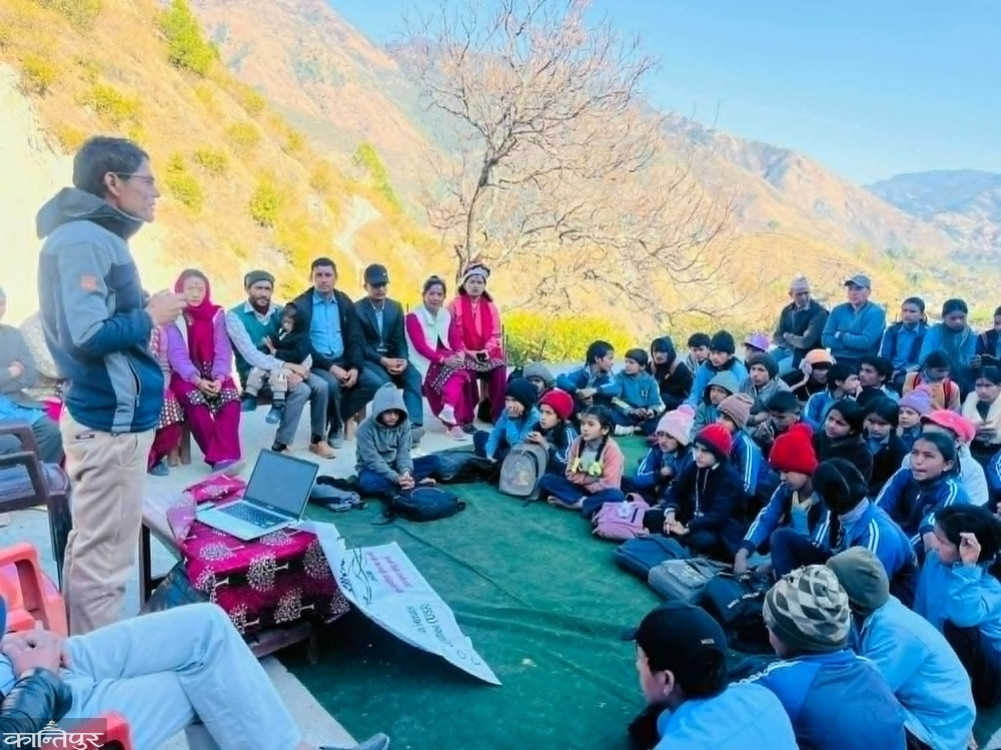
After the death of his daughter, Purna Bahadur Malla has launched a campaign to spread mental health awareness among teachers, students, and parents in schools in Bajhang.
We use Google Cloud Translation Services. Google requires we provide the following disclaimer relating to use of this service:
This service may contain translations powered by Google. Google disclaims all warranties related to the translations, expressed or implied, including any warranties of accuracy, reliability, and any implied warranties of merchantability, fitness for a particular purpose, and noninfringement.
Sometimes unexpected events happen in a person's life. The same thing happened two years ago in the family of Purna Bahadur Malla, a writer who entertained everyone by reciting short ghazals in the Bajhangi language. Malla's only daughter, who was also a teacher, committed suicide in the heat of the exam. That incident not only made her crazy, but also changed the purpose of her life.
SEE was going on on Chaitra 12, 2081. Akanksha Malla, a student of Garjepani Secondary School in Kedarsyun, had happily gone to school in the morning with her father Purna Bahadur (a teacher at the same school). That day was a science exam.
Akanksha, who had returned from school with her friends, was making notes for the social studies subject that was to be tested the next day when her father Purna Bahadur reached her house. 'She had also eaten.' We didn't disturb her, thinking she was preparing for tomorrow's exam,' Malla said, recalling the incident of that day. 'We left the house at around 2 pm for some work. She was alone at home. When we returned home in the evening, the incident had already happened.'
16-year-old Akanksha was the only daughter of the family. The Malla family was in mourning due to the pain of her death. 'We were more like friends than father and daughter. How could my daughter, who had informed me even when making small decisions, do such a thing, shook my psyche,' Malla said. 'This incident left both me and her mother deranged. Unable to cope on our own, we had to go to Kathmandu for psychological counseling on the advice of a relative.'
During psychological counseling, he came to understand that the reason for his daughter's suicide was related to mental health. 'I taught children for so many years. It was only when the incident happened in my own home that I realized how important mental health is for children. Which I had never considered,” says Malla. “After returning to Bajhang from Kathmandu, we took care of ourselves, but if a conscious parent like me is in this situation, what about other people? I started to worry.”
Malla, who saw many children in school, family and neighborhood who behaved like her daughter and had similar symptoms, decided to do something to prevent others from losing their children like her. He asked many friends for advice on how to spread awareness about mental health in Bajhang. “The piece of heart (daughter) that my family lost will not come back, but I decided to start a campaign so that other families do not have to suffer like this,” says Malla. “Initially, I based my own experience, With the knowledge gained from the consultation and further study, I conducted mental health awareness classes for the students of Garjepani Secondary School where I teach. This also resulted in significant improvement in the behavior of the children.’
While thinking about how to extend this campaign to other schools, Dr. Bishnu Joshi, a senior scientist at Harvard Innovation Labs, a biomedical company in the US, who lives in Bajhang, came in contact.
Inspired by Malla’s thinking, Dr. Sanjay Yadav, a renowned professor and psychiatrist working in the US and also the co-founder of the Nepal Institute of Mental Health, and Sarana Shrestha Parajuli, a senator in the Education Global Senate, a global network working in the education sector run by Nepalis, also joined Malla’s campaign. With their help, Malla was able to take virtual training on psychotherapy from a world-renowned psychiatrist. After learning about mental health problems in children and adolescents and ways to get rid of them, he is now visiting schools in the district on an awareness campaign.
Using the school holidays, he has so far visited 9 schools in Bajhang and conducted awareness classes on mental health. Malla informed that 75 teachers and 643 students have so far received information about mental health problems and ways to avoid them.
With the help of Joshi, Yadav and Parajuli, Malla is working to increase the number of volunteer counselors in the district, not only himself but also with the help of volunteer psychiatrists working in the country and abroad to spread this campaign throughout the district. In the meantime, with the help of Krishna Adhikari, a psychiatrist living in the UK who has also worked as a trainer in the United Nations Community Mental Health Program, he is currently providing mental health training to eight teachers, lawyers and health workers from Bajhang.
‘While conducting the campaign, I came to know about the incidents where many people lost their lives due to lack of basic counseling,’ says Malla, ‘I am going to create a network within the district so that this campaign should not only be limited to schools but also reach every household and individual. Our collaborators living abroad are supporting this.’ He said that his goal is to reach every corner of Bajhang with a volunteer network that reaches remote villages and provides counseling to teachers, students and parents. He says that in the future, he also wants to help patients with mental problems who need treatment through this network.’
‘His determination and activism to help others by turning his pain into strength made me feel that we should also do something,’ says Dr., a senior scientist working in Boston, USA. Bishnu Joshi said, ‘Since he himself is a writer who is liked by many, I am coordinating to spread it throughout the district.’
Various studies have also shown that the incidence of mental health problems has increased in Bajhang in recent times. In a mental health camp held in Thalara Rural Municipality of Bajhang, 258 people were identified with mental problems in Thalara alone. Half of them have been suffering for a long time, says Prakash Rokaya, the rural municipality chairman. However, such mental health activities have not been carried out in other municipalities in the district.
According to the records of the District Police Office, 92 people have committed suicide in Bajhang in the past four years. Most of them are teenagers. ‘With the increase in the use of social media, the content, cyber violence and bullying incidents that come with it have led to suicide among teenagers,’ says DSP Tek Jora, Chief of the District Police Office. ‘Similarly, in districts like Bajhang where access to counseling is low, such campaigns act as a cornerstone for suicide prevention and control of mental problems.’
The Constitution of Nepal has ensured the right of every citizen to receive free basic health services from the state and to have equal access to health services. Similarly, Sub-section 4 (e) of Section 3 of the Public Health Act 2075 BS has included mental health services in the list of basic health services. The United Nations’ Sustainable Development Goals (2016-2030) also aim to promote mental health by prioritizing mental health, reducing deaths from non-communicable diseases by one third, and preventing, treating and rehabilitating drug addiction. However, in remote districts like Bajhang, effective efforts to control mental illness have not been made. According to the World Health Organization's October 2025 data, more than one billion people worldwide are living with mental health problems.