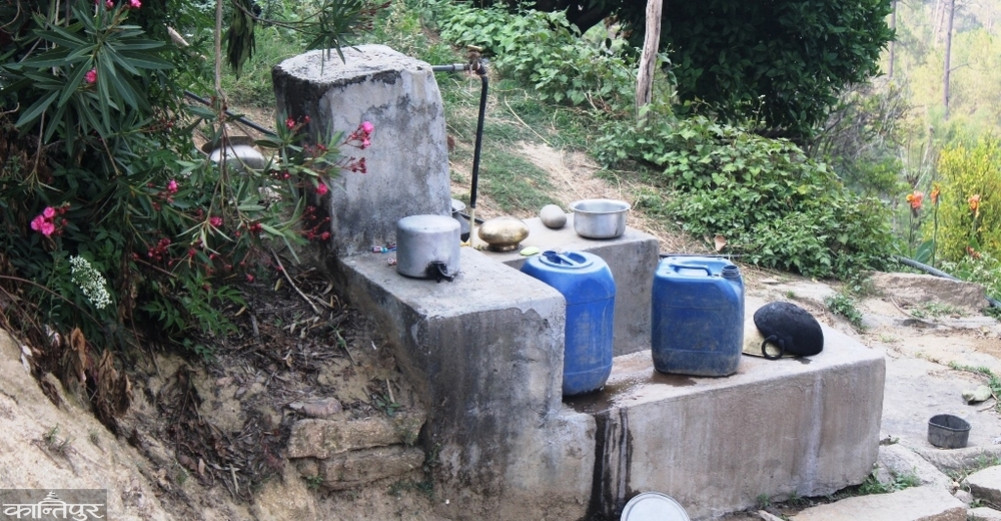
Even water brought from 13 kilometers away has not solved the drinking water and irrigation problems of 29 families in Dhaulakot.
We use Google Cloud Translation Services. Google requires we provide the following disclaimer relating to use of this service:
This service may contain translations powered by Google. Google disclaims all warranties related to the translations, expressed or implied, including any warranties of accuracy, reliability, and any implied warranties of merchantability, fitness for a particular purpose, and noninfringement.
For 29 families in Dhaulakot, Ganyapadhura Rural Municipality-1, Dadeldhura, the water brought from the 'Tusrani' spring, 13 kilometers away, will have to be used for drinking water, livestock and vegetable gardens. However, due to the low water content in the spring itself, there is a shortage of both drinking water and irrigation.
Even though taps have been built in every household, most of the taps are dry due to lack of regular water. Farmers who are engaged in commercial farming relying on rainwater are worried about the decline in production. Although most of the villagers depend on agriculture, efforts to increase production have not been successful due to lack of sufficient water.
Locals complain that the taps built with the help of the Drinking Water and Sanitation Division Office have not been able to provide the expected facilities due to the weak source. According to locals, even though a plan to bring drinking water from the source of the 'Kulbanj' river, about two kilometers away from the village, have not been able to provide regular supply due to low water in the source. Apart from that, even though water is brought from the Tusrani area 13 kilometers away, stored in tanks and distributed to the village through pipes, the shortage is still the same.
When there is no water in the tap, the locals are forced to carry jugs and buckets to the river below the village. Bringing water from the source there has become a part of daily life, and sometimes they have to wait in line for hours. Locals say that even though there is a tap in front of their houses, they are forced to reach the river. According to locals, efforts are being made to bring water from the river to the village through lift technology. They believe that water can be supplied easily with budget management and technical support.
Farmer Yagyaraj Awasthi, who has been engaged in agriculture since 2056 BS, has been commercially producing vegetables including cauliflower, radish and other vegetables on an area of four ropanis in recent years. He is farming by building polyhouses with government assistance and his own investment, and said that he has not been able to increase production due to lack of irrigation.
‘Earlier, we used to farm only enough to feed our own family, now we have commercial vegetable farming,’ he said, ‘but there is not enough water for irrigation. If there was water, we could have produced more.'
According to local Basanti Awasthi, the lack of drinking water and irrigation has directly affected daily life and agricultural production. 'We work hard to produce greens and vegetables,' she said, 'but for irrigation, we have to bring water from a distance through pipes. Sometimes, when there is no water, the fields dry up.'
According to her, since both drinking water and irrigation have to be operated from the same source, there is a shortage of water in both areas. Not only does not irrigation reduce production on time, but even the crops planted are destroyed, she said.
According to local Malati Awasthi, although tanks have been built for irrigation, they have not been used because there is less water at the source. 'If the water pipe breaks somewhere, it is very difficult to repair it,' she said. 'When there is no water in the stream, you have to go to the river below the settlement to get drinking water. It takes more than half an hour to get there and fill the water.' According to local Chet Awasthi, one has to walk for about four hours to reach the Tusrani spring that supplies water to the village. Due to the hilly terrain, it is a big challenge to understand the condition of the pipeline or to repair it. 'If the pipeline breaks down, it takes a long time to repair it,' he said. 'You have to walk for four hours to reach the spring, and it is even more difficult to carry things.' According to local Laxmi Devi Awasthi, even the little water that comes to the village has to be stored. 'The water brought from the source is stored in tanks, but it is not enough for the farmers of the entire village,' she said. 'We have to rely on sky water for farming. There are problems in drinking, cleaning and watering the livestock. Even the vegetables planted have started to dry up.' According to her, one of the two springs in the Kulbanj area is being used privately, while the villagers have been consuming water from the other collectively. In 2056 BS, the then District Soil Conservation Office provided pipes for drinking water in this village, and the locals did the work of digging the pipeline and building the tank through public labor. At that time, only 16 families lived in the village, but now the number has increased to 29, said local Chetraj Awasthi. Later, with the help of the Water Supply and Sanitation Office, the pipeline was expanded and water was brought to the village.
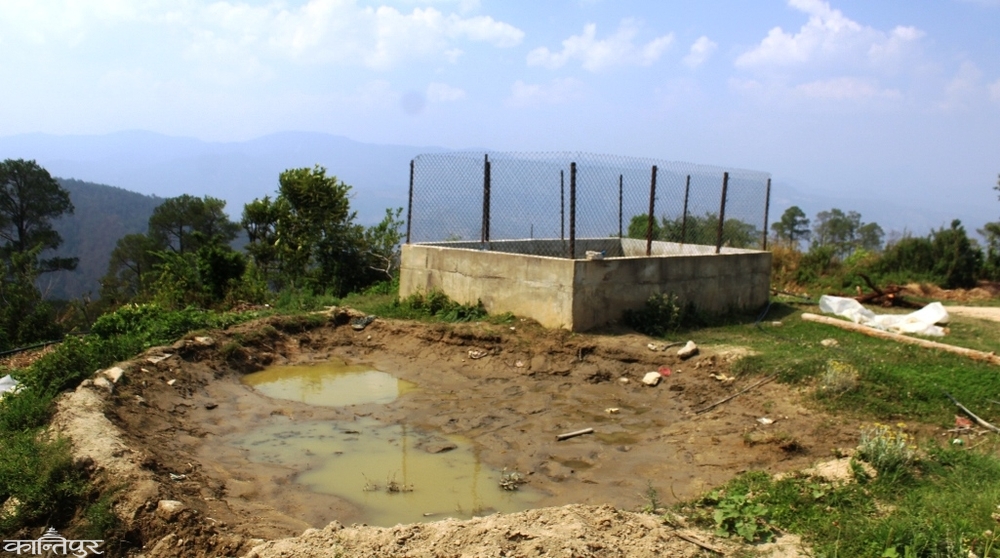
Farmer Khemraj Awasthi said that he is farming in polyhouses as it requires less water than open fields. He claims that if there is irrigation facility, the production will increase at least twice. “We are farming as per the advice of the technicians of the Agricultural Knowledge Center,” he said, “but there is no adequate irrigation system.”
Mahim Bohara, head of the Water Supply and Sanitation Division Office, Dadeldhura, said that the Dhaulakot drinking water project was completed two years ago and handed over to the consumers. He said that after the project is handed over, the responsibility of maintenance and operation will lie with the consumers’ committee. Amar Bahadur Pal, Chief of the Water Resources and Irrigation Development Division Office, Dadeldhura, informed that there are 241 embankment and irrigation-related projects across the district in the current fiscal year. He said that although 84 of them could not be implemented due to various reasons, the rest are in operation. He said that despite the shortage of manpower as there are only two technicians in the office, monitoring is being carried out even on holidays and that assistance including distribution of pipes according to the needs of farmers will be continued in the coming year.