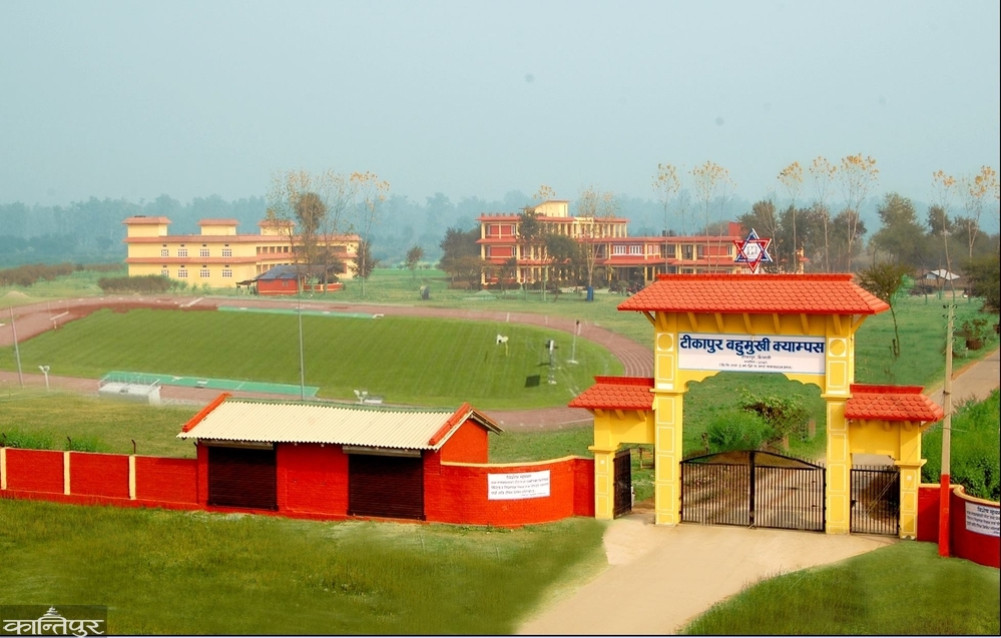
The quality and expansion of education have been affected by the failure to return the campus's three hundred bighas of land due to political interference, unorganized settlement, and government neglect.
We use Google Cloud Translation Services. Google requires we provide the following disclaimer relating to use of this service:
This service may contain translations powered by Google. Google disclaims all warranties related to the translations, expressed or implied, including any warranties of accuracy, reliability, and any implied warranties of merchantability, fitness for a particular purpose, and noninfringement.
Tikapur Multiple Campus, which has had 300 bighas of land encroached on for 20 years, has reached a point where it is unable to expand its education. This institution, which should move forward with a master plan for educational development, has had to shrink because it could not get its own land back.
Out of the 380 bighas of land owned by the campus, 300 bighas of land have been encroached on for the past 20 years. Illegal settlements and hundreds of physical structures have been built on the land of this institution, which is providing higher education in agricultural science as a constituent campus of Sudurpaschim University.
According to campus chief Dhavindra Rawal, the campus had an area of 80 bighas when it was established in 2058. Later, in 2062, an additional 300 bighas of land were acquired from the Tikapur Development Committee. The campus also has the title deed and the land title deed of this land. According to him, the encroachment of the campus's land began in 2063. ‘The campus has been trying to stop encroachment from the beginning,’ says campus chief Rawal, ‘but encroachment did not stop due to vested interests and vote bank politics.’ Structures like schools, health posts and roads have been built on campus land without the permission of the campus. Development plans have reached the encroached areas with government investment. According to campus chief Rawal, despite repeated objections from the campus, roads and electricity have been expanded. Recently, a complaint has been filed with the CIAA after an attempt was made to connect a drinking water tap.
This encroachment has directly affected the academic quality and expansion of the campus. Currently, experimental education programs like BSCAG and MSCAG are also being run on the campus. Students need the necessary land for agricultural education. But since the campus land is in the possession of others, it has become very difficult to conduct experimental classes. ‘Despite having ample land, we have not been able to expand education as much as we wanted,’ said Campus Chief Rawal.
Where did the squatters come from?
The bigger the problem of encroachment, the more complex the social structure within it is. According to Mohan BK, Ward Chairman of Tikapur Municipality-1, 5,100 families in this ward have filled out forms declaring themselves as squatters. Many of them are living in the encroached area of the campus. How many families are actually landless and squatters in the encroached area? Where did they come from? How and why did they end up encroaching on that land? No one has the answer. It has been found that the people living here are from the hilly districts of Achham, Doti, Bajhang, Bajura in the far west to Kalikot, Humla, Jumla and Surkhet in Karnali.
According to Ward Chairman BK, there are 4 types of settlements on the encroached land. Where freed Kamaiya, flood victims and unorganized settlers also live. What is more surprising is that some former employees of the former Tikapur Development Committee have also encroached on the land, saying that they did not get additional facilities. But the actual squatters have not been identified yet. A local who lives in the encroached area of the campus says that most of the families living here are not actual squatters. ‘Many people who have houses in other places in Kailali are also living here as squatters,’ he said. He also said that he also has houses in Janaki Rural Municipality and that his family built a house in the encroached settlement in Lahalhai. According to him, many other families like him are living like that.
The campus has made repeated attempts to vacate the encroached areas and solve the problem, but it has not been successful. But the efforts to solve it have failed due to the lack of an investigation into the number of actual squatters and landless people. ‘We have appealed to the government from every ministry many times. Many reports have also been prepared on this. But the number of actual squatters has not been investigated yet,’ said campus chief Rawal.
Although the investigation is the responsibility of the Land Reforms Commission, ward chairman BK understands that concrete work to separate the actual squatters has not been done because the commission is stuck in a cycle of dissolution and formation due to political instability. He said that the landless people will be managed in appropriate places and the encroached settlements will be cleared gradually.
Campus chief Rawal says that the state should manage the squatters and protect the property of educational institutions. ‘We are confident that the current stable government will identify the real landless and provide them with a systematic settlement option to clear 300 bighas of campus land,’ he said.
The data of 10,000 landless people is being verified
Tikapur Municipality has informed that it has collected data on landless Dalits, squatters and unorganized settlers in the city. According to the municipality’s records, there are around 10,000 such people. ‘We are in the final stage of data collection. A list of names with three-generation details will be made public in each ward within the next week,’ said Devi Prasad Acharya, the municipality’s information officer.
He said that the municipality plans to identify the real landless people after which they will be given seven days to object to the claims or correct errors in the details.
Ward 1 has a high concentration of squatters and landless people. The municipality believes that it is challenging to work there due to some legal complications. Government service facilities (roads, electricity, health posts) that have reached the settlements within the campus may have been minor works on humanitarian grounds.
The municipality has vigorously pursued a campaign to clear encroached public land and structures within the city. The municipality has started removing structures built encroaching on public land since April 14.
According to information officer Acharya, priority has been given to the market area in the first phase. Work is underway to remove the tents, huts, hoarding boards and promotional materials placed in the market area that have been obstructing the movement of pedestrians. Information officer Acharya said that the municipality alone cannot resolve the issue of encroached land of Tikapur Multiple Campus, which has been in the news for a long time. 'This is an issue that needs coordination from the higher level and the national level,' he said.