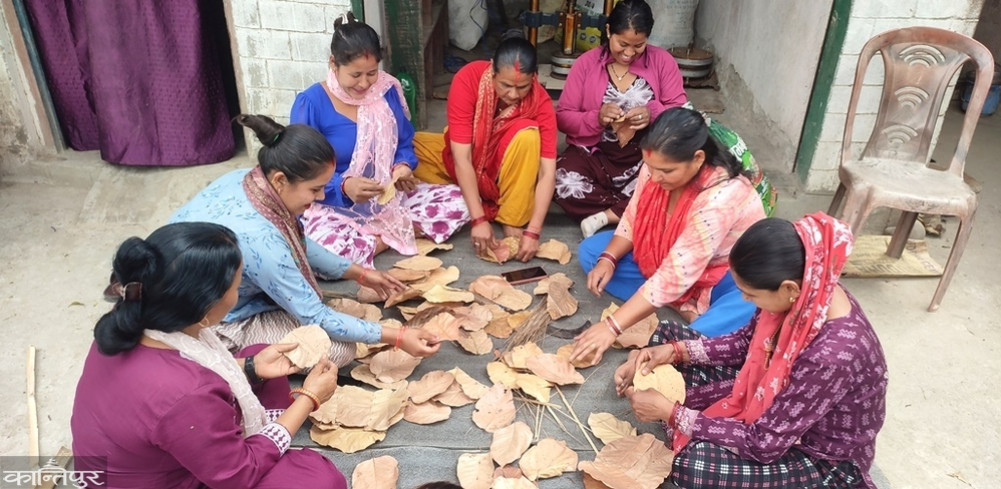
Women in the Far West are breaking away from traditional roles and embarking on a journey of self-employment in bakeries, agriculture, and cottage industries.
We use Google Cloud Translation Services. Google requires we provide the following disclaimer relating to use of this service:
This service may contain translations powered by Google. Google disclaims all warranties related to the translations, expressed or implied, including any warranties of accuracy, reliability, and any implied warranties of merchantability, fitness for a particular purpose, and noninfringement.
There is a ‘Himalaya Bakery-Cafe’ in the busy LN Chowk of Dhangadhi. This cafe opens earlier than other shops in the morning. Local Laxmi Bista opens the shutters of the cafe early in the morning and cleans the floor, chairs, tables and kitchen. By then, customers have also arrived. From the time the customer orders start to arrive, there is a rush. In the evening, after she finishes the day’s calculations, her stress decreases.
Laxmi got married at the age of 16. She lost her husband at the age of 23. After that, she reached here by overcoming obstacles. Despite being a victim of all kinds of economic and social discrimination and exploitation, she did not stop struggling. Due to which she has made a name for herself as a capable female entrepreneur in the Far West. Laxmi, who is from Patan Municipality of Baitadi, has made Dhangadhi her business headquarters.
After undergoing 9 months of bakery training, she started her business by raising a loan of about 3 million rupees from banks, cooperatives and relatives. At a time when most women in the Far West were confined to the kitchen, she set an example by becoming an entrepreneur. She has now employed 4 people in her bakery. Now other women in the province have also started becoming financially independent by coming out of the kitchen and traditional responsibilities. The Nepal government's 'Empowered Women, Prosperous Nepal' program has been providing them with skill-based training. After receiving the training, many are on the path to becoming self-reliant.
Sarita Chaudhary, 34, of Belauri, Kanchanpur, is another example. She took 18 days of vegetable farming training through an organization. She then formed a group of 10 people and started collective farming. Sarita, who previously had to work with her husband for 1 rupee each, now earns on her own. Along with this, she has connected other women to self-employment. Many women like Sarita and Lakshmi have become self-reliant by starting small businesses.
The provincial government had set a goal to make women 'drivers of development' through the first five-year plan. Before the implementation of the plan, the number of registered women entrepreneurs in the province was 350. The goal was to double that number.
For women's empowerment and gender equality, Rs 700 million was allocated for concessional loans, grants and enterprise promotion. The plan is about to end this year. Information officer of the Provincial Policy and Planning Commission, Jayaraj Ojha, said that the achievements so far will be known only after the progress report is made public. He said that no reliable data has been received yet on how many women entrepreneurs there are in the Far West. According to the data of the Directorate of Industry, Commerce and Consumer Protection, 54,481 industries are currently registered across the Far West. Of which, only 26,026 have been renewed. The Ministry of Industry, Tourism, Forest and Environment does not have separate data on women entrepreneurs. According to the Cottage and Small Industries Office, there are 7,000 registered women entrepreneurs in the district. However, most of them are market-oriented. According to the data, there are 17,794 registered industries in the district. Of these, 11,083 are in the name of men. 6,711 industries are registered in the name of women. Most of the industries registered in the name of women are in Dhangadhi, Godavari, Lamkichuha, Ghodaghodi and Gauriganga municipalities. The number of women entrepreneurs is low in remote municipalities like Mohanyal and Chure. This shows that women in remote areas are still limited to traditional labor as access to information, investment and markets is concentrated in cities. The provincial government has made a policy to exempt women entrepreneurs from business registration. The Provincial Industrial Business Act, 2075 BS has made a provision to provide 25 percent discount on registration fees to women entrepreneurs. Its Chapter 5 provides for providing concessions to industries in the name of women. Section 25 of the Act mentions that women entrepreneurs can be given a discount on registration and renewal fees.
There is also a provision to give priority to women entrepreneurs if they want to establish an industry in an industrial area or industrial village. Another aspect of the increase in the number of women entrepreneurs in the province is the ‘greed for discounts’. Parvati Bhatta, head of the Cottage and Small Industries Office, says that there is a growing trend of registering industries in the name of women to get this concession, but men are in the main role.
‘Women are the owners on paper, but they do not know about the business, income and expenditure and operation of the industry,’ says Bhatta. ‘The process of registering businesses in the name of women is encouraging even if it is just to get concessions.’ She says that this does not contribute to real women empowerment. There is no monitoring of the condition and operation process of industries registered in the name of women. Officer Bhatta says that even though the industry monitoring falls within her scope of work, it has not been possible due to lack of necessary manpower.
The provincial government has formulated the ‘Far West Provincial Industrial Business Act, 2075’. In which special exemptions have been made for women entrepreneurs in registration, renewal and taxes. Chand says that its main objective is to make women self-reliant by utilizing local resources and create employment within the province. According to Section 26 of the Act, there is a policy to coordinate the registration of land purchased by women entrepreneurs and industrial safety according to Section 27. Bhatta, head of the Cottage and Small Industries Office, says that not only women but also the poor, Dalit and backward communities will get concessions.
‘The staff may not have told us that the registration was with a discount,’ she said. ‘According to the law, if a woman comes to register in her name, she will be registered with a discount.’ According to the province’s economic survey 2080/81, the agricultural sector contributes 34.95 percent and the industrial sector 12.30 percent to the province’s economy. This means that agriculture and cottage industries play a major role in connecting women in the Far West to entrepreneurship, says Rajendra Chand, an associate professor at Kailali Multiple Campus who holds a PhD in economics. ‘Women are the backbone of the agricultural sector, which makes a significant contribution to the Far West’s economy.’ While men go out for employment, 90 percent of the burden of agriculture is on the shoulders of women, he said, “There is no alternative to involving women in small and cottage industries based on the ‘value chain’ to link agricultural productivity with the industrial sector.”
Making the fair self-employment
Dhangadhi Sub-metropolitan City has implemented a special program to promote women entrepreneurs. One of them is the ‘Saturday Fair’. In this fair, which is held every Saturday under the management of the sub-metropolitan city, women who are forced to stay at home despite having skills have started getting involved in business.
Stalls have been set up at the fair for singles, women with disabilities, and sexual minorities. Mira Kathayat of Dhangadhi sells chatpates made from ‘organic quanti’ at the fair. No prepared food is added to her chatpates. She has been running the stall for five weeks and said that every Saturday, chatpates worth 2 to 3 thousand rupees are sold. She used to spend her days cooking, washing dishes, cleaning and taking care of her children at home. Now, on Saturdays, after doing housework, she arrives at Jenjimarg in Dhangadhi at 2 pm to set up a stall.
She said that the municipality has made a good effort to connect women like her, who are stuck at home despite having skills, to economic activities. ‘Even though we have skills in many things, we cannot go out because of housework,’ she said. ‘Now, with the efforts of the municipality, we are going to use our skills to earn money.’
Pushkar Ojha, president of the Kailali Chamber of Commerce and Industry, said that he is happy with the efforts of women staying at home to connect with economic activities using their skills and become self-employed. He said that the association is also trying to connect women entrepreneurs to startups.
Kandakala Rana, deputy chief of Dhangadhi Sub-metropolitan City, said that the fair has given women the energy to become self-reliant. ‘We organized this fair to uplift women economically. Our objective is being fulfilled,’ she said, ‘As we expected, women are also participating and earning income.’
The sub-metropolitan city has also arranged for the necessary chairs, tables, free drinking water and toilets at the fair. She said that women do not have to pay any tax for setting up stalls. Like Dhangadhi, the ‘Kanchan Hariyali Women’ Group of Godavari-7 in Kailali has linked traditional skills with the modern market by producing duna-tapari. This group started the enterprise with the help of the ward and the Women’s Awareness and Development Center. Now the group has started earning good income by raising investment, said the group’s chairperson Nanda Saund.
Other municipalities like Dhangadhi and Godavari are also running various women’s empowerment programs. The ‘Strong Women, Prosperous Nepal’ program is being run in 10 local levels of the Far West. This program has been implemented in Dhangadhi, Godavari and Chure of Kailali, Belauri of Kanchanpur, Jorayal and Dipayal Siliguri of Doti, Durgathali, Mashta and Khaptadchanna of Bajhang and Badimalika of Bajura.