Commissions and committees have been formed since 2037 to rehabilitate those displaced during the then expansion of the reserve. So far, 32 commissions have been formed. However, they have not yet been able to identify the exact number of displaced people.
We use Google Cloud Translation Services. Google requires we provide the following disclaimer relating to use of this service:
This service may contain translations powered by Google. Google disclaims all warranties related to the translations, expressed or implied, including any warranties of accuracy, reliability, and any implied warranties of merchantability, fitness for a particular purpose, and noninfringement.
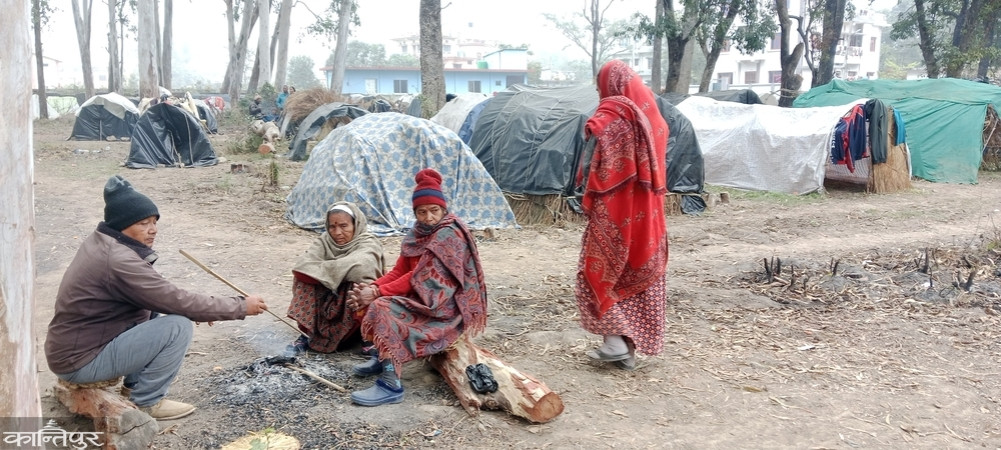
The bitter cold of mid-December. Sleeping under tents. The bed is completely soaked with frost. Sometimes even the clothes on the body are wet. Those displaced during the expansion of the then Shuklaphanta Wildlife Reserve are now spending the night in similar conditions on the vacant land of the Herbs Office in front of the Division Forest Office in Mahendranagar.
Tents have been erected all over the vacant land. Some of the tents are empty, while others are occupied. When they are unable to go out even during the day due to the cold wave, they sit by the fire next to the tent.
‘We have been living here for two and a half months, and as the cold increases, our stay here has become difficult,’ said Krishna Prasad Bhatta, who was displaced from the former Rautelibichwa VDC in 2058. ‘We sleep four or five people together because it gets cold when we sleep alone at night.’ According to him, some of the displaced people have fallen ill due to the cold while living under the tent and have sought shelter at their relatives’ houses.
‘I can’t sleep at night because of the cold, on the one hand the cold on the ground, on the other hand the frost from above makes it very difficult,’ said Kuntadevi Shah, who was displaced from Rautelibichwa, ‘It is very difficult for the elderly to live here.’ Despite the cold, the displaced people have built tents here as part of a movement demanding rehabilitation. They have been living in tents for two and a half months. Initially, only a few families came, but now more than two hundred and fifty families have pitched tents here.’
‘Repeatedly there have been protests, repeatedly there have been commissions, but our pain remains the same,’ said 60-year-old Kapure Okheda, ‘Our generation has been involved in the movement, and our children and grandchildren have also spent their days here.’ He was also displaced from Rautelibichwa in 2058. Half a bigha of his land was acquired during the then reserve expansion.’ 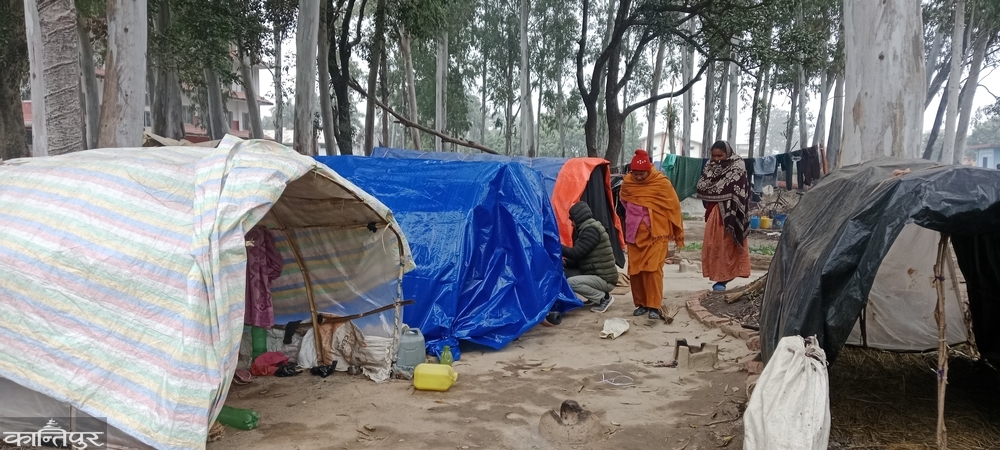
The displaced families are currently living in 14 different camps. The displaced are living in places like Dhaka, Tarapur, Bhatpuri, and Lallare Danda, which are in the core area of the park. Those who came from those camps are now living in huts on the barren land of the Herbs Office.
In 2033, the eastern area was expanded after the then Royal Hunting Reserve was declared the Shuklaphanta Wildlife Reserve. By 2058, settlements were evacuated from the expanded areas of the park. The problem of displacement that began in 2033 has not yet been resolved. The eastern area of the reserve, which has an area of 150 square kilometers, has been expanded to 350 square kilometers. Shuklaphanta was upgraded from a reserve to a park in 2073.
Commissions and committees have been formed since 2037 for the rehabilitation of those displaced during the then expansion of the reserve. So far, 32 commissions have been formed. The commissions and committees, which will be formed with a period of three months to a year, have not yet been able to identify the exact number of displaced people.
The 32nd commission, recently formed under the coordination of former Appellate Court judge Jayanand Paneru, has shown the number of displaced people at 2,027. Before that, in 2071, the commission of former Appellate Court judge Thakur Prasad Sharma had submitted a report stating that the number of displaced people was 1,480 and that they should be rehabilitated. The previous commission had said that the number of displaced people was 2,473.
The Paneru-led commission had submitted a report to the government in December last year. The displaced people have been saying that the report is not acceptable. The Paneru-led commission has mentioned in its report that Rs 1 million will be given to each family living in parks and forest areas and that they should be immediately removed from the forest area. Similarly, it has suggested Rs 700,000 to families living outside the forest area and Rs 500,000 to families who have received land certificates but have not been able to use the land. The report mentions that 11 people have applied for land and some are yet to apply.
Various commissions and task forces formed so far have distributed more than 4,042 bighas of land to 5,200 families in various places in the district. They have been rehabilitated by giving them land in Bagphanta of Bhimdatta Municipality-19, Pipraiya of 13, Dhaka of Beldandi, Laxmipur of Rampur Vilasipur, Simalphanta of Shuklaphanta Municipality and Sundarpur of Bedkot.
Displaced people living in tents on vacant land in front of the Division Forest Office. Photo: Bhavani Bhatt/Kantipur