Interference with the sole rights of provinces is against the constitution: MP Shahi
We use Google Cloud Translation Services. Google requires we provide the following disclaimer relating to use of this service:
This service may contain translations powered by Google. Google disclaims all warranties related to the translations, expressed or implied, including any warranties of accuracy, reliability, and any implied warranties of merchantability, fitness for a particular purpose, and noninfringement.
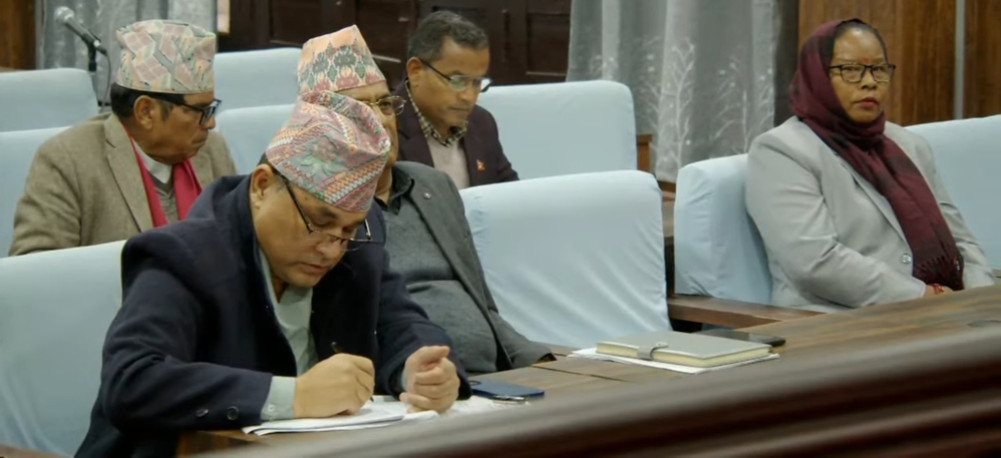
Far Western Province Assembly member Naresh Kumar Shahi has said that the federal government is also interfering in the exclusive rights of the provinces. He says that the federal government's doing so would be a violation of the constitutional system.
Speaking during the zero hour of the Sudurpaschim Provincial Assembly meeting held on Wednesday after more than four months, MP Shahi said that Article 171 of the Constitution states that the remuneration and other facilities of the Chief Minister and ministers will be in accordance with the Provincial Act, and said that the federal government has interfered with the rights of the provinces by issuing various circulars.
As per the decision of the Council of Ministers on Asoj 20, the Ministry of Finance had issued a circular stating that ministers and MPs cannot have personal secretaries.
He claims that the activities of the federal government are attacking federalism. ‘The constitution clearly mentions the individual and common rights of all three levels. The issues of individual rights of the provinces are governed according to the provisions of the act made by the Provincial Assembly,’ he said, ‘But the letter sent by the federation has attacked the provincial act, which is against the constitution.
He said that the center is continuing to face cases of financial irregularities worth billions, but the provinces should issue instructions to office assistants or drivers to be frugal within their jurisdiction through legal provisions.
Other lawmakers speaking during the zero hour raised various issues. NCP's Shiv Singh Oli argued that the provincial government should implement the project as the Supreme Court has already ordered it to be implemented through the consumer committee, so the provincial government should implement it accordingly.
'The provincial government should implement the Supreme Court's order, the Chief Minister should not keep the Supreme Court's order hidden in a drawer,' he said. After the Gen-G rebellion, the provincial government had decided not to implement the project through the consumer committee. But a case was filed in the Supreme Court against that decision. The Supreme Court had asked the provincial government not to implement the decision.
Similarly, lawmaker Rameshwor Chaudhary said that the project with a budget of Rs 1.2-1.3 million cannot be completed if the project is implemented through tenders or quotations. He said that if it is implemented through the consumer, the project can be completed with the addition of labor donations.
MP Laxmi BK accused the government of deciding to implement only projects worth more than Rs 1 million and to implement them through tenders to earn commission. Another MP Man Bahadur Dhami said that the provincial government should implement the plan as per the Public Procurement Regulations as the Supreme Court had quashed the decision not to implement the project through consumers.
MP Geeta Mal said that the provincial government was in a dilemma when it decided to implement the plan through contracts and when through consumers, and the provincial offices were unable to implement the plan.
Ruling Congress provincial MP Dambari Mahara opposed the attack on President Sher Bahadur Deuba during the Gen-G movement. She said that the attack on the Deuba couple was an attack on democracy.
In Wednesday's meeting, Minister for Land Management, Agriculture and Cooperatives Bir Bahadur Thapa tabled the bill in the assembly to make provisions regarding the management of pesticides in the province.
Similarly, Minister for Internal Affairs and Law Hirasingh Sarki has presented the first, sixth and seventh annual reports of the Auditor General, the fourth annual report of the Provincial Public Service Commission and the report of the Chief Advocate for the last fiscal year in the Assembly. Public Accounts Committee Chairman Akkal Bahadur Rawal presented the third annual report of the Public Accounts Committee in the Provincial Assembly.