The office stated that 842 people have been tested for HIV so far in the current fiscal year, and 10 have been confirmed to be infected.
We use Google Cloud Translation Services. Google requires we provide the following disclaimer relating to use of this service:
This service may contain translations powered by Google. Google disclaims all warranties related to the translations, expressed or implied, including any warranties of accuracy, reliability, and any implied warranties of merchantability, fitness for a particular purpose, and noninfringement.
ART services for HIV-infected people are expanding in Dadeldhura. Those infected have been receiving services regularly from Dadeldhura Hospital and Jogbudha Hospital in the district. According to the Dadeldhura Health Office, 125 people are currently receiving ART services through these two hospitals.
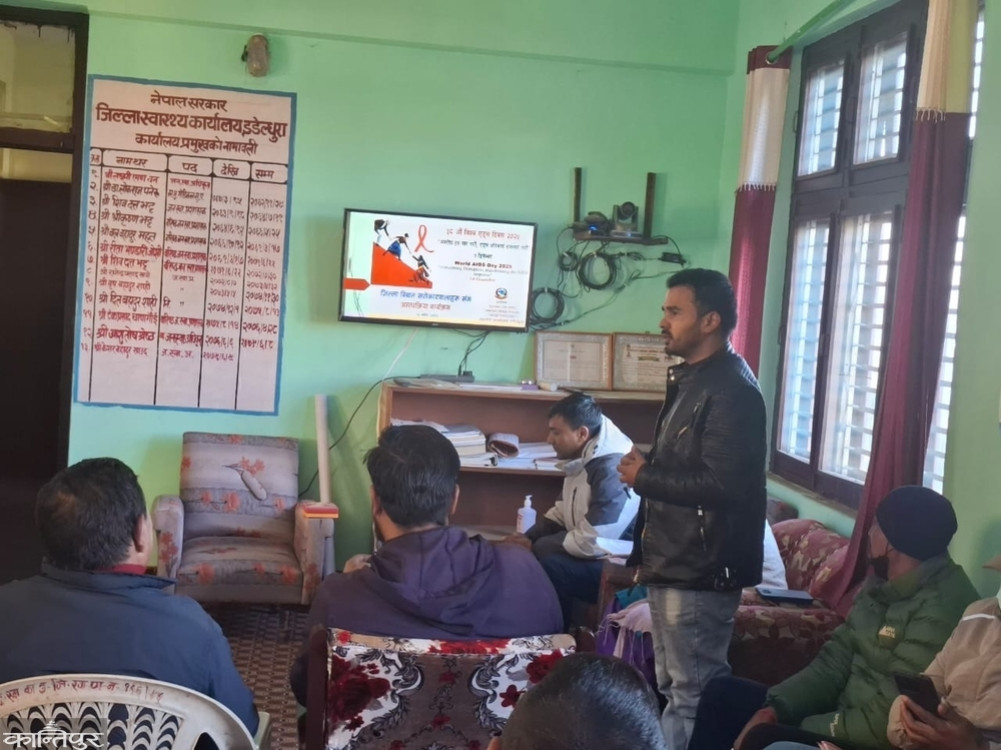
In a program organized by the Health Office on Monday on the occasion of the 38th World AIDS Day 2025, Public Health Officer Amrit Bista presented detailed information about the HIV situation in the district and said that continuous monitoring, treatment and counseling services are being provided to the infected. According to him, 68 women, 5 girls under the age of 12 and 52 men are among the service recipients.
The office says that although the scope of testing within the district has expanded somewhat in the current fiscal year, it needs to be moved forward with more proactivity. The office has stated that out of 842 people who have undergone HIV tests so far in the current fiscal year, 10 have been confirmed infected. Similarly, the fact that none of the 2,948 pregnant women tested positive for the virus has been taken as a positive indicator for the district.
According to the Health Office data, the number of HIV infected people in Dadeldhura varies according to the local level. Parshuram Municipality has been identified as the most affected area in the district, where 38 people are infected. There are 15 people infected in Amargadhi Municipality, 12 in Alital Rural Municipality, 11 in Navadurga Rural Municipality, 8 each in Ganyapadhura and Bhageshwor Rural Municipality, and 7 in Ajaymeru Rural Municipality.
According to Dinesh Tiwari, a representative of Dadeldhura Plus, which is active in the field of HIV (AIDS), the infected are still facing discrimination and contempt in society. According to him, the infected have not yet been able to get the necessary support at the family, community, and institutional levels. Their biggest challenge is not getting social acceptance along with treatment.
According to Tiwari, community-based programs are necessary to provide counseling, psychosocial support, increase public awareness about safe behavior, and ensure continuity in regular treatment.
According to health workers, HIV (AIDS) is a disease that is mainly spread through unprotected sexual contact, contact with infected blood and blood products, and the risk of transmission from an infected mother to her child. Public Health Officer Bista said that many people are still reluctant to get tested due to misunderstanding, shame, and fear. According to him, many infected people start treatment late because they do not get tested on time, which increases health complications. The infected and stakeholders participating in the
program emphasized that it is possible to lead a normal life after treatment, but regular medication, counseling, and social support are indispensable for that. They also demanded that infected people be made self-reliant by linking them to income-earning, that awareness programs be conducted in schools and communities, and that the role of the local level be made more active.
Although the treatment and counseling services for HIV infected people are currently expanding in Dadeldhura, public health workers say that challenges such as expanding the scope of testing, controlling risky behavior, and reducing discrimination at the community level remain the same. They say that the geographical remoteness of the district, lack of access to health services, lack of public awareness, and social prejudice are the problems of not receiving accurate information about HIV and not participating in testing.
According to Hari Prasad Bhatta, Vector Control Inspector of the Dadeldhura Health Office, plans have been made to intensify public awareness campaigns across the district from next year, identify risk groups by collaborating with schools and local organizations, and further expand access to ART services. The office has stated that cooperation from all parties is essential to ensure continuity in safe behavior, regular testing, counseling, and treatment at the community level.