In Radhapur area between Shuklaphanta National Park and Chaudhar River, river erosion on one side and wildlife damage on the other. Farmers are facing a lot of problems to protect their production from both. They have been working traditionally by making scaffolding and tending the fields.
We use Google Cloud Translation Services. Google requires we provide the following disclaimer relating to use of this service:
This service may contain translations powered by Google. Google disclaims all warranties related to the translations, expressed or implied, including any warranties of accuracy, reliability, and any implied warranties of merchantability, fitness for a particular purpose, and noninfringement.
Jhikdu Rana of Beldandi rural municipality-5 Emilia only gets to stay at home at night. Most of the time, his residence is in the farm across Chaudhar river. 60-year-old Rana's daily life has been going on like this for 15 years. He used to stay in the field to guard the farm at night to protect the farm from wild animals. He has built a wooden scaffolding in the field.
In the evening, after having dinner at home, they go to sleep in the loft across the river. He has kept a bed inside the thatched loft. Rana, who cultivates sugarcane on his two bigha land, is worried about protecting the crop from wild animals. Wild animals such as elephants, rhinos, wild boars and chitals have been coming and damaging his farm . His residence is in the loft in the middle of the field to protect crops by driving away animals.
Rana has placed a tin can on the edge of the field. When the wood hits it and makes a sound, the wild animals run away . The wood is tied with a rope . That rope goes all the way to the scaffolding. Pulling and releasing the rope causes the wood to hit the tin . "Even if they do this, they will eat half of the farm, it is very difficult to protect," Rana said, "It is difficult to cross the river in Barkha to reach the farm, then even to go out of the scaffolding, there is fear of snakes and wild animals." There is Chaudhar river in the middle of the
. Emilia village of Beldadi rural municipality-5 to the east. Radhapur to the west. Most of the people living in Emilia have farming in Radhapur. There are only five families living in Radhapur, which is connected to Shuklaphanta National Park. Locals also call Radhapur 72 Bigha. It seems that the locals have built scaffolding everywhere to protect the crops of 72 bighas. They used to sleep in the loft at night.
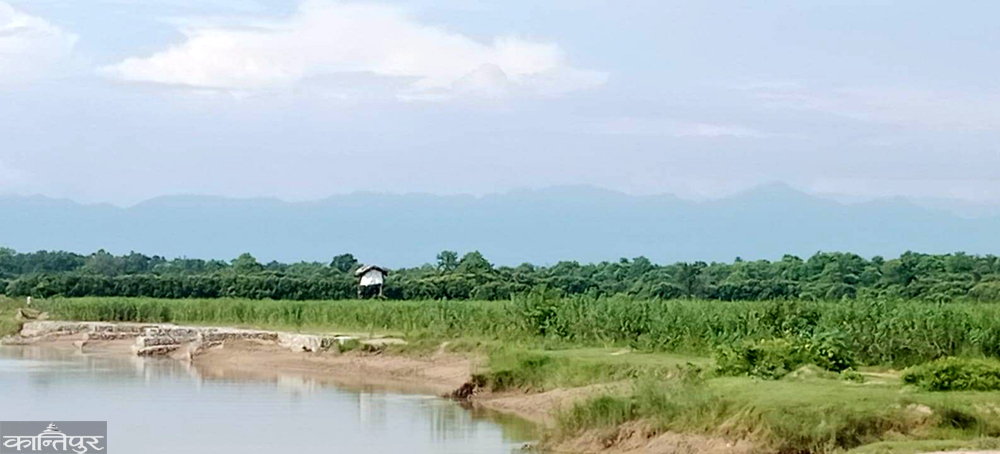
"We all have built scaffolding in our fields," said 53-year-old Bisna Chaudhary of Emilia, "I have been living in scaffolding for 10 years." According to her, there are more than one and a half dozen scaffoldings in Radhapur area. Out of which 2 concrete scaffoldings have been constructed . Chaudhary has half a bigha of land . He also wears cane . According to Chaudhary, the land of Radhapur was acquired during the expansion of the park. As it is a registered land, the locals applied for mining . Then it was decided to plow . As 72 bighas were found while measuring, its name has remained there . There is also a residence of 5 families in 72 bighas.
"In winter, the water in the Chaudhar river is low, it is not difficult to cross," said Chaudhar, "when the river overflows in Barkha, it is very difficult to go through the tube." They return home only after morning light. Chaudhary says that if someone is sick at home or if there is any problem with himself, he should return home at night. For that, the tube of the vehicle should be kept together . He says that it is very risky to return home when the river is high during the dry season.
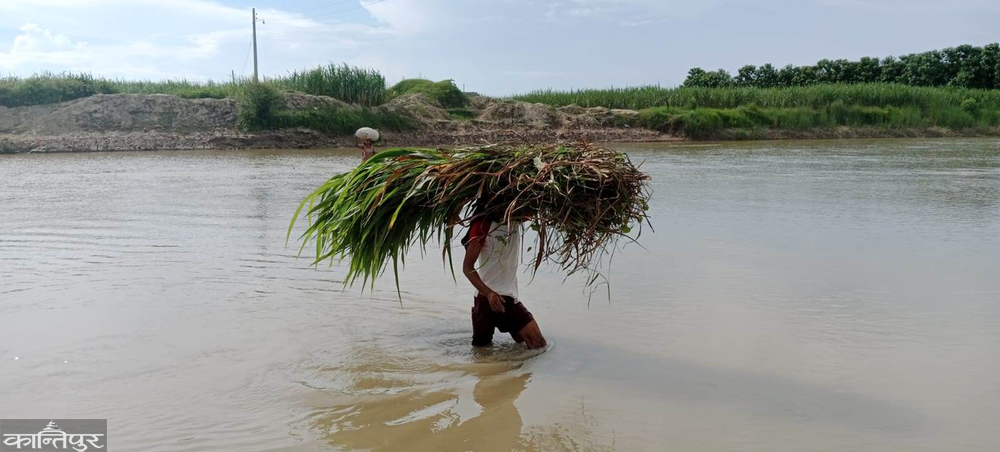
After wild animals come to the farm at night, everyone calls each other and alerts them. Then tin plate is played with wood . Chaudhary says that it is very difficult to drive away elephants when they come. Elephants are very fond of sugarcane. In addition to eating sugarcane, they also break it. He says that boars also break sugarcane and eat it . They say that rhinos and chitals only eat leaves so they do not suffer much damage. "Rhinoceros live in fields," said Jhikdu Rana, "but because they only eat leaves, they don't cause much damage, while walking in fields causes more damage."
Everyone in Radhapur has cultivated sugarcane. That's why local elephants come here regularly, says Manmati Rana. He also has half a bigha of land across the river. She has also done sugarcane farming. During the day, women go to cut grass . They also chase wild animals. Men go at night.
In the Radhapur area between Shuklaphanta National Park and Chaudhar river, on one side, river erosion and on the other, damage from wild animals . Farmers are facing a lot of problems to protect their production from both. They have been working traditionally by making scaffolding and tending the fields . But it is very risky. They fear that if a herd of elephants comes and destroys the scaffolding, their lives will be at risk.

