We use Google Cloud Translation Services. Google requires we provide the following disclaimer relating to use of this service:
This service may contain translations powered by Google. Google disclaims all warranties related to the translations, expressed or implied, including any warranties of accuracy, reliability, and any implied warranties of merchantability, fitness for a particular purpose, and noninfringement.
Bhagarathi Bista of Bhimdatta Municipality-3 was busy with her household chores. She was engaged in cooking and farming. Having studied up to SLC, she could not think of any other work after marriage. She could not even study at the upper level. Since he has to take care of his family, he is not able to engage in any business or employment.
But now Bista has not only become a successful entrepreneur, she is also invited to train in soap making. She attends training provided by various wards and local levels as a trainer. She said that along with income, more learning is also taking place.
'I am also giving training, I am also producing jhol soap at home,' Bista said, 'Different wards and municipalities are calling after conducting soap making training.' She said that such training has been conducted in all 9 wards of Bhimdatta municipality in a period of 2 years. Similarly, she has played the role of chief trainer in 3 trainings in Dodhara Chandni Municipality. She has also given training for one week in Shuklaphanta municipality.
With the worldwide spread of the Covid-19 epidemic, Bishta's life has also changed . With the support of the Asian Development Bank under the Japanese Fund for a Prosperous and Resilient Asia and the Pacific (JFPR), Bista's life has changed after the start of the Covid-19 Prevention and Control Project (Covid Response Project) through the promotion of drinking water, sanitation, hygiene and health services in medium and small towns in Nepal. After the
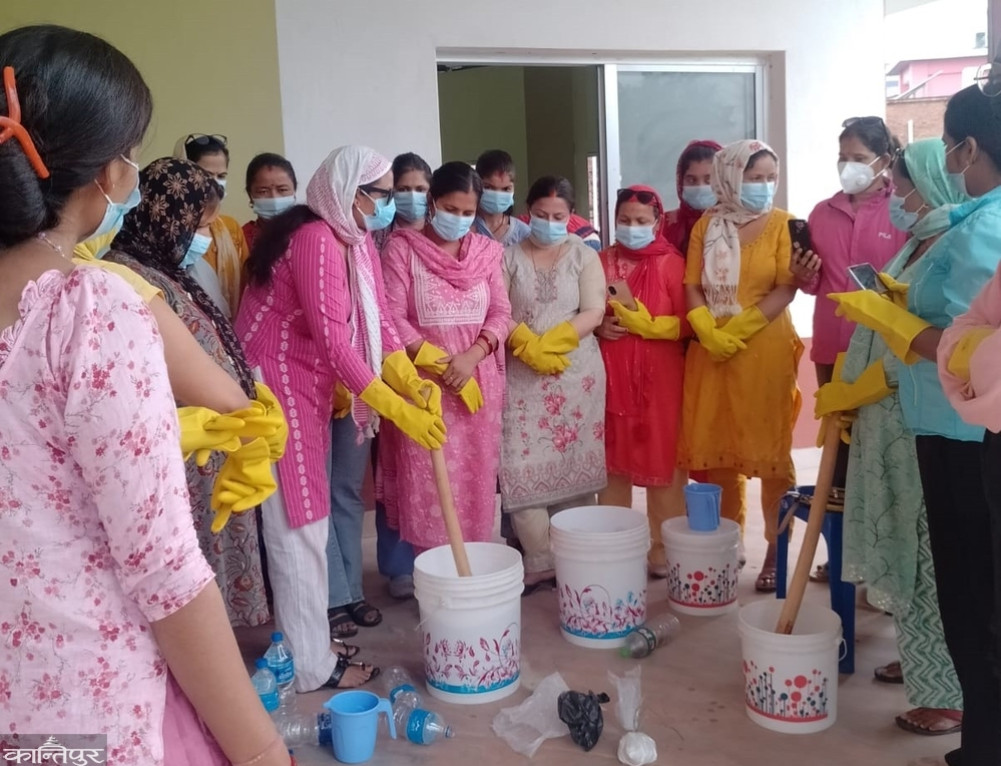
project trained women in her field to make soap, she was also able to participate in it . She said that she had reached Nagarkot for training for the first time. Before that, she said that it was difficult for her to even go out of the house.
Bishta now produces jhol soap at home . Which is more in demand in hotels and restaurants. She says that the soap is sold for 5/6 thousand monthly. She said that if packaging and labeling can be done, it can be produced and sold in large quantities. But that requires more investment .
Bishta's husband Ramesh runs a grocery store. From that, the expenses of the Zenten family and the education of the children were spent. "Now that he has started producing soap and training himself, it has become easier to manage the expenses of the family," he said. The soap produced by him is also being sold from his own grocery store .
"Jhol soap is less preferred in villages, most of them use soda more," said Bisht, "There is a plan to slowly produce Dalle soap as well." There is a problem of investment as packaging is expensive.
Godavari Seti of Bhimdatta Municipality-15 Nimbukheda, who trained with Bista, is also going to different places to teach what she knows. She attends training conducted by municipalities and wards as a trainer. She said that she earns up to two and a half thousand daily.
"Both practical and theoretical things should be taught," Seti said, "Now I am busy with training." She has also run a grocery store and poultry farming near home. She has also thought of soap production. But she said that the problem is that the raw materials needed for that are not easily available in the local market.
'Chemicals are not available here, they cannot be brought from outside,' said Seti, 'for that, we have to make it easier for us.' She says that even after learning the skills, she was unable to work because of the availability of raw materials.
Due to the covid infection, the works of drinking water projects operating in 15 cities of the country were stopped, this new program was started while laying the groundwork for the re-operation of those projects, according to Manina Vaidya, deputy project director of the covid response project. According to him, the project is trying to produce and promote cleaning materials including soap at the local level to deal with Covid.
"At the same time, skill-based training was provided to the participants selected by local bodies," she said. During this project, 68 people including 12 men and 56 women were trained in soap making. Among them, about a dozen participants have started their businesses .
Based on the learning of the Covid epidemic, such as maintaining personal hygiene and social distancing, she said that the project conducted such trainings, realizing that the production of hygiene materials at the local level would promote both their availability and entrepreneurship. .
With the availability of resource persons at the local level, the local levels have recently been increasing soap making training . But along with training, emphasis should also be placed on production, says Seti. "Only then will the skills be utilized and women will be able to earn," she said.