We use Google Cloud Translation Services. Google requires we provide the following disclaimer relating to use of this service:
This service may contain translations powered by Google. Google disclaims all warranties related to the translations, expressed or implied, including any warranties of accuracy, reliability, and any implied warranties of merchantability, fitness for a particular purpose, and noninfringement.
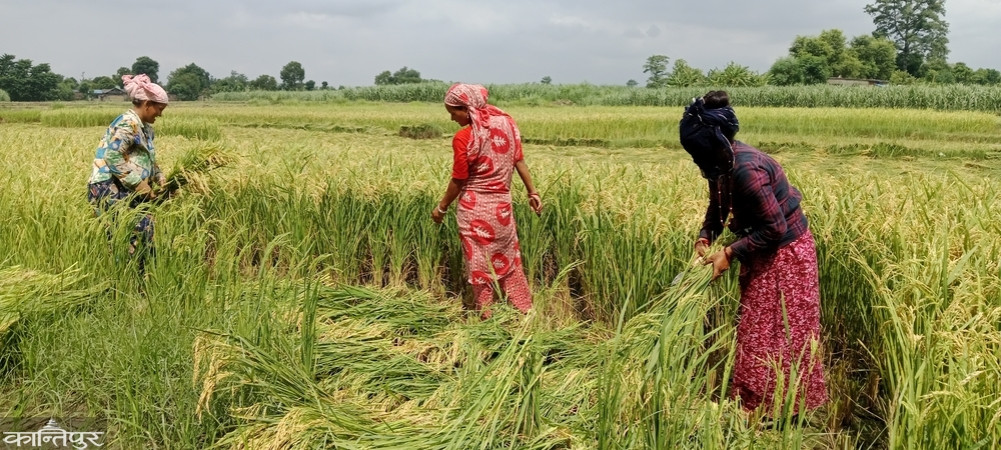
Dal Bahadur Budha of Punarwas Municipality-9 is currently having trouble bringing in chaite paddy. As it is raining, he is also worried that his farm will be flooded.
He, who cultivated Chaite rice for the first time with the rush of work and anxiety, seems very happy because of the good yield. "This paddy that I planted for the first time has grown well, now I will bring it in and plant dry paddy," said the old man, "I am thinking of planting the next crop even better." He planted chaite paddy in about 5 bighas.
Krishi Gyan Kendra Kanchanpur has handed over irrigation and fertilizer materials along with seeds to the farmers for the promotion of chaite paddy. Apart from this, from time to time, they visited the farmer's fields and imparted technical knowledge and were also employed in the treatment of diseases and pests. This is the reason why farmers are attracted to chaite rice.
If irrigation facilities can be provided, it is possible to produce more than dry season, so the attraction of farmers towards dry season rice is increasing. But the farmers are also worried because there is a problem in bringing them in during the dry season and there is also a lack of market.
Some of those who cultivated Chaite paddy have already imported the crop, while others are busy importing it. During the rainy season, the hanging rice fields look very attractive. The farmers are busy bringing in and planting the same paddy after the rainy season.
"We were able to harvest the paddy quickly," said Ishwar Budha of the resettlement, "now all the cutting is done by machines, that's why it's not difficult." He also cultivated chaite paddy in two bighas. He who planted Chaite paddy for the first time also said that the yield was better than expected.
Chaite paddy has been cultivated in Kanchanpur on one and a half hundred hectares. Until a decade ago, chaite paddy was cultivated here on more than 400 hectares. But due to irrigation problems, lack of market, farmers are decreasing due to various reasons. After the Agricultural Knowledge Center started to support from production to marketing, the farmers are again attracted towards it. Chaite paddy yields 4 and a half to 5 metric tons per hectare while barkhe paddy yields around 4 metric tons per hectare.
Now in Kanchanpur, Hardinath 1 and Chaite 5 are applied in large quantities. "Currently there is a lack of market, the farmers are not getting good prices," said Jagriha Khanal, crop development officer of Krishi Gyan Kendra Kanchanpur, "Chaite paddy is mainly used to make chiura, but we don't have chiura industry, that's why the farmers couldn't get the market."
According to him, after cultivating wheat, chaite paddy cannot ripen properly to plant dry paddy. Such rice is used to make chiura. Well-ripened paddy can also be used in rice.