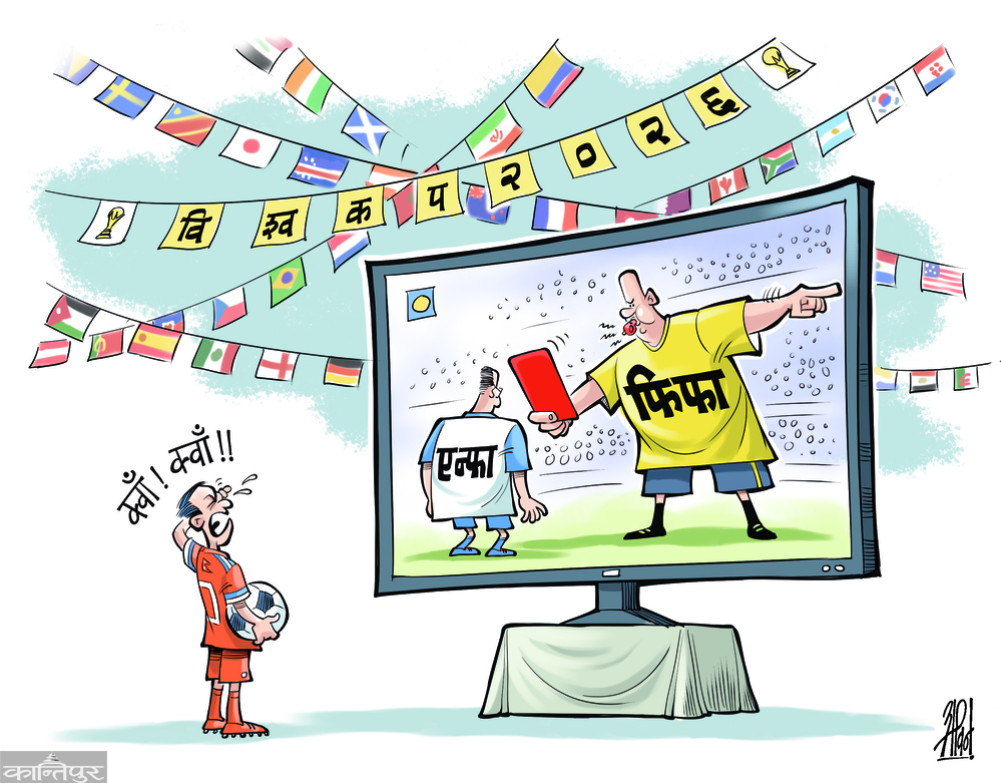
Nepali football, which has been embroiled in internal conflicts, disputes, and controversies, has been pushed into further confusion and uncertainty after the ban, bringing disrepute to the country, and the players' disrespect for the game.
We use Google Cloud Translation Services. Google requires we provide the following disclaimer relating to use of this service:
This service may contain translations powered by Google. Google disclaims all warranties related to the translations, expressed or implied, including any warranties of accuracy, reliability, and any implied warranties of merchantability, fitness for a particular purpose, and noninfringement.
The International Federation of Association Football (FIFA) has imposed an indefinite ban on Nepal after the controversy over the interference of the government body, the National Sports Council (NSC), reached its peak. After FIFA imposed the ban citing ‘third party interference’, Nepal has been isolated from the biggest football festival in the world, the World Cup.
Nepali football, which has been embroiled in internal conflict, strife and controversy, has been pushed into further confusion and uncertainty after this ban. Now Nepali football players will not be allowed to participate in international competitions, and the future of referees and coaches is also in doubt. The controversy that started with ANFA’s ‘early election’ has finally reached the point of ban. FIFA Secretary General Mathis Grafström wrote a letter to ANFA informing about the ban.
The four-year term of the ANFA Executive Committee led by Pankaj Bikram Nembang ended on 5 Ashad. But the controversy started after an attempt was made to hold an ‘early election’ 5 months ago. At that time, there was an attempt to hold only the central committee elections without holding the updated elections at the level (district structure). After receiving a complaint about that, the NSC suspended ANFA for 3 months in Chaitra. But the suspension was lifted before even two months had passed. Even then, confusion persisted and FIFA has now announced the decision to ban. Nepal officially became a member of FIFA in 1970. Two years later, Nepal also became a member of the Asian Football Confederation (AFC). Since then, Nepal has been banned from FIFA for the first time.
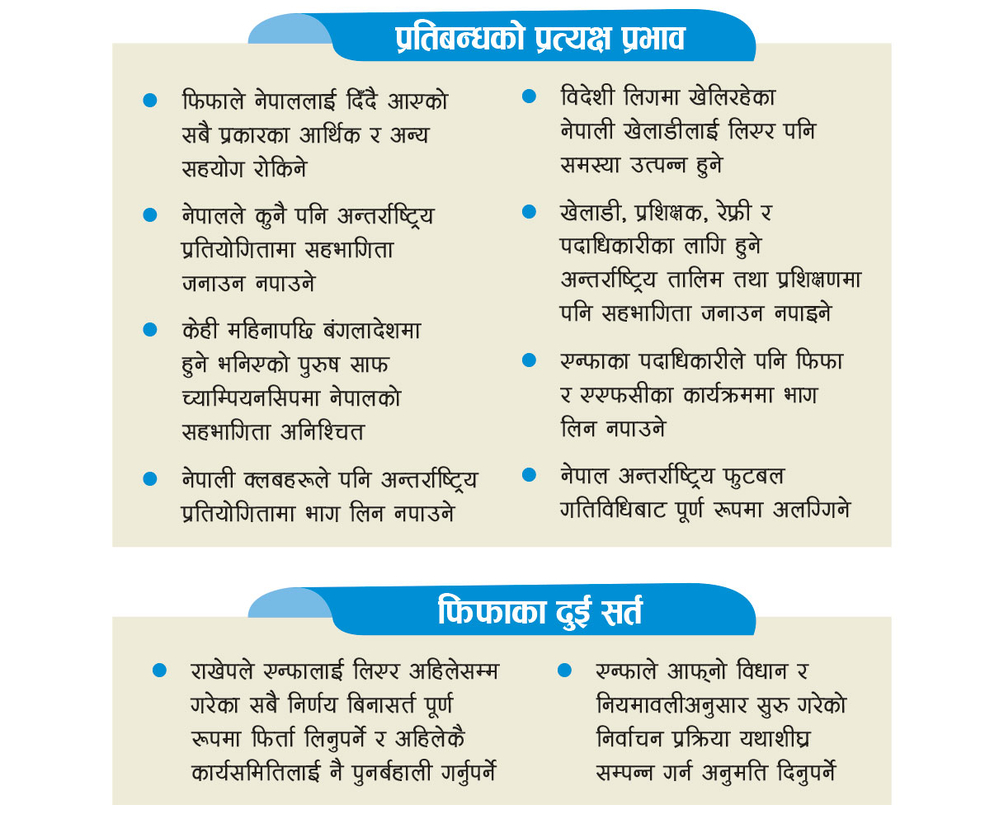
FIFA has put forward two conditions for lifting the ban. According to that, the NSC must completely withdraw all the decisions it has made so far regarding ANFA and the current ANFA working committee must be reinstated. Similarly, ANFA should be allowed to complete the election process that it has started according to its statute and regulations as soon as possible. What that means is that it will have to return to the point from which the dispute began and complete the predetermined program.
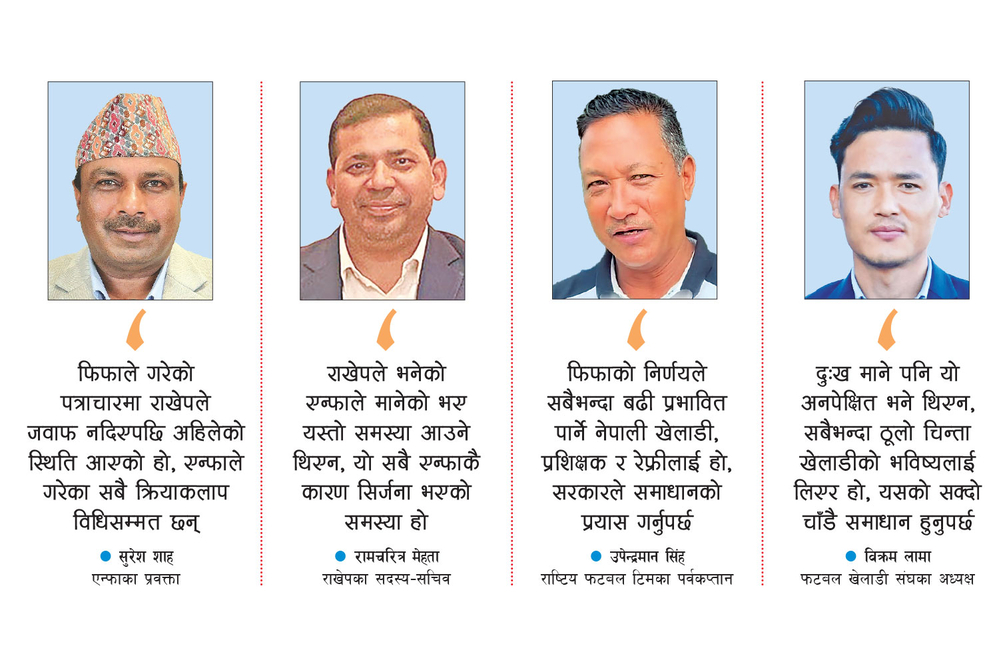
ANFA spokesperson Suresh Shah claimed that all the activities they have carried out are in accordance with the statute. He argues, ‘We have acted in accordance with the statute that we have registered with the council and which has been recognized. The current situation has come to this after the council did not respond to FIFA’s last correspondence. The suspension of ANFA by the council was also based on a different act, such an interpretation is not mentioned in the statute. The decision to go for our election was also made by the general assembly.’
NFA member-secretary Ramcharitra Mehta expressed his regret over FIFA’s ban and accused ANFA of creating problems that it could have avoided. His argument was, ‘If ANFA had listened to what we said, such a problem would not have arisen, this is all a problem created by ANFA.’ He expressed confidence that this dispute in Nepali football would be resolved soon and also informed that a ‘Normalization Committee’ is in the process of being formed. He argues that this committee will do the necessary work later.
Former captain of the Nepali national team Upendraman Singh said that Nepali football has reached a complicated phase after the FIFA ban. He said, ‘Nepali football has faced a very big accident and this is a very complicated phase. If the ban affects any one party the most, it is the players, coaches, and referees. This ban will not affect those who try to do politics in football. Therefore, the Nepal government should come forward and try to solve this.’
Former vice president of ANFA He said that everyone should try to solve the problem carefully in a situation where there is uncertainty about how long the FIFA ban will last and what the solution is. Singh expressed his fear that it will be difficult to bring sponsors back to Nepali football in the coming days. He said, ‘The longer the ban lasts, the more the problem will increase. Nepali football is already in a situation where it has gone back ten years. Nepal has never been banned by FIFA before, and it is very sad to see it now.’
Football Players Association President Vikram Lama says, ‘Our biggest concern is about the future of the players, so it should be resolved as soon as possible.’ He said that while he was saddened by the whole incident, it was not unexpected. His argument is, ‘Whatever has happened is definitely not good. But Nepali football should be good now.’ Stressing on the need to make domestic Nepali football dynamic, he said that this problem has arisen due to internal conflicts within Nepali football.
Former ANFA president Karma Tshering Sherpa said that the main reason for FIFA’s ban was the attempt to select the leadership without going to the level-level elections. He said, ‘A really bad situation has arisen now, all the blame for this goes to the current ANFA leadership. This has misled both FIFA and the council by giving wrong information. The main reason for the current ban is the backtracking on the decision of the ANFA general assembly to hold elections at the level.'
He added, 'There are many other supporting reasons for this. There are many other problems, including not being able to hold regular leagues. However, the current ANFA leadership did not want to solve the problem in Nepali football. Instead, it wanted it to worsen. ANFA could not even coordinate between FIFA and the council, and this only increased the distance between the two parties. If ANFA had held elections at the level at the scheduled time, the problem would not have arisen. The solution now is to form an ad hoc committee and hold elections.'
After FIFA imposes the ban, it will have a serious impact on Nepali football. All types of financial and other assistance that FIFA has been providing to Nepal will be stopped. Similarly, Nepal will not be allowed to participate in any international competition under the ban. This will apply to both national and age-group men's and women's competitions. This means that Nepal's participation in the men's SAFF Championship, which is scheduled to be held in Bangladesh in a few months, is uncertain.
Nepali clubs will also not be allowed to participate in any competition. There will also be problems with Nepali players playing in foreign leagues. They will not be allowed to participate in training and coaching for players, coaches, referees and officials.
ANFA officials will also not be allowed to participate in any FIFA and AFC events. This means that Nepal will be completely isolated from all types of international football activities.