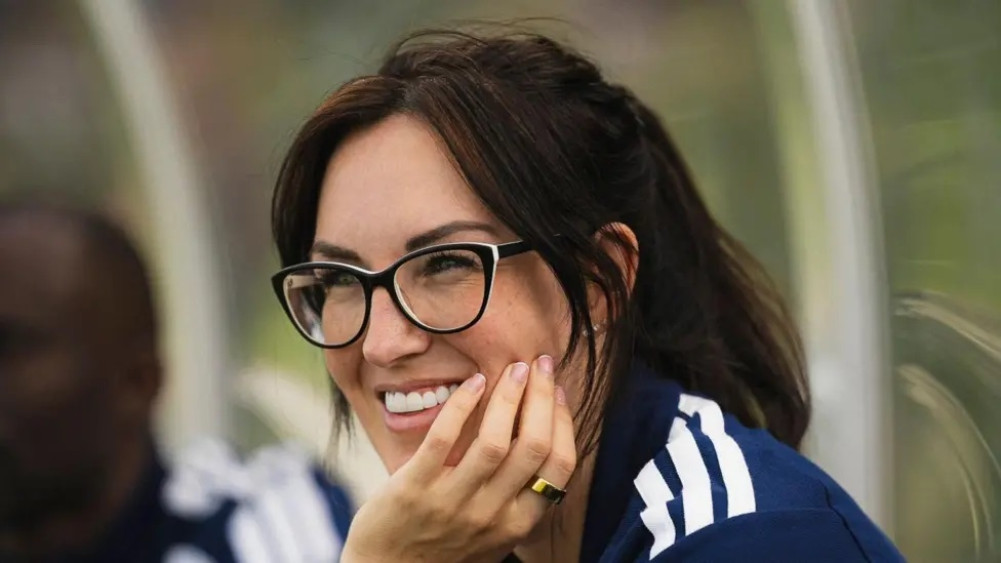
Dr. Suzanne Hurman serves as the chief of medical staff for the national men's team of Curaçao, the smallest team in terms of population and size to play in the World Cup.
We use Google Cloud Translation Services. Google requires we provide the following disclaimer relating to use of this service:
This service may contain translations powered by Google. Google disclaims all warranties related to the translations, expressed or implied, including any warranties of accuracy, reliability, and any implied warranties of merchantability, fitness for a particular purpose, and noninfringement.
One woman and 47 men. This is the medical staff at the 2026 World Cup. Dr Suzanne Hurman is the head of medical staff for the national men's team of Curaçao, the smallest team in terms of population and size to play in the World Cup. She is the third female team doctor in the 96-year history of the World Cup.
Dr Celeste Gertse worked with the New Zealand men's national team at the 2010 World Cup in South Africa. She became the first female doctor to work at a men's World Cup. Dr Silja Schwarz has been the team doctor for the Germany men's team since 2023.
FIFA said Dr Hurman would be the only female head of medical staff at the World Cup. But she hasn't thought much of it. 'I didn't realise it at first because it's completely normal to be the only woman or one of a few women in the room,' Hurman said. 'But I hope to see more women soon because there are so many more capable women.'
BBC Sport reported that Dr. We spoke to Dr. Hurman about what is needed, the opportunities and the challenges to increase female representation in football. Born in Brazil, Dr. Hurman has worked with Real Madrid, Go Ahead Eagles and PSV Eindhoven, and was the medical director of the Netherlands U-16 boys’ team and the Dutch women’s handball team.
Curaçao has a population of around 158,000. The Caribbean island is part of the Netherlands. It is culturally Dutch-influenced. But it is not a fully sovereign state. Curaçao qualified for the World Cup with seven wins and three draws in the qualifying round.
Dr. Hurman is not intimidated by working in a male-dominated field. However, she says there are challenges. “If you are capable and you are good at what you do, it is easy to accept because it is about quality and performance. If they see that you are capable. If your goals are the same, it will impress them,” Hurman said, “but you have to prove yourself. It’s hard to get in at first because at first there are always a lot of people saying, ‘It’s not possible. How can women work in that environment?’
She continued, “Curacao had an all-male football association. There were no women, not just in the medical team, but in any area. We came to the World Cup with 49 players and staff, I’m the only woman in the team.”
Dr Hurman studied medicine in the Netherlands in 2008. She recalls that her course was more gender-balanced with women. “When I was studying medicine, it was about 70-75 percent women and the rest were men,” she said. “I specialized in sports medicine in 2014 and then it turned the other way around, because there were only 20-30 percent women. I’ve seen a difference, especially in sports.”
At the 2023 Women’s World Cup, it wasn’t just all women doctors in football. England and Sweden were the only countries where the team doctors were male. When asked why there were so few female doctors working in football, Hurman said it could be because of the always-active culture.
‘It’s not just your ability, if you’re good at professional things that’s one thing, but the travel, the lifestyle can affect your personal life,’ she said. ‘If you have a family or are pregnant, you have to take a certain amount of time off work. Because you can’t combine that with the professional football season. It’s not just football. It’s the whole world of high-level sport, where your work is in demand 24/7.’