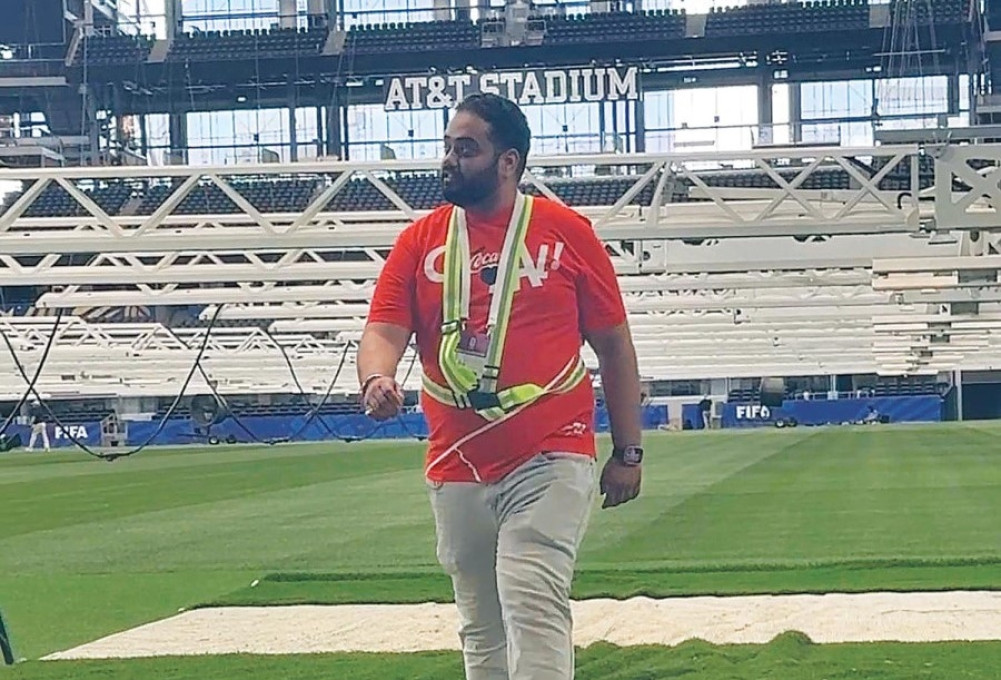
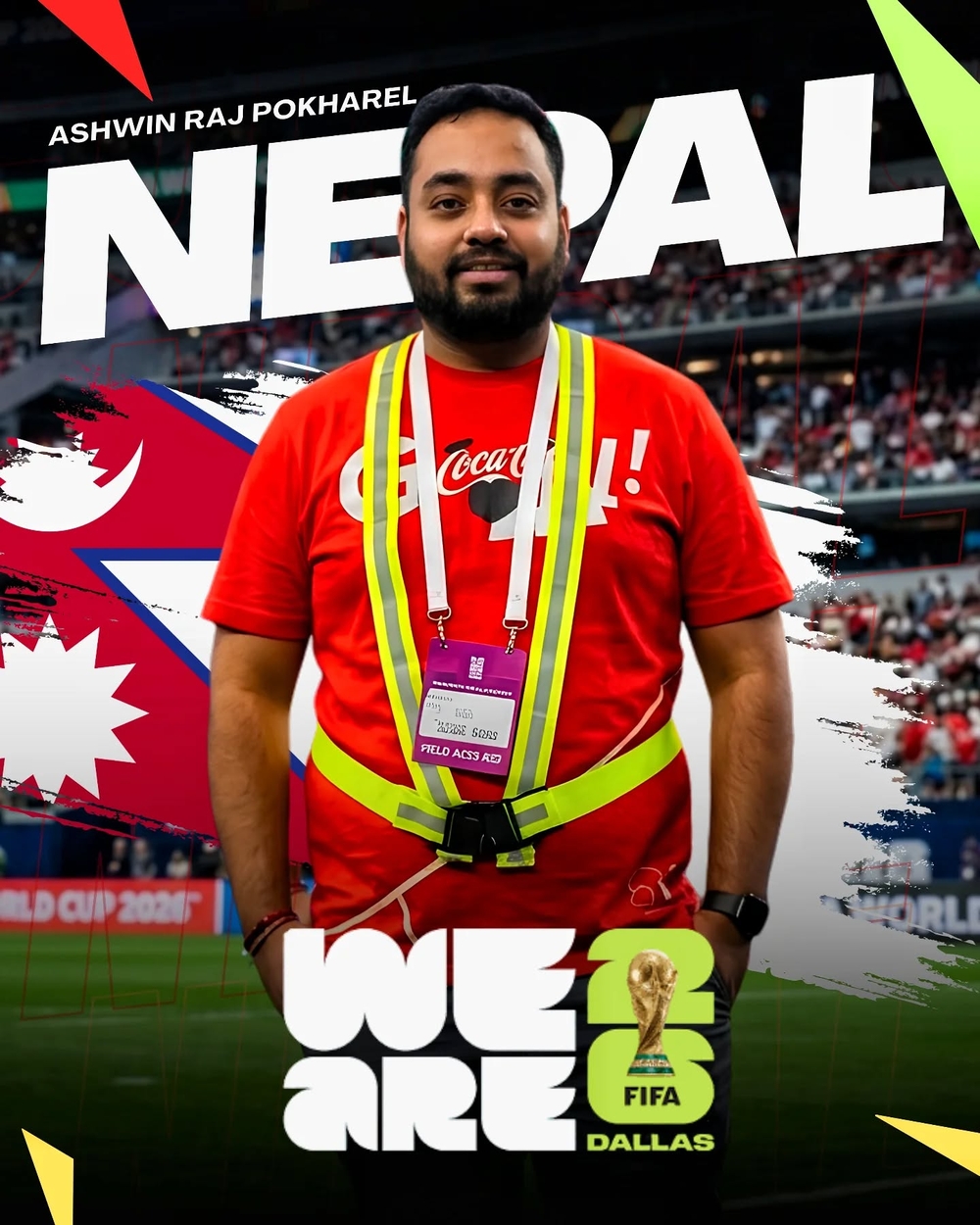
Ashwin Raj Pokharel, 29, who has been living in the US since 2018, works as a 'lead supervisor' for Coca-Cola at the Dallas Stadium, where most of the World Cup matches are being held.
We use Google Cloud Translation Services. Google requires we provide the following disclaimer relating to use of this service:
This service may contain translations powered by Google. Google disclaims all warranties related to the translations, expressed or implied, including any warranties of accuracy, reliability, and any implied warranties of merchantability, fitness for a particular purpose, and noninfringement.
A bearded young man wearing a red Coca-Cola T-shirt is seen busy inside the huge AT&T Stadium in Arlington, Texas, USA. His photos and videos inside the stadium, which has been named ‘Dallas Stadium’ for the 2026 FIFA World Cup, have been viral on social media for the past three weeks. He has become a source of pride for Nepalis to be associated with the biggest celebration of world football.
That young man is 29-year-old Ashwin Raj Pokharel. Pokharel, who has been living in the US since 2018, is working at the Dallas Stadium as Coca-Cola’s ‘lead supervisor’ for the World Cup. This is the stadium that will host the most matches out of the 16 stadiums in the US, Mexico and Canada that will host the World Cup.
The 23rd edition of the FIFA World Cup has officially begun with the match between co-hosts Mexico and South Africa in Mexico City on Friday night.
This is not the first time that Nepalis have been involved in the preparations for the biggest tournament in world football. Thousands of Nepali workers contributed to the construction of the infrastructure for the 2022 Qatar World Cup. It also revealed many stories of hard work, sacrifice and pain.
But for Pokharel, the World Cup is more than a matter of pride. His journey from Kathmandu to the World Cup is a continuation of various professions and struggles in Nepal and the US. In a recent conversation with ‘The Post’, Pokharel recalled uploading videos for ‘Highlights Nepal’ in 2014-15 while he was in school.
‘After that, I helped import goods from China in our family’s wholesale business on Naya Street,’ he said. ‘Later, I worked in the travel and tourism sector. Then I ran an education consultancy. I came to the US in 2018. After coming here, I completed my bachelor’s degree in business management and my master’s degree in business analytics. During various jobs, I also got the opportunity to work as a supervisor at Amazon.'
For the past one year, he has also been running a platform called 'AshFinances'. This platform provides useful information on education, career, expense management and daily life to Nepalis coming to the US. 'Many Nepalis coming to the US for the first time are cheated in various ways,' says Pokharel, 'I started this platform to give them the right information and guidance.'
He has also gained experience in 'event management' at big events featuring Bollywood artists. But Pokharel says that the opportunity to become a supervisor for Coca-Cola at the Dallas Stadium was an experience he never dreamed of.
In February, he saw an advertisement for the position. After applying, he went through various stages of selection processes and interviews and participated in the 'orientation' program on May 8. ‘I have been very happy since the day of orientation,’ he said. ‘Being a part of such a big competition is beyond my imagination.’
According to Pokharel, the main responsibility of his team is to provide Coca-Cola drinks to the spectators who come to the stadium within 20 seconds.’ This stadium is also the home ground of the ‘Dallas Cowboys’, which is considered the most valuable sports team in the world. According to Forbes, the value of the ‘Dallas Cowboys’ has reached 13 billion US dollars in 2025. Forbes has also called it the world’s most profitable sports franchise.
‘This stadium will be used primarily for American football,’ Pokharel said. ‘It has been converted into a soccer stadium for the World Cup.’ The stadium, which has been partnered with Pepsi for years, is now under Coca-Cola’s ownership, so things are very busy. In addition to ensuring Coca-Cola’s branding, he is also responsible for collecting feedback from the audience.
‘I now spend 40 to 50 hours a week in the stadium,’ he said. ‘I have to walk 20 to 25 kilometers a day for work.’ He has experienced that excitement is growing across America as the World Cup approaches. ‘From restaurants to markets, the World Cup is the talk of the town,’ he said. ‘Fans are coming from all over the world. Their enthusiasm is incredible. Sometimes it’s hard to believe when you see people spending thousands of dollars to watch the game. It’s truly incredible to play a role in making such a big tournament a success.’
According to Pokharel, his contract with Coca-Cola will end with the semi-final match on July 15. ‘I will go to Kathmandu for some time after the World Cup,’ he said, ‘and then I will decide what else to do.’
Ashwin’s story is not about becoming a celebrity or getting into the news. It is the story of a Nepali who, through continuous hard work, struggle and searching for opportunities, has reached the biggest stage of world football from Nepal. Amidst the glitter of the World Cup, he is not on the field, but behind the scenes. But that role is also making a significant contribution to making the World Cup a success.