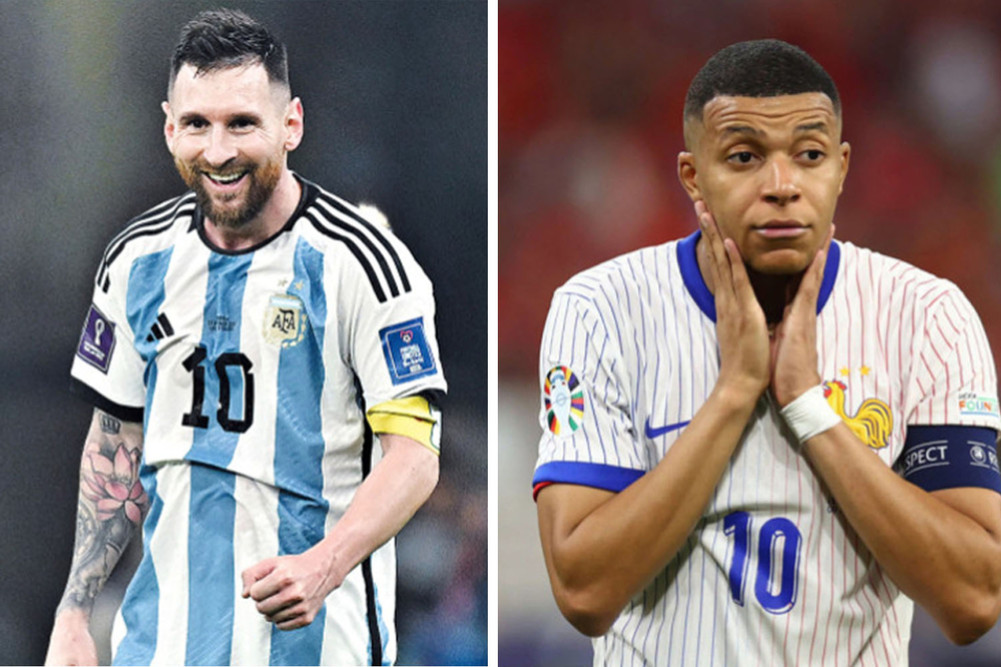
There is an interesting similarity between the greatest footballers of all time, Pele, Maradona, Zidane and Messi. That is - all four of them have lifted the World Cup trophy wearing the number 10 jersey.
We use Google Cloud Translation Services. Google requires we provide the following disclaimer relating to use of this service:
This service may contain translations powered by Google. Google disclaims all warranties related to the translations, expressed or implied, including any warranties of accuracy, reliability, and any implied warranties of merchantability, fitness for a particular purpose, and noninfringement.
In football, players who wear jersey number 10 are always in the eyes of the fans. The number 10 jersey is not just a number, it is a legacy and a standard of excellence. But, how did the story of the number 10 jersey begin? And who contributed to making it a standard?
There is an interesting similarity between the all-time great footballers Pele, Maradona, Zidane and Messi. That is - all four of these men have lifted the World Cup trophy wearing jersey number 10.
Sometimes, who is playing wearing number 10 is a matter of great interest in itself. When Lionel Messi moved from Barcelona to PSG, the issue of whether Neymar would wear this jersey or hand it over to Messi became a major issue.
What is so special about jersey number 10? Why do footballers die?
Earlier, there was no fixed number for players in football. The number system began only with the 1954 World Cup. Immediately after, the next edition, the 1958 World Cup, due to a procedural error, the legacy of jersey number 10 began. At that time, after the Brazilian Football Confederation forgot to submit the list of players, a Uruguayan representative of FIFA randomly distributed the numbers.
The number 10 fell to a 17-year-old player in the team. That player was Pele. Pele scored against Wales at the age of 17 years and 239 days, setting the record for the youngest goalscorer in World Cup history, and ultimately making Brazil the world champion for the first time.
If the FIFA officials had given Pele a different number that day, perhaps the story of jersey number 10 today would have been different. After Pele, Argentina's Diego Maradona made number 10 a symbol of rebellion in 1986. Wearing the number 10 jersey, he gave football fans iconic moments like the 'Hand of God' and the 'Goal of the Century' in the 1986 World Cup.
In Argentina, a player wearing the number 10 is called 'Enganche', which means to put a curb. A curb that connects the midfield and the attack. On the other hand, in Italy, this number is called 'Fantasia'. That is, a player who plays a free and creative game on the field.
Over time, jersey number 10 has become a standard of excellence proven by great players like Pele and Maradona.
Meanwhile, Zinedine Zidane showed magic on the field for France wearing the number 10. Especially his performance against Brazil in the 2006 World Cup is called a masterclass in football.
In the last decade, Argentine superstar Lionel Messi has given another standard to jersey number 10. He has won the Champions League, the Copa America and the World Cup wearing this number. This jersey has been the witness to many titles such as the most Ballon d'Ors and the most Golden Boots in Europe.
Now Messi is also becoming the first player in history to play in 6 World Cups. And, this may also be his last World Cup. This is a matter of legacy. Emerging players in world football are currently fighting for the number 10. Lamine Yamal in Spain, Vinicius Junior in Brazil, Jamal Musiala in Germany and Kylian Mbappe in France.
These emerging players have chosen jersey number 10 for their careers. Recently, a controversy over who will wear Brazil's five-star jersey number 10 for the upcoming World Cup has surfaced. After a long discussion, it has been agreed that Neymar will be given the number 10 that Vinicius has been wearing in Neymar's absence.
This time, Neymar is in line to break Pele's record by becoming the first Brazilian to wear the number 10 in 4 World Cups. An interesting aspect of this World Cup is that the jersey number 10 is being passed down from generation to generation. If Messi makes this World Cup his last, Argentina will have to find a new successor for the jersey number 10.
In Messi's absence, Thiago Almada and Franco Mastantuno have been using the number 10 recently. Meanwhile, there is talk in Brazil that Neymar will play his last World Cup. Vinicius Junior is almost certain to be the successor to the number 10 jersey in Brazil.
Luka Modric, who led Croatia to the final in 2018, is also playing his last World Cup wearing the number 10 jersey. Who will be his successor is also a matter of interest.