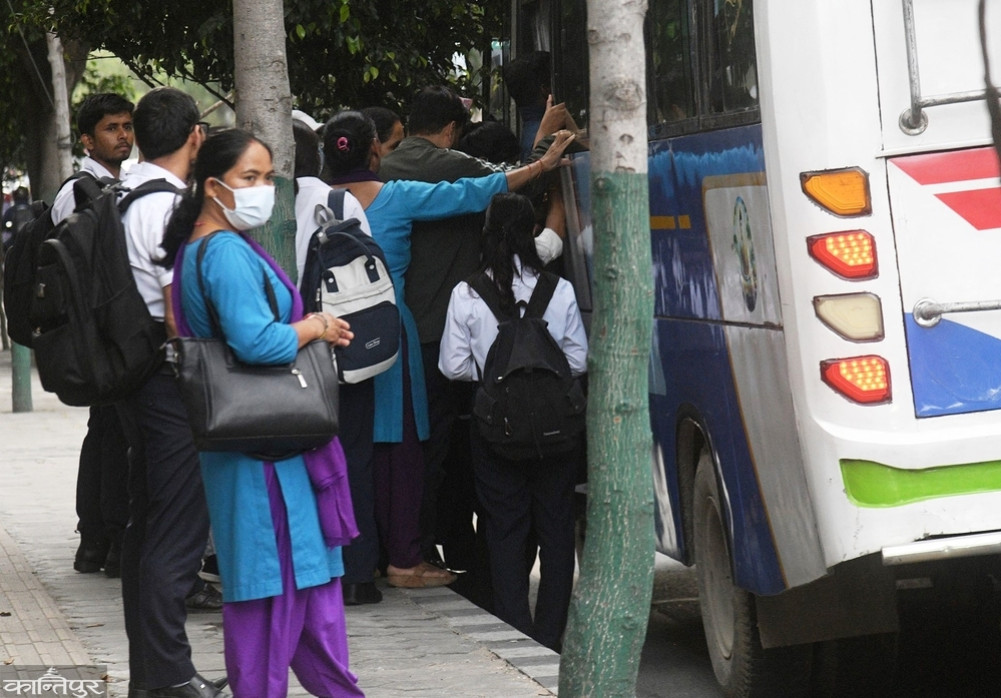
Although the announcement of opportunities and salary increases based on performance is positive, many other decisions have left employees fearful and under pressure.
We use Google Cloud Translation Services. Google requires we provide the following disclaimer relating to use of this service:
This service may contain translations powered by Google. Google disclaims all warranties related to the translations, expressed or implied, including any warranties of accuracy, reliability, and any implied warranties of merchantability, fitness for a particular purpose, and noninfringement.
On Asar 25, Chief Secretary Sumanraj Aryal, who served as the Prime Minister’s principal aide, was given a farewell by Prime Minister’s advisor Asim Shah. Previously, it was customary for the sitting Prime Minister to bid farewell to the Chief Secretary, but Aryal, who had remained with Prime Minister Balendra Shah for more than three months, received an unusual send-off that generated discussion among civil servants, though they did not consider it abnormal. This is because, after former Secretary Krishnahari Pushkar had already been arrested simply on the basis of a mobile message, civil servants saw this as just another incident.
In fact, the civil service was unsettled from the very first day Prime Minister Shah was appointed, when he issued instructions to the secretaries. “Until now, you have worked for the interests of the people’s representatives, not for the people themselves. That must not continue,” he told the staff immediately after taking the oath on Chaitra 13. “You have come through the Public Service Commission, and today’s ministers are also educated. Please do not try to teach us.” Quoting the Prime Minister, one secretary added, “Do not avoid work by citing laws and regulations, and do not use that as a way to lecture ministers.”
According to that secretary, civil servants are bound by the Civil Service Act, laws, and regulations, and must base their work on them. However, the Prime Minister seemed to have a negative perception of civil servants who referred to laws and regulations, viewing it as reluctance to work, an attempt to be uncooperative, or making excuses. According to the secretary, the Prime Minister firmly stated, “Match your pace with ours, or make way.”
While the Shah government’s announcements to provide opportunities based on performance and decisions such as salary increases were positive steps, many other decisions have created fear and pressure, according to civil servants. The passport case, in particular, has generated a sense of fear among the bureaucracy. Under the direction of the Prime Minister’s Office, the Commission for the Investigation of Abuse of Authority decided on Asar 1 to arrest and prosecute then-Director General of the Department of Passports, Tirtharaj Aryal. Aryal was arrested directly from the Prime Minister’s Office. According to one official, this incident further terrorized civil servants.
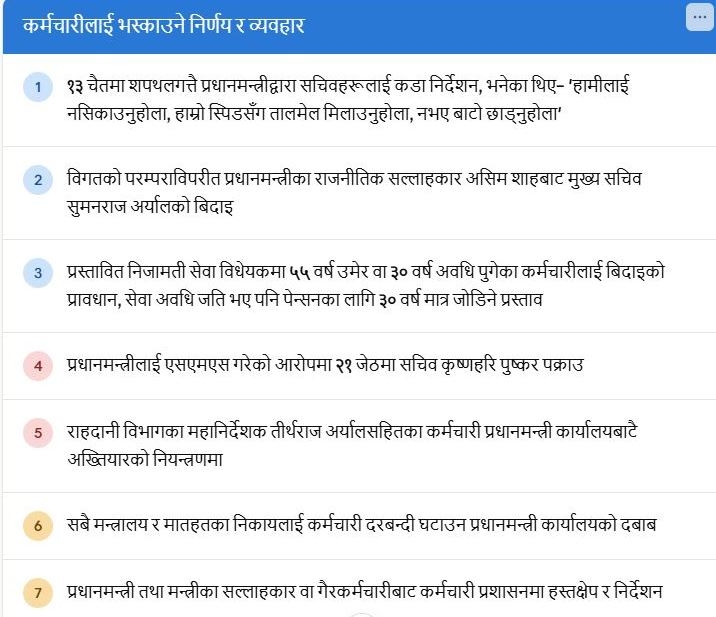
Similarly, discussions about a new retirement proposal have added to the confusion among civil servants. After it became public that the Ministry of Land Management, Cooperatives, and Federal Affairs and General Administration had drafted a new Civil Service Bill proposing retirement for those who reach 55 years of age or complete 30 years of service, trust in the government among civil servants appears to have weakened further. Currently, the legal provision is retirement at 58 years. However, the proposed bill has not yet been registered in Parliament. If the bill with the new retirement provision is enacted as law, about 10,000 civil servants will retire early. The list of those eligible for such retirement includes more than 50 secretaries, 260 joint secretaries, and over 700 undersecretaries.
On the other hand, there is talk within Singha Durbar about the added stress among civil servants over where they will end up if they are placed in the surplus (reserve) pool. According to government decisions, ministries have already conducted organization and management (O&M) surveys to streamline and downsize the administrative structure. However, the Prime Minister’s Office rejected the first draft of the organizational survey submitted by ministries, which had identified the required staff based on workload. According to one joint secretary, the Prime Minister’s Office is pressuring ministries to cut even essential divisions, departments, and staff.
He noted that instead of “right-sizing” the organization, the concept of forced “down-sizing” has been introduced. If the new O&M is fully implemented, many positions will be eliminated, and a large number of staff will become surplus and without work. This has also increased fear among civil servants. Managing thousands of surplus staff will also be a challenge for the government. An official from the Ministry of Land Management, Cooperatives, and Federal Affairs and General Administration said that while the government wants to issue citizenship and land certificates within 15 minutes, it has not shown the same interest in managing the necessary resources for this.
The government’s 100-point action plan emphasizes governance reform. It states that administrative reform, public service delivery, digital governance, fiscal discipline, project management, infrastructure development, and the social sector are priorities. Another secretary said that achieving these priorities and goals set by the government will require the support of the bureaucracy. “But the government is keeping civil servants in fear, not trying to win their trust, and seems to have a prejudice against them,” he said. “You cannot get results from civil servants by keeping them afraid and undermining their confidence.”
The government’s decision to abolish trade unions has also created a sense of fear, especially among lower-level staff. There is a perception among civil servants that the government began its assault on them by abolishing trade unions. Particularly among lower-level staff, there is a belief that the government is trying to keep the entire administrative mechanism under pressure by abolishing trade unions. Last Baisakh, the government amended the Civil Service Act through an ordinance and abolished civil service trade unions. However, a writ petition against this decision is pending in the Supreme Court.
The government has made several efforts to improve service delivery, promote frugality in government spending, ensure good governance, and prevent middlemen from entering government offices. However, civil servants complain that they have to endure unnecessary instructions and reprimands from the Prime Minister’s Secretariat in Singha Durbar. In the past, the involvement of the Prime Minister’s advisors or personal secretariat members in government decision-making was a subject of criticism. Now, civil servants complain that this is being institutionalized.
A recently retired secretary said that the current practice of secretaries receiving instructions from the Prime Minister’s subject-specific advisors and having to inform them in advance of any important decisions taken by ministries has surpassed previous negative trends. He cited the treatment of senior officials, including the Foreign Secretary, by the Prime Minister’s Secretariat during the passport case as the latest example of this trend.
“They have always had a certain attitude toward the bureaucracy, a prejudiced approach toward civil servants, and a strategy of making them work under fear and pressure,” he said. “The demeanor, presentation, and instructions of the Prime Minister’s advisory team reflect this, and perhaps the Prime Minister himself has given such directives.” He noted that this has weakened the confidence of the bureaucracy.
After Home Minister Sudan Gurung’s resignation and until his reappointment, Prime Minister Shah himself held the Home Ministry portfolio. During that period, from Baisakh 9 to Jestha 26, the Prime Minister’s Secretariat team was issuing instructions in the sensitive and important Home Ministry. According to a Home Ministry source, “During that period, the Home Secretary rarely got to meet the Prime Minister with ministry matters, and even the most sensitive briefings had to be given to the Secretariat team.”
Former Secretary Gopinath Mainali says that placing the advisory personal secretariat above the layers of civil service sends a message that the government does not trust its bureaucracy. “There is now a sense among civil servants that the government does not trust us, and that is not good,” he said. “The most reliable and dependable mechanism for implementing government policies, plans, and the will of the state is the civil service. If you do not trust it, you will not get results.”
Meanwhile, the Prime Minister’s Office has also increased the activity of the National Vigilance Center during this period. However, the Center has a reputation in the civil service as a “Panchayat-era weapon” used to intimidate staff. In the past three months, the Vigilance Center has taken action against 6,682 civil servants for reasons such as not being present on time or not wearing uniforms. This number exceeds the total number of staff disciplined in the entire previous fiscal year. Last year, the Center recommended action against 5,937 staff for not coming to the office on time.
Previously, civil servants hesitated to make decisions due to anonymous complaints filed with the Commission for the Investigation of Abuse of Authority. Now, they also fear the Property Investigation Commission. Yet, civil servants have always submitted their property details annually. Now, all current and former civil servants must submit their property details to the commission formed by the government. Civil servants complain that such steps taken one after another by the government have created an atmosphere of fear in the bureaucracy.
On the other hand, the door to career advancement for civil servants has been closed. No secretaries have been promoted since last Mangsir. “With promotions halted, joint secretaries in line to become secretaries are also dissatisfied. This will inevitably affect performance, decision-making, and results,” said one joint secretary.
Growing dissatisfaction among civil servants over government decisions is now being openly expressed. In the last week of Asar, contract staff such as office assistants, computer technicians, and drivers staged protests inside Singha Durbar, saying their jobs had become uncertain. A task force including secretaries, formed at the Office of the Prime Minister and Council of Ministers, had proposed that necessary staff for support services and general technical services could be hired through a public company limited or external service providers (outsourcing). After this proposal became public, thousands of contract staff, feeling their jobs were insecure, took to protest. The government, under pressure from the protests, decided to retain contract staff for the time being.
 Former Secretary Mainali says that the decisions, policies, and various actions taken by the government in recent times have lowered the morale of civil servants. “Civil servants appear to be without guardians, and the political executive level itself has contributed to increasing fear among staff,” he said. “You cannot get good results from fearful and unconfident staff; the government must understand this. It is necessary to create an environment that boosts morale and fosters trust in civil servants.”
Another former secretary, Kedar Nyaupane, says that the government’s behavior and some decisions have led to fear and a lack of confidence throughout the civil service. “As a result, civil servants have developed a mentality of just keeping their heads down and not taking any risks,” he said. “The permanent mechanism of the state is the civil service. But sidelining it and trying to mobilize staff through people who have not taken an oath, do not have the authority to sign, and are not recognized by state laws and regulations is not good.” He says the government should dispel the growing fear among civil servants and run the country through them by trusting them.
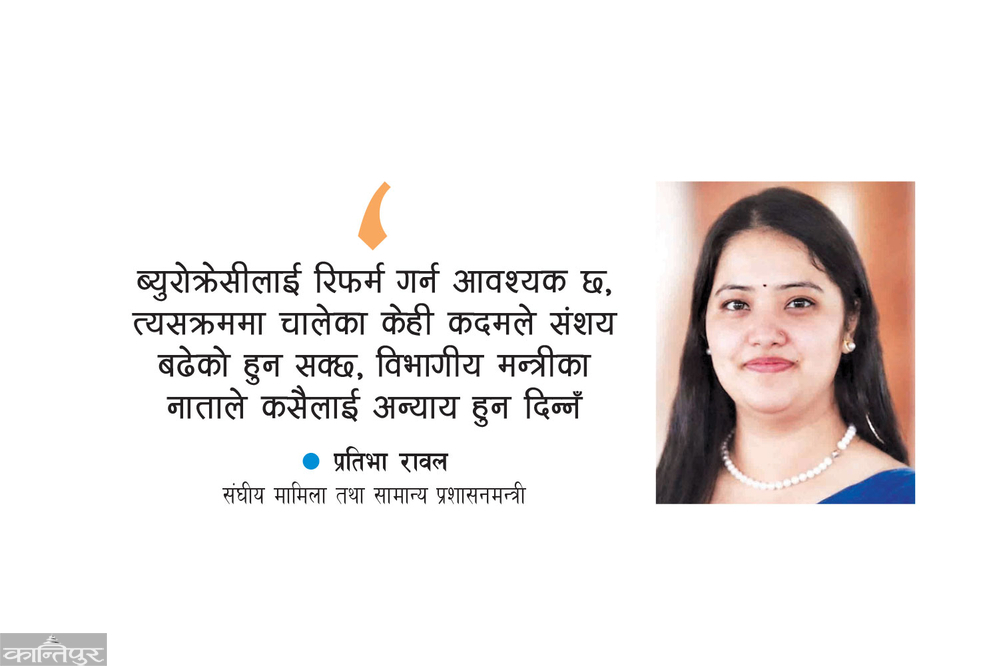
Minister for Land Management, Cooperatives, and Federal Affairs and General Administration, Pratibha Rawal, acknowledges that while some steps taken by the government to reform the bureaucracy were necessary, they may have increased suspicion among some. “It is necessary to reform the bureaucracy, and some steps taken in that process may have increased suspicion. As a departmental minister, I will not allow anyone to be treated unfairly,” she said.
She said that staff who do wrong will be punished and those who do well will be rewarded. “Those who have done wrong naturally should be afraid, and it is right for them to be afraid. Those who misbehaved in the past may be anxious or fearful,” she said. “No good civil servant needs to be afraid. Nor are they afraid.” She said that those who were previously treated unfairly or worked as neutral civil servants are now happy.