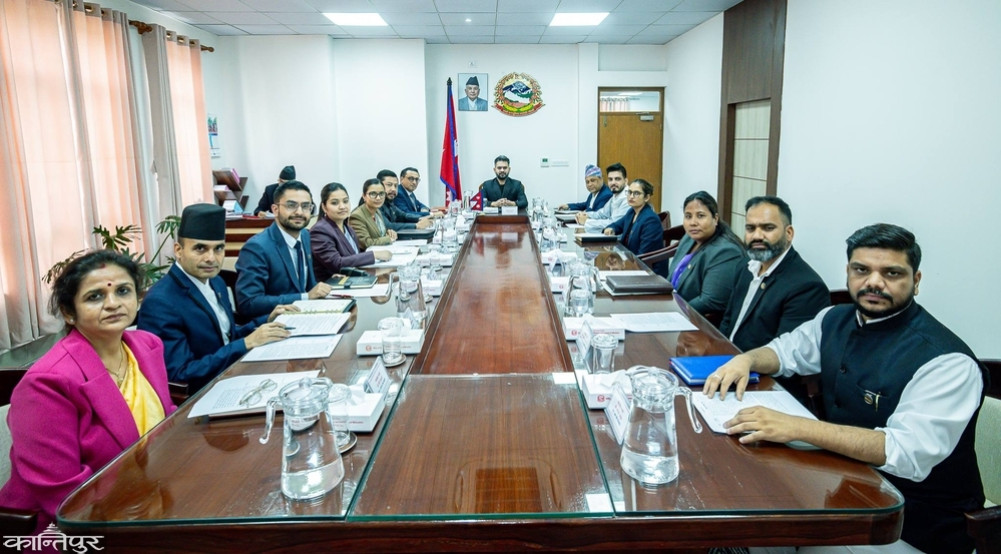
An analysis by the Kantipur team of government data, decisions, implementation status, and progress shows that 38 out of 100 action plans have been implemented.
We use Google Cloud Translation Services. Google requires we provide the following disclaimer relating to use of this service:
This service may contain translations powered by Google. Google disclaims all warranties related to the translations, expressed or implied, including any warranties of accuracy, reliability, and any implied warranties of merchantability, fitness for a particular purpose, and noninfringement.
About one-third of the ‘100 agendas related to governance reforms’ brought by the government led by Prime Minister Balendra Shah have been implemented. An analysis by the Kantipur team on government data, decisions, implementation status and progress shows that 38 out of the 100 agendas have been implemented.
On the day the government was formed on Chaitra 13, the agendas were put forward to be implemented from 24 hours to 1,000 days, ranging from public administrative service delivery reform, Digital Nepal, corruption control to agriculture, infrastructure, health, and education sector reforms. Significant work has been done in some of these action plans, while limited achievements have been made in others. In most of them, the government’s commitments are yet to be fulfilled. 62 lists are incomplete, and no implementation process has started in them.
Foreign Minister Shishir Khanal claims that the government has been successful in instilling hope in the people and providing a sense of good governance. ‘If we compare the previous government and us, in many ways, we can see capacity, dedication, motivation, and a sense of dedication to the people. That has brought some initial results. The government has given a clear message that it is working towards good governance,' he told Kantipur.
The most important and timely item on the agenda is item number 99, which states that the process of refunding the money of small savers of troubled cooperatives will begin within 100 days. The government had started the refund of savings of less than Rs 10,000 in the first phase on Jestha 4. So far, savings of Rs 44,348,016 have been refunded to 1,895 people.
Another achievement of the government is seen under item number 3. In that item, there was a provision to select implementable issues from the manifestos of all political parties and prepare a common national commitment. Accordingly, the government has analyzed the manifestos of all parties and prepared an 18-point national commitment. Although this commitment was made public on April 1, two days later than the specified deadline. The government says that this is an attempt to build political consensus on a common agenda for national development.
62 lists are incomplete, and no implementation process has been started on them. The agenda was to form a task force within seven days to prepare a constitutional amendment debate paper. Although the task force was formed later than the scheduled time, it is moving ahead with discussions with various political parties, constitutional bodies and stakeholders. The government has interpreted this as the beginning of long-term political reforms.
As mentioned in number 6 of the agenda, the government has already started providing relief to the families of those who lost their lives during the Gen-G movement. 53 families have been provided relief at the rate of Rs. 1.5 million. 81.67 million rupees have been sent to 134 injured people through the concerned district administration offices. It was announced that the number of federal ministries would be reduced to 17 within 30 days. Although it could not be completed on time, the government has changed the number of ministries by amending the work division regulations. The number of ministries has been kept at 18.
Numbers 91 and 92 of the agenda mention the collection of digital records of landless squatters and unorganized settlers, verification and the launch of a public land conservation campaign. According to which, the government had started removing encroached structures in various parts of the country, including the Kathmandu Valley, on April 12.
Gen-G activist Majid Ansari says that the government itself violated the action plan regarding the management of squatters. ‘The action plan had said that the data of the squatters would be collected first and the management would be finalized before they would be relocated. The government itself first demolished the settlements using a dozer,’ he said, ‘The data was collected only after the settlements were demolished. No attention was paid to the management of the displaced.’
The issue of closing betting apps and websites within 24 hours was also on the government’s agenda. Under this, the Nepal Telecommunication Authority has directed to close 26 apps so far. According to the information given by the authority’s spokesperson Min Aryal, more than 300,000 websites have been closed by various internet service providers including Wordlink, Subisu, Vianet.
The government had announced to restructure unproductive bodies. It was said that the boards, committees and institutional structures that were not working would be abolished or restructured. The government has evaluated unnecessary bodies and abolished some structures and restructured some. This issue is also mentioned in the government's budget statement. During this period, 1,594 office bearers (including political appointees) in various constitutional bodies, public institutions, universities, health science institutes and regulatory bodies have been dismissed through ordinances.
The government's commitment was to abolish party trade unions to free public administration from political influence. Accordingly, the decision to abolish party trade unions has been implemented. Under the government's anti-corruption campaign, point no. 43 mentioned the formation of a fully-fledged property investigation commission within 15 days. Accordingly, a five-member commission has been formed under the coordination of former judge Rajendra Kumar Bhandari. The commission has been given the responsibility of investigating property in two phases.
The government has presented digital governance as one of its major achievements. Under this, a 24-hour national citizen assistance and complaint management system has been brought into operation. Hello Government has been upgraded with a real-time dashboard. As of Friday, more than 125,000 complaints were registered on the portal, of which 73,888 were resolved. 47.41 percent of the complaints were registered through the website.
The government has also started the process of implementing faceless digital services in passport, citizenship and driving license services. The government claims that arrangements have been made so that citizens can receive many services without visiting the office. The work schedule was to arrange for the certificates to be downloaded on the official mobile app and citizen app or email within 15 days. The facility for service recipients to download the required certificates online has also been 'enabled'.
To make service delivery faster, easier and more effective, 'autofill' has been arranged for various government bodies and financial institutions. Under this, arrangements have been made to enable the Department of Transport Management, Passport Department, banks and insurance companies to automatically obtain the necessary details and make service delivery easier.
The system of delivering passports to doorsteps has started, and the work of printing driving licenses, which have not been printed for a long time, has also gained momentum. The facility to get information about whether a license has been printed or not has been added through the Nagarik app. The Department of Transport Management has stated that about 2.4 million police stations have been printed out of the 2.9 million licenses that need to be printed since Kartik 2082. Land-related services including land revenue and surveying have also been made available online.
Progress has also been seen in implementing result-based governance to make the overall performance of the government result-oriented and effective. Under this, an action plan with 10 major tasks, deadlines, and performance indicators from responsible officials has been submitted by all ministries.
The government has implemented various programs to facilitate industry and investment under economic reform, although it has been delayed. A single point service center has been made effective for industry registration. The government claims that through this, arrangements have been made to provide various industry-related permits and services from one place.
According to point no. 56, a system has been started to register a business within two days through the Startup Fast Track System. Arrangements have been made to complete new business registration within two working days. This is expected to promote entrepreneurship and make the business registration process faster and easier. The situation of having to go to the Internal Revenue Office to register a company and get a PAN card has come to an end.
'One Door Business Platform' has been launched. According to point no. 60, the Private Sector Protection and Promotion Strategy has been approved by the Council of Ministers. Under this, a draft of the Companies Act 2083 has been prepared, and a proposal has been made to facilitate company registration and dissolution. Policy arrangements have been put in place for business security and investment promotion.
Strict legal action has also been taken against those who damage or loot private property. The Ministry of Home Affairs has given necessary instructions to all district administration offices and security agencies and has started the process of registering cases and arresting people in the relevant incidents. So far, 6,978 people have been taken into custody.
Some old and good works have been continued in the health sector. The burn ward started when Congress leader Pradeep Poudel was the Health Minister has been expanded. Burn treatment wards have been established in 14 federal hospitals for burn treatment services, while preparations are underway to operate burn wards in 9 provincial hospitals. So far, 164 hospitals have entered details of providing 10 percent of the total beds free of charge on the portal.
The agenda for governance reforms mentioned operating and expanding Sulabh Pharmacies in government hospitals. So far, Sulabh Pharmacies have been operated in 16 federal hospitals. As per point no. 86, the government has also taken steps to end party interference in campuses. Tribhuvan University has directed to remove party student organization structures from its affiliated campuses across the country. Student leaders have been protesting the government's decision to remove student organizations.
So far, the academic calendar has been implemented in 9 universities. As per point 88, a system has been implemented to admit children without birth certificates to schools based on details certified by the local level. It has also been decided to implement a system that does not require citizenship for undergraduate admissions. Universities have stated that they are preparing procedures for the implementation process.
The government has announced that CCTV, dash cameras, and GPS buttons will be mandatory in vehicles within 30 days to prevent gender-based violence in public transport, but the work has not been fully implemented. According to Naresh Raj Subedi, Superintendent of Police at Kathmandu Valley Traffic Police Office, CCTVs have been installed in only 3,303 public vehicles. Since there is no exact data on public vehicles, it is not certain how many vehicles are yet to be installed with CCTVs. An SOS button facility has been added to the ‘ride sharing app’.
The government had announced in point no. 5 that the state would formally apologize to Dalits and marginalized communities within 15 days. This was limited to the announcement only. This was not just a symbolic program, it was seen as an attempt to accept the historical injustice of the state of Nepal. Gen-G activist Ansari comments that the point was implemented by RSP President Ravi Lamichhane, rather than the government, apologizing to the Dalit community.
Progress in the agricultural sector also seems weak. A large part of Nepal’s economy still depends on agriculture. According to the Agricultural Census 2078, 4,130,789 farming families are engaged in agricultural work on 2,218,410 hectares of land in Nepal. Of the total land of these farming families, only 54.5 percent of the land has irrigation facilities. Agricultural reforms, minimum support price, farmers' loan repayment, construction of moisture centers, and market management programs have not gained the expected momentum.
It was said that a high-level committee would be formed within a week to investigate the facts and circumstances of the incidents that took place on 24 Bhadra during the Gen-G movement, but the committee has not been formed. In the incident of 23 Bhadra, the implementation of the report prepared by the inquiry commission led by Gauri Bahadur Karki was started the day after the government was formed. Former Prime Minister KP Sharma Oli and former Home Minister Ramesh Lekhak were arrested on 4 Chaitra during the implementation of the report. The investigation against them is still ongoing. Although the government has committed to starting the process of implementing the recommendations of various commission reports, no progress has been seen in that regard.
The government had promised to bring a relief and rehabilitation package for businesses affected by the Gen-G movement. But the plan has not been fully implemented. Although measures such as tax exemption, concessional loans, insurance claim facilitation and reconstruction assistance are proposed, their practical implementation is slow. Even after the deadline has passed, there has been no clear and concrete implementation. The plan to establish a 12-hour citizen service center in major cities has remained limited to paper.
Although the government has prioritized the expansion of digital services, many important plans have not yet been implemented. The government had announced to implement an 'auto-fill' system that automatically fills in details using the citizenship number and to launch the facility to apply for police reports, passports and licenses through the Nagarik app. This announcement could not be fulfilled within the stipulated time. The government's goal of immediately integrating services provided by the district administration, including citizenship, passports, national identity cards, to provide citizens with fast, easy and middleman-free services, has also not been achieved. Chief District Officers say that although the government promised to be able to avail this service from inter-district, it has not been put into practice.
The work of preparing the 'Digital Governance' policy, personal data protection law, information technology regulatory body, e-Governance Bill and 'National Enterprise Architecture Framework' included in points no. 37, 38, 40 and 41 has not yet been completed. There is also a delay in tourism, urban development and revenue reforms. The work of preparing a special blueprint for tourism development in areas including Udayapur, Achham, Bajura and Api Himal has not been able to move forward.
Although the government has committed to operationalizing the 'appointment booking' system at the Citizen Service Center, it has not been implemented even after the stipulated 90-day deadline has passed. The system for booking service times online has also not yet been operational. It was said that after implementing such a system, the obligation of having to stand in long queues to receive government services would end.