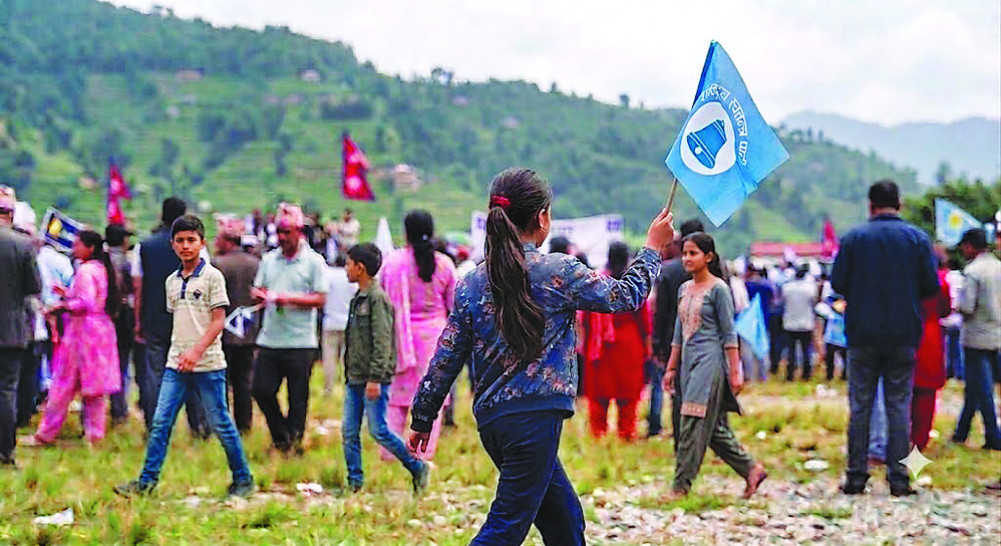
Article 39 of the Constitution prohibits any form of exploitation or improper use of children.
We use Google Cloud Translation Services. Google requires we provide the following disclaimer relating to use of this service:
This service may contain translations powered by Google. Google disclaims all warranties related to the translations, expressed or implied, including any warranties of accuracy, reliability, and any implied warranties of merchantability, fitness for a particular purpose, and noninfringement.
Political parties, parliamentarians and human rights activists have objected to the fact that the National Independent Party, which is leading the government to implement the law, has made children under the age of 18 party members, contrary to the country's laws and international conventions. The organizational report presented by outgoing General Secretary of the Rashtriya Swatantra Party (RSWP) Kabindra Burlakoti on June 21 during the closed session of the first general convention, states that more than 35,000 children under the age of 18 are party members.
According to the report submitted by Burlakoti, who informed that the number of party members is 523,465, there are 35,257 members under the age of 18 in the RSWP. The highest number of children is in Bagmati Province, with 13,011, while the lowest number is in Karnali, with 1,414 children. Similarly, the RSVP has made 6,235 children under the age of 18 members in Koshi, 3,030 in Madhesh, 5,116 in Gandaki, 3,648 in Lumbini, and 2,813 in Sudurpaschim.
Former Executive Director of the National Council for Child Rights Milan Dharel said that the RSVP has acted against the law by making children members. 'Our law prohibits giving party membership to children. In that sense, this is violence against children under Section 64 (2) of the Children's Act. The law on political parties has also prohibited this, so this act was against the law,' Dharel said, 'What the RSVP or political parties of Nepal need to understand is that children have the right to political participation. There are various ways to exercise that right.
Political parties can talk about communicating their ideas, principles, modalities and contemporary state system and being accountable to children, but it is not possible to make membership, that is legally wrong.’ 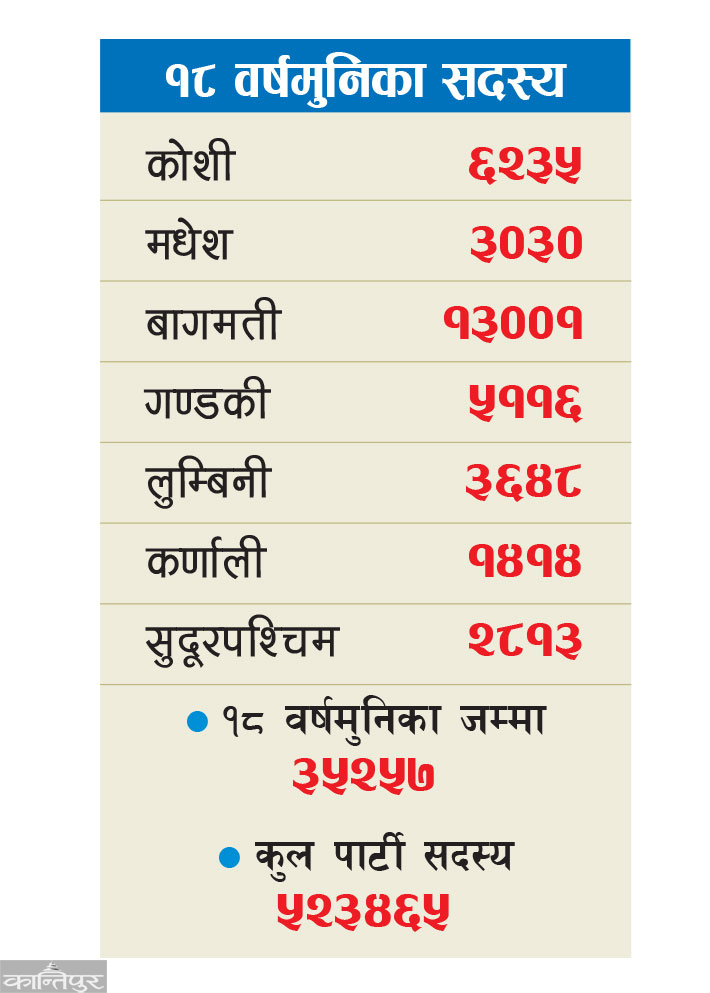
The Constitution of Nepal has made provisions on the rights of children. Article 39 of the Constitution stipulates that children should not be exploited or used in any way. This has also been explained in the Children's Act and various election-related acts.
The Children's Act 2075 has defined how old a person is a child. The definition section of this act states, ‘A child should be understood as a person who has not completed 18 years of age.’ The Children's Act itself has made provisions that children should not be used for political purposes. Section 7 (7) of this act states, ‘No child shall be recruited into the army, police or armed group and shall not be used directly or indirectly for armed conflict or political purposes.’
A fine of up to 50,000 rupees or imprisonment for up to one year or both is provided for such an act. ‘Any person who commits any act contrary to this Act or the rules made under this Act shall be liable to a fine of up to fifty thousand rupees or imprisonment for up to one year or both, depending on the severity of the offense,’ the Act states.
The Political Parties Act has set the provisions on who can become a party member. The first number of the qualifications for party members is that children cannot/will not be allowed to become members of any party. Section 14 of the Political Parties Act states in the first number of the criteria that must be met by persons eligible to become party members, ‘have completed 18 years of age.’
The Voters’ List Act also provides that only after completing 18 years of age can a person be registered in the voter list for election purposes. This Act states that a person must have completed 18 years of age to be a voter in local level, provincial and House of Representatives elections in Nepal. However, the Rashtriya Swayamsevak Sangh (RSS) party, which is running a single-party government by winning almost two-thirds of the seats in the country's largest House of Representatives, had presented the report at the party's largest structure, which has more than 35,000 children as its members.
The 'Children's Peace Area National Campaign (CJAP)' has expressed its opposition to the issue of the RSS party granting membership to children. 'Although informing children about democratic values, the constitution and civic education is a positive practice, making them formal members of political parties is considered to be against the existing law, the principles of child rights and the best interests of children,' the CJAP statement said. 'We request the Election Commission, the National Human Rights Commission, the National Child Rights Council and the concerned bodies to conduct a necessary investigation into this matter and take necessary steps in accordance with the prevailing law.' The CJAP has also urged that children be free from political use and their rights be ensured.
The United Nations Convention on the Rights of the Child (CRC), to which Nepal is a party, also states that the state and stakeholders have a responsibility to protect children from political interests and abuse and to prevent them from being involved in political activities.
Former Executive Director of the National Council for Child Rights Milan Dharel says that the party membership given to children by the Rashtriya Swayamsevak Sangh (RSS) should be revoked immediately. ‘The membership of children should be revoked in line with political accountability,’ Dharel said, ‘The Election Commission can ask the RSS to clarify this matter, basing it on the provisions of the Political Parties Act. The Human Rights Commission, the National Council for Child Rights and the Ministry of Women and Children can take suo motu cognizance of this matter and bring the concerned party to judicial process.’
Election Commission spokesperson Narayan Prasad Bhattarai said that he heard from the public media that the RSS had submitted a report in the closed session of the general convention stating that the RSS had made children members. He said, "No complaint has been filed with the Election Commission regarding this. If a complaint is filed, the commission will investigate."
The Congress has objected to the RSVP violating the constitution and law by making children members. In the House of Representatives meeting on Sunday, Congress MP Renuka Kaucha wished the central members and office bearers elected by the RSVP general convention a successful term, but objected to the issue of giving party membership to children under the age of 18 mentioned in the organizational report of the then General Secretary Kabindra Burlakoti presented in the closed session of the general convention.
"Looking at the list of those who have taken membership of the RSVP, there are 35,257 members under the age of 18. I would like to inform you that the attention of the Congress has been drawn to this issue that was officially announced. According to the Constitution of Nepal and the Political Parties Act 2073, children under the age of 18 cannot be made members of political parties," said MP Kaucha on behalf of the party. "In the case of the ruling party, the RSVP, will the provisions made in the constitution and this act not be applicable?" Or is the RSVP above the constitution and will it be the same even if it does not follow the constitution?’
Congress MP Kaucha raised questions about the party, which is preparing to ban students from forming organizations, giving membership to children against the law. ‘A government that wants to abolish various student organizations, including the Self-Union University, saying that students should not engage in politics, can children be included in the membership queue of its party? Can young children be allowed to carry the party’s bag or not?’ she said.
The then general secretary of the RSVP and chief whip of the parliamentary party, Kavindra Burlakoti, said that if a person under the age of 18 has applied for party membership and it is approved, he will be removed from the membership immediately. "If Gen-G was involved in the movement, they may have applied to be politically active. Even if those under the age of 18 have applied, we will not accept them," he said. "You have to wait for how many years, wait, show goodwill and support, but you cannot become a member. We have said that if you are made a member, the party will face questions."
However, in the report presented at the general convention, when the date of birth was given, the date of birth was written in the place where the Vikram Sambat should be written, and Burlakoti argued that children under the age of 18 were not made party members.