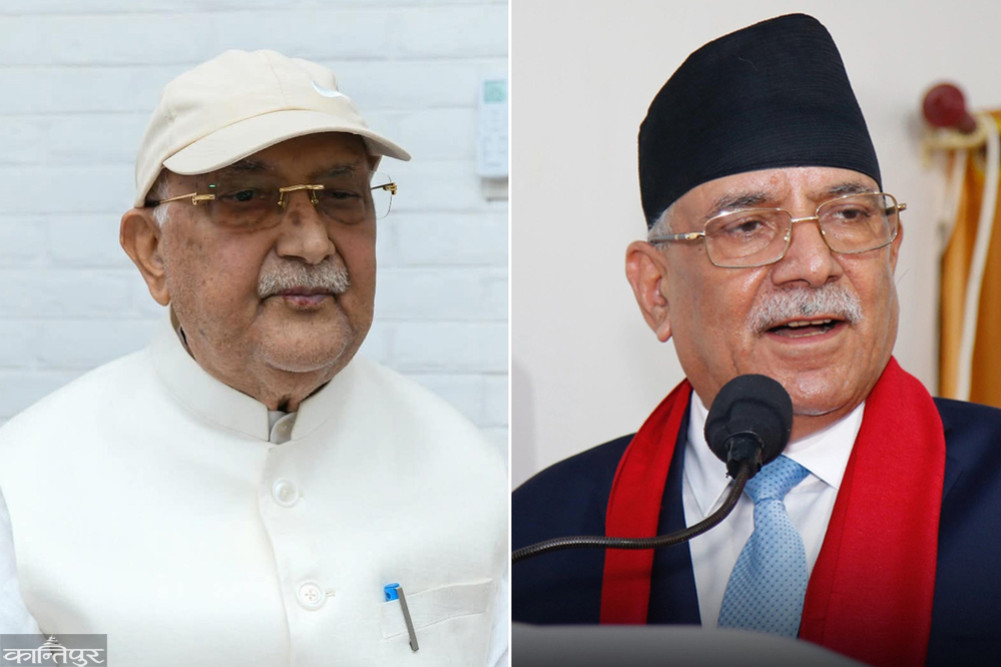
Forgetting their past 'egos', the two leaders have moved forward on the path of left-wing collaboration, formulating a strategy to pressure the government from Parliament and the streets. And, on the occasion of Madan Bhandari's birth anniversary on Asad 14, they are also speaking from the same platform.
We use Google Cloud Translation Services. Google requires we provide the following disclaimer relating to use of this service:
This service may contain translations powered by Google. Google disclaims all warranties related to the translations, expressed or implied, including any warranties of accuracy, reliability, and any implied warranties of merchantability, fitness for a particular purpose, and noninfringement.
UML Chairman KP Sharma Oli and NCP Coordinator Pushpa Kamal Dahal have started getting closer for future collaboration. The two leaders have been holding talks on this issue recently.
At a program organized in Biratnagar on Friday, Dahal said that the process of reunification and collaboration among communist forces in the country is moving forward. He also claimed that there will be collaboration with UML in the parliament, streets and local levels.
At the UML central office-bearers' meeting held last week, Oli had raised the need for collaboration with parties including the NCP. He spoke about the relevance of left unity, citing the government's move against UML and the arrest of Vice-President Bishnu Poudel in the name of investigation.
‘KP Oli is in favor of cooperating with the NCP and other parties without prejudice,’ said a UML leader. ‘For that, cooperation has already begun between the NCP and the opposition parties in parliament.’
With the weak public opinion in the Falgun House of Representatives elections, Oli and Dahal have forgotten their past ‘egos’ and are in a state of mind to cooperate. The NCP has already formally decided to cooperate with the left, while the UML is discussing this proposal in the upcoming central committee meeting.
UML has 25 seats in the House of Representatives and the NCP has 17. Leaders say that Oli and Dahal understand that if the two parties cooperate, they can put pressure on the government from the parliament and the streets. The two parties are united against the government’s decisions including the displacement of squatters and the abolition of trade unions.
In a few days, Oli and Dahal will even be seen on the same stage. On the occasion of the 75th birth anniversary of former UML General Secretary Madan Bhandari on Asad 14, both leaders will speak about ‘Left unity or cooperation’ at a symposium on ‘Nepali Communist Movement and Madan Bhandari’.
Former President Bidya Bhandari will be the chief guest at the symposium. Who is trying to return to active politics again. Oli and Dahal were not seen on the same stage after the Gen-G movement.
Leaders have said that UML and NCP will form an alliance in the provincial government, cooperate on issues such as nationality, and protect the constitution. UML Deputy General Secretary Lekhraj Bhatta said that discussions are underway between the two top leaders about joining the provincial government together. ‘KP Oli and Prachanda are discussing raising their voices in parliament against nationalism, government misdeeds, and joining the provincial government together,’ he said, ‘Despite activities that weaken the constitution, UML and NCP stand together.’
Collaboration between Oli and Dahal began in 2074. In the elections held after the collaboration, they received about two-thirds of the public vote. But due to leadership clashes, the alliance between the two leaders lasted only 2 years and 10 months. Even after the 2079 elections, UML and Maoists were together, but that collaboration also ended within 2 months.
Analysts say that Oli and Dahal get closer whenever a political crisis arises. Political science professor Krishna Pokharel says, ‘Oli and Dahal get together when they are in trouble.’ There is a history of separation after gaining power,' he said, 'It seems that there has been some difficulty after the election. That is why there may have been a matter of cooperation.'
CPN leader Devendra Poudele says that cooperation between the two parties is necessary for the local and provincial elections to be held next year.
'Even now, there is no other solution if the leftist parties do not unite. There seems to be a consensus among local level leaders and cadres that the leftist parties must unite,' he said, 'Now it is not possible to keep the previous ego. We must unite after introspection.' Both parties are also discussing this.'
Dialogue is also taking place between the second-tier leaders of both parties. Leaders say that discussions are also underway between UML General Secretary Shankar Pokharel, Vice President Prithvisubba Gurung, Deputy General Secretary Lekhraj Bhatta and CPN leaders Narayan Kaji Shrestha and Barshaman Pun.
Despite the unity between the Maoists and the Unified Socialists in October, the organization is not being adjusted. The NCP is preparing to collaborate with the left after the organization adjustment. Central member Govinda Acharya said, ‘Left-wing collaboration will start after the party is restructured. The party has already decided.’
Oli and Dahal, who have been weakened by the election results, are in favor of forming a common position on the issues of nationality and constitutional amendment as the ‘constitution-making’ leaders.
Oli and Dahal had differences over the Gen-G movement. After the movement, former Chief Justice Sushila Karki was not in favor of Oli going to the elections announced by the government, but Dahal had openly supported the elections. After the election results, Oli and Dahal are in favor of amending the constitution based on the original spirit of the constitution. Dahal supported the Gen-G movement, while Oli has been accusing it of being a ‘serious conspiracy’.
The NCP has concluded that the division of the left-wing vote was one of the main reasons for losing the election. In the review report of the 2002 House of Representatives election, the coordination committee meeting held in Chait had mentioned the lack of unity of the left-wing parties as one of the reasons for losing the election. The report says, ‘The proportional votes received by the 9 communist parties that contested the election alone are more than 4 million. If the left forces had been united, they could have attracted even more votes.’
On 3 Jestha 2075, the two parties formed the Nepal Communist Party. Oli and Dahal became the presidents. Although Oli became the Prime Minister of a strong government, he was not able to run the government for the full term due to the power struggle between the two leaders. An understanding was reached that Oli would run the government and Dahal would run the party. As the conflict between the two leaders was escalating, the left public opinion was divided after the Supreme Court, while hearing a petition regarding the name of the NCP, separated the UML and the Maoists on 23 Falgun 2077.
Even before the Supreme Court's decision legally revived the former parties UML and Maoists, these two groups had already separated politically and practically after the dissolution of the House of Representatives in Poush 2077 due to intense internal disputes within the party. After Oli fell into a minority in the party secretariat, he dissolved the parliament, but the Supreme Court overturned it. After falling into a minority, Oli had recommended to the then President Bidya Bhandari to go for the mid-term elections. After that, a front was formed between the Congress, Maoists, and the Madhav Nepal group.
In the 2079 election, the UML was the second party and the Maoists were the third. After these parties became even weaker in the 2082 election, discussions are underway again about cooperation and unity.