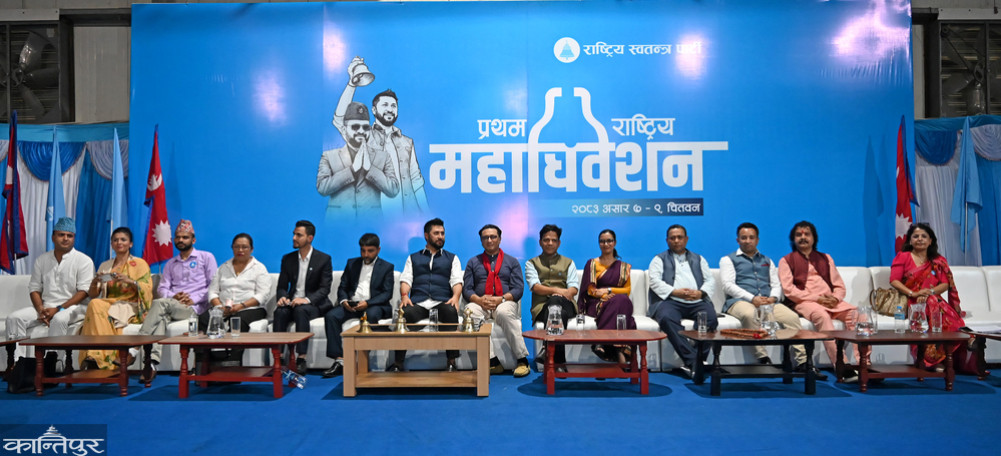
The Rashtriya Swayamsevak Sangh (RSS) has clarified that it is a pluralistic democratic party that believes in a liberal economy with social justice and is committed to the equitable progress of Nepalis.
We use Google Cloud Translation Services. Google requires we provide the following disclaimer relating to use of this service:
This service may contain translations powered by Google. Google disclaims all warranties related to the translations, expressed or implied, including any warranties of accuracy, reliability, and any implied warranties of merchantability, fitness for a particular purpose, and noninfringement.
The National Independent Party, which is in government with a near two-thirds majority, has adopted the main policy of building a welfare state with a liberal economy. The RSP has clarified that it is a pluralistic democratic party that believes in a liberal economy with social justice, committed to the equitable progress of the Nepalis.
The economic and political document presented by party leader and Finance Minister Swarnim Wagle at the first general convention of the RSP in Chitwan states that the goal is to build an equitable and inclusive society through accountable good governance based on the law within a fully democratic republican governance system that guarantees individual freedom and fundamental rights. The RSP has a policy of creating a clean and strong regulatory structure for the development of an enterprise-friendly, investment-friendly and competitive social market economy by sustainably mobilizing public, private and community resources to ensure a welfare state.
RSP President Ravi Lamichhane has said that the party's core political principle will be 'social democracy'. In the political report presented at the closed session of the general convention on Tuesday, President Lamichhane said that he has come to the conclusion that it is not appropriate to adopt the constitution as a 'theme' or principle. Lamichhane said that the RSP is not a traditional 'leftist' or 'rightist' and is not deliberately limited to that political polarization. 'We give priority to a practical, sensible, need-based and reality-based approach, not to any rigid ideological framework,' he said. He also said that he will respect the historical contribution, experience and positive practices given to human society by old ideological frameworks, but will weigh them against practical utility and social justice.
'Some people may consider us right-wing in terms of encouraging the private sector, investment-friendly environment and competition. "We will show the left that the state should ensure basic health care and education for all citizens," Lamichhane added. "The left will show us the labor rights, minimum wage and social security guarantees that the state has not shown us by encouraging startups, private enterprise and market freedom."
He also said that they believe that the state, society and economy should be moved forward from a mixed, balanced and situation-friendly perspective, not from a single ideological framework. He also mentioned that they have concluded that they will adopt 'social democracy' as the party's core political principle based on the analysis of the stability and consolidation of the achievements achieved so far, the current economic and social situation of Nepal and the basic character of the state that the citizens expect. Lamichhane also said that the RSVP's philosophy to ensure social justice through social democracy is based on five main pillars. According to him, the five pillars are a competitive liberal economy, the rule of law, a people-responsive government, a welfare state and an equitable and inclusive society.
The Rashtriya Swayamsevak Sangh (RSS) has made it clear that it is in favor of a democratic republican system of governance and that it does not consider any alternative to it. Stating that the democratic republican system of governance is intertwined with both Nepal's original political experience and the historical development of world politics, the RSS has emphasized its strengthening. In addition, the agenda for debate has made the restructuring of federalism with the abolition of provinces, party-free local levels and reducing the number of local levels by one-third.
In the preamble, the RSS has stated that the RSS is a pluralist democratic party that believes in a liberal economy. The RSS has positioned itself in favor of accountable good governance based on the law within a complete democratic republican system of governance with guarantees of individual freedom and fundamental rights. It has also stated that the party's objective is to build an equitable and inclusive society. The RSS has emphasized the amendment or rewriting of the Constitution of Nepal 2072. ‘We will amend the current constitution on the day we reach our numbers and strength,’ Wagle said in the preamble, ‘The RSNP has already submitted for debate the agenda of restructuring federalism, including a directly elected prime minister, a system where MPs do not become ministers, party-less local levels, and the abolition of the provincial assembly.’ Wagle said that the party is committed to an enterprise-friendly, investment-friendly, and competitive social market by sustainably mobilizing public, private, and community resources to ensure a welfare state. The preamble mentions the growth of social capital dedicated to labor, a commitment to climate-environmental balance, and coexistence and mutual respect based on Nepal’s history, ancient civilization, and religious-cultural diversity.
RSNP’s income is 122 million
In the current fiscal year 2082/83, the RSNP has earned an income of 122 million 15 thousand rupees. This was shown in the report submitted by the party’s treasurer Lima Adhikari at the first general convention. The party was established with an income of only Rs 410,000 in the fiscal year 2078/79. According to the report, donations and support accounted for 51.43 percent of the total income in the fiscal year 2082/83, fees received from direct and proportional parliamentary candidates accounted for 26.61 percent, and membership fees accounted for 17.98 percent. The report states that the remaining 2.52 percent was received from lobbyists.