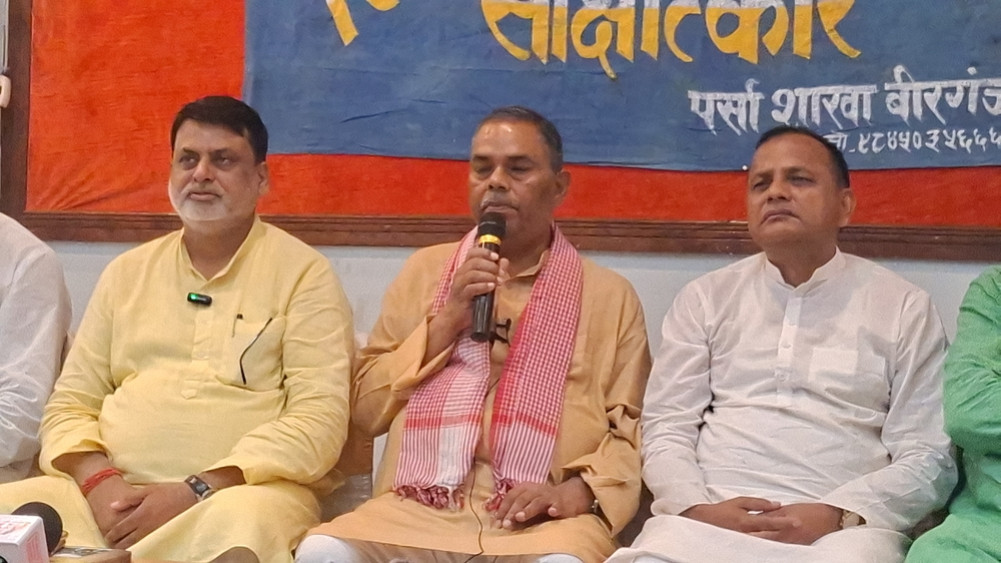
Question from Yadav, who is also a former foreign minister: How did the Prime Minister know something that India did not know and we did not know either?
We use Google Cloud Translation Services. Google requires we provide the following disclaimer relating to use of this service:
This service may contain translations powered by Google. Google disclaims all warranties related to the translations, expressed or implied, including any warranties of accuracy, reliability, and any implied warranties of merchantability, fitness for a particular purpose, and noninfringement.
JSP Nepal Chairman Upendra Yadav has said that Nepal has not encroached on India's border anywhere. In an interview program organized by Reporters Club Parsa in Birgunj on Sunday, Yadav, who is also a former foreign minister, shared his views on the Nepal-India border dispute and said that Nepal has not encroached on India's land anywhere.
'I had the opportunity to hold the Foreign Ministry twice. At that time, India's Foreign Minister Pranab Mukherjee was there,' Yadav said, 'Neither the Indian government nor the Indian Ministry of External Affairs had made any formal claim that Nepal had encroached on Indian land regarding the border dispute.'
Yadav also disagreed with Prime Minister Balendra Shah's statement in the House of Representatives that Nepal had encroached on Indian land. 'Nepal has not encroached on anyone's border, not just India's,' he said.
Yadav commented that it was surprising for the Prime Minister to make such a claim when India has not formally accused Nepal of border encroachment so far. 'How did the Prime Minister know that India did not know and we did not know?' he quipped. If such a claim is made, he said that historical documents, maps and evidence should be made public to confirm it.
In a different context, Yadav said that in the last election, the people gave the JSP Nepal the role of sitting on the streets and struggling for five years and the National Independent Party the responsibility of running the government. He suggested the RSVP to work according to the mandate given by the people. 'The people have a lot of expectations from the current government,' he said, 'The government should work according to the people's wishes.' Claiming that the possibility of a personality from the Madhesi community becoming the Prime Minister has received widespread support from the voters of Madhesh, he said that this support should be addressed through public interest works.
Yadav also opined that a constitutional amendment is necessary for the country's long-term political stability. He said that the country cannot move forward as expected unless the flaws in the current constitution are corrected and a governance system and constitutional structure are built according to the country's needs.