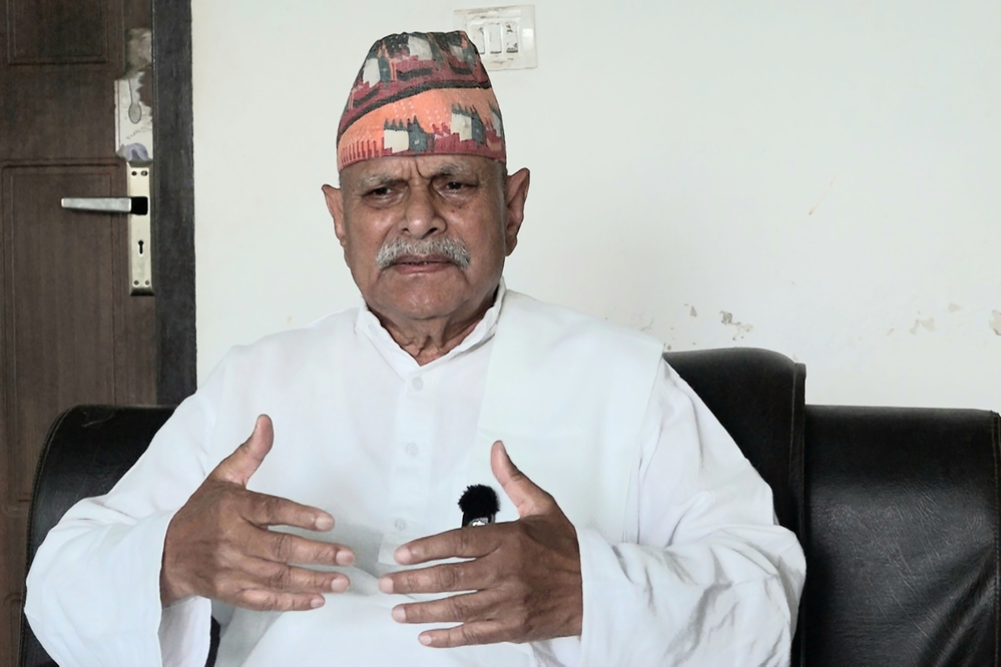
He, who became the first President of Nepal, says - Today we are celebrating the 19th Republic Day. This is the most important day for the Nepali people. A democratic republic is the best system in the world.
We use Google Cloud Translation Services. Google requires we provide the following disclaimer relating to use of this service:
This service may contain translations powered by Google. Google disclaims all warranties related to the translations, expressed or implied, including any warranties of accuracy, reliability, and any implied warranties of merchantability, fitness for a particular purpose, and noninfringement.
After a seven-decade-long struggle by the Nepali people and the strength of the people's movement of 2062/63, Nepal was declared a federal democratic republic in the first meeting of the historic Constituent Assembly held on 15 Jestha 2065. After that, on 6 Shrawan 2065, Dr. Ram Baran Yadav was elected as the first President of the Republic of Nepal. With the declaration of the republic and the establishment of the presidential institution, the federal system of governance was implemented. The federal democratic republican system was institutionalized after the promulgation of the Constitution of Nepal by the Constituent Assembly on 3 Asoj 2072 by the hands of the first President Dr. Yadav. Today, the 19th Republic Day is being celebrated in memory of the day the republic was declared. Presented here is an edited excerpt of a conversation between RSS's Madhav Prasad Ghimire and the first President of the Republic of Nepal, Dr. Yadav, in the context of the 18th anniversary of the republic and the celebration of the 19th republic:
How did you feel after successfully assuming the responsibility of the first President of the Republic of Nepal from the field of struggle to this point?
There was a regression in 2017 against the democracy achieved in 2007 BS. At that time, we started the struggle through the student movement, after the people's movement of 2036, 2046, 2062/63 BS, I got the opportunity to become the first President of the Republic of Nepal on the basis of the changes that took place. May the constitution that exists in the country be institutionalized. May the country improve. I wish that the journey of prosperity of thirty million Nepalis will be successful.
How do you see the need for a republic in Nepal?
The monarchy that existed at that time was repeatedly trampling on the constitution and exercising its arbitrary rule. In 2017, 2059 BS, the essence of the constitution was trampled upon and the ruling power was taken into the hands of the people against their will. As a result, the people did not believe that the monarchy protects the rights of the people and protects democracy. It was said that it repeatedly attacks the rights of the people and does not respect the expectations of the people. That is why the people made sacrifices, protested and struggled to overthrow the monarchy and establish a republic. If we recall the old history of our country, during the Rana period and the Shah period, there was a system of authoritarian rule. You may also know that in those days, those who ruled used to take the rights of the people into their own hands and the people had to struggle for their rights. The struggle of 2007 BS is the result of that, after that struggle, the people established their rights. In 2017, the king took away the rights of the people, and again the people had to struggle for a long time to get back the rights that the king took away. After a 30-year struggle, the people got their rights in 2046, but again in 2059, the king took the step that the people fought together with political parties and established their rights.
It has been almost two decades since the establishment of the republic in the country. What do you think the republic gave to the people and the country?
The republic made the people the masters of the country, the people themselves are the masters of the country. The rights of the people went to the people. There is a republic in the system established by the people. We have made a constitution through two constituent assemblies and dedicated it to the people. We did, according to that constitution, the country has a democratic system, there is a system of federalism, inclusiveness, rule of law, there is a legal system of governance run by the people, with the participation of the people, for the people, there is a system of periodic elections and the people choosing their own representatives, if the people are sovereign, there is a system of governance elected by the people, there is a theoretical basis of democracy, there is a House of Representatives elected by the people, the representatives of the people form the government, the government runs the country's system according to the feelings of the people and according to the decisions of the House of Representatives, the government is in the interest of the people, this is the advanced system of the world .
When the constitution was promulgated in 2072 BS, you bowed to the constitution, how did you come up with the idea of bowing to the constitution at that time ?
When I was promulgating the constitution, the gesture that I was giving to the people from the temple of democracy in front of the people by signing it was extremely important . Because it was a constitution made by the Constituent Assembly, there was participation of political parties, and it was my responsibility and obligation to present it to the people according to the constitutional system . At that time, my feelings told me that thousands of people have sacrificed in such a long struggle, that the Nepali people have struggled so much for their political rights, economic rights, and social justice, and that the achievement of the constitution, which was formed by the two Constituent Assemblies, gave me the responsibility to dedicate it to the 30 million Nepali people and the motherland. Embracing that feeling, I bowed down to the Constituent Assembly, the temple of democracy, and dedicated the country's basic law to the people. That was my duty. The main contribution is from the Nepali Congress, UML and Maoists, but still an environment of trust could not be created among the people. The parties that formed the government in the meantime could not win the trust of the people. The democratic system was moving forward after the elections, but the purity of governance and administration, which is the basis for gaining the trust of the people, decreased. Due to this, the youth saw a change in time, weakness in good governance, transparency, and raised their voices against corruption. In today's digital world, the influence of social media is increasing, the young generation is getting used to it, but it could not create an employment environment for the young generation, the youth started leaving, problems arose in business, they raised their voices for ensuring a working environment in the country, and an environment where they could live peacefully in the family was not created. These various reasons created anger especially among the young generation. That anger led to a movement. This also shows that if the ruling power does not understand the feelings of the people, such movements and upheavals continue to occur intermittently. The people seek their rights, if the government does not understand, there is a demand for change .
The republic was achieved through the great struggle and sacrifice of the Nepali people. What should the government and political parties do now to further strengthen it ?
Today we are celebrating the 19th Republic Day, this is the most important day for the Nepali people, a democratic republic is the best system in the world . The President, the legislature, the executive, and the judiciary are important parts of democracy, the governance and administration of these subordinate bodies must be efficient, all these things must be implemented to create a civilized democratic system . In a democratic system, all these four institutions are respected institutions, and they must operate in a tradition of respecting each other . In a republic, constitutional officials must remain within each other's boundaries . They must follow the law, the law, and established traditions . Conscious Nepalis have given responsibility to the National Independent Party, now it must take other parties into confidence and institutionalize the republic and democratic system and organize the governance system .
Finally, would you like to say something to the countrymen?
As a senior citizen like me who has contributed to democracy for fifty years, I wish you the best of luck. Now that the government has been formed through elections, this government will also institutionalize the democratic republic. In the past, the voice for change was raised because the government was not run according to the people's feelings. In a multi-party system, the people's decisions are paramount. If the parties in parliament fail to improve their working style and institutionalize democracy, another movement may occur. My wish is that the Nepali people do not have to hold another movement for democracy. I would like to remember the contribution of martyrs Shukraraj Shastri, Gangalal Shrestha, Dharmamakta Mathema and Dasharath Chand who contributed in 1997 and pay tribute to them. After that, I would like to pay tribute to those who sacrificed their lives during the movements of 2007, 2017, 2036, 2046, 2062/63 and the recent Genji movement.