The task force plans to draft a debate paper by incorporating the people's suggestions, then finalize it by taking the suggestions of the parties and submitting it to the Prime Minister.
We use Google Cloud Translation Services. Google requires we provide the following disclaimer relating to use of this service:
This service may contain translations powered by Google. Google disclaims all warranties related to the translations, expressed or implied, including any warranties of accuracy, reliability, and any implied warranties of merchantability, fitness for a particular purpose, and noninfringement.
The task force formed to prepare a discussion paper on the constitutional amendment has prepared 54 proposals in eight points for discussion. The proposals include issues ranging from granting voting rights to Nepalis living abroad, reappointing judges of all levels of courts to establishing a directly elected executive president.
The proposal prepared by the task force includes 7 proposals under the heading of form of governance, 8 on the electoral system, 2 on federalism, 8 on provinces, 3 on local levels, 11 on the judiciary, 6 on constitutional bodies, and 9 proposals under various other topics. Asim Shah, coordinator of the 'Constitutional Amendment Discussion Paper Preparation Task Force 2082', said that the topics have been set as the basis for discussions for preparing a discussion paper on the constitutional amendment.
He, who is also an advisor to the Prime Minister, said, 'We are also holding discussions based on these and other similar topics.' The task force has already held discussions with political parties, former judges, former attorneys general, senior advocates, constitutional law experts, former chief secretaries and administrators, and media persons to identify issues for constitutional amendment. A group of Gen-G activists boycotted the discussion, while some Gen-G members participated in the discussion and made suggestions.
Shah, the coordinator of the task force, informed that work is underway to prepare a discussion paper within 100 days. The task force was formed on 16 Chaitra. ‘We are in the middle of discussions to prepare a discussion paper,’ Shah said, ‘We are yet to take suggestions from some stakeholder groups, including the former Prime Minister.’ There is also an agenda to discuss with former presidents.
According to Shah, after taking suggestions from a round of discussions, the task force will prepare a draft of the discussion paper, including suggestions from the general public. After that, the plan is to take suggestions from the parties again and finalize the discussion paper and submit it to the Prime Minister. The task force has also requested political parties to provide their suggestions for constitutional amendment in writing. The task force also includes representation from major political parties.
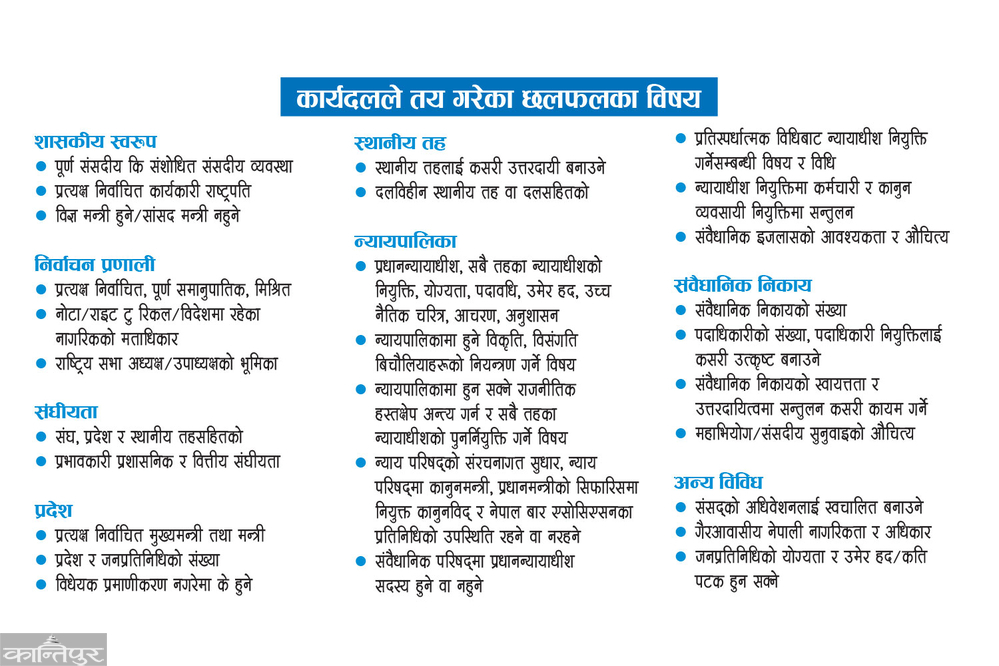 The first point of discussion prepared by the task force is about the form of government. Under which, discussions are being held on issues such as whether it is right now, making it fully parliamentary, or moving towards a revised parliamentary system. There is also mention of a directly elected executive president, the system of having expert ministers/not having MPs as ministers, the formation of the Council of Ministers, and the accountability of ministers. Under the current constitution, there is a system for the parliament to elect the prime minister and MPs to become ministers. Non-MPs can only be made ministers for 6 months.
The second point is the electoral system. This includes issues such as making it directly elected, fully proportional, mixed, more democratic and inclusive, NOTA/right to recall/voting rights of citizens living abroad. Currently, a direct and proportional electoral system, i.e. a mixed electoral system, has been adopted in the elections to the House of Representatives. The constitution provides for 275 MPs to be elected directly and 110 through proportional representation.
Currently, there is no provision for Nepalis living abroad to vote. But the Supreme Court has already ruled to give them the right to vote. Based on that ruling, the task force is seeking suggestions on this. Similarly, there is mention of reform of the legislature, the role of the National Assembly Speaker, Vice-Chairman, and how to organize the coalition culture in elections. Some have been saying that the Vice President does not have much of a role, and that the role of the National Assembly Speaker should be given.
The 100-point agenda on governance reforms brought by the first cabinet meeting led by Prime Minister Shah mentioned preparing a constitutional amendment debate paper. The third point contains a proposal on federalism, which mentions how to make administrative and financial federalism including the union, provinces, and local levels effective. The fourth point contains a proposal related to provinces. It includes issues such as making the directly elected Chief Minister and Ministers, ministries, and structures more efficient, the number of provinces and people's representatives, the number of provinces, the structure in the provinces/provincial chief/how to do his work from within the provinces in his absence, and what will happen if the bill is not certified.
The fifth point contains issues related to local levels. Proposals such as how to make the local level accountable, reform of the local level and the judicial committee with a non-party system or a party system have been put forward under this point. The current constitution has a provision for political parties to compete in local level elections.
The sixth point is about the judiciary. It includes issues ranging from the reappointment of judges at all levels to the control of middlemen. The reforms to be made to create an independent, impartial and competent judiciary, the appointment of the Chief Justice, Supreme Court, High and District Court judges, their qualifications, tenure, age limit, high moral character, conduct, discipline or similar issues, and the distortions and anomalies of the judiciary raised by various reports formed by the court itself, and the control of middlemen.
Under the structural reform of the Judicial Council, the issue of the presence or absence of the Minister of Law, a legal expert appointed on the recommendation of the Prime Minister and a representative of the Nepal Bar Association in the Judicial Council is mentioned. Similarly, the issue of whether or not the Chief Justice will be a member of the Constitutional Council, the issue and method related to appointing judges through a competitive process, the development of the professional skills of the Nepal Judicial Service officers in the appointment of judges, and maintaining a balance in the appointment of legal practitioners have also been put forward.
Discussions are being held on the issue of the need and justification of the Constitutional Bench and the issue of increasing the powers of the High Court to reduce the case load in the Supreme Court. There is no provision for the reappointment of judges in the current constitution. There is a provision for the Prime Minister to be the chairman of the Constitutional Council. There is a provision for the Law Minister to also be a member of the council when recommending the Chief Justice. There is a provision for the Law Minister to also be a member of the Judicial Council, which will be chaired by the Chief Justice. The Nepal Bar Association has been demanding amendments with the argument that political interference in the judiciary has occurred due to the structure of the Constitutional Council and the Judicial Council.
The seventh point is related to constitutional bodies. It mentions the number of constitutional bodies, the number of office bearers, how to make the appointment of office bearers optimal, how to maintain a balance between the autonomy and accountability of constitutional bodies, the justification of impeachment/parliamentary hearings, recommendations and implementation of reports.
In the eighth point, ‘Other miscellaneous matters’, it has been sought to discuss the issues of automating the parliamentary session, non-resident Nepali citizenship and its rights, the qualifications and age limit of people’s representatives/how many times it can be held, the progressive implementation of the Directive Principles of Policy of Article 54 of the Constitution, and the reform of the federal management method of Article 111 (5). Similarly, the provisions related to pardon, postponement, change or reduction of sentences, provisions related to bill verification, implementation of fundamental rights and removal of the Chief Justice or granting the right to prosecution are also included in it. The task force has stated that other issues related to the experts will also be included.
Task Force Member Secretary Leeladhar Subedi said that these points have been decided so that discussions and suggestions do not go out of the window and concrete suggestions are made. ‘We can give suggestions on issues other than those we have decided,’ he said.
 Request for suggestions from the public
The ‘Task Force to Prepare a Constitutional Amendment Debate Paper’ issued a notice on Friday, requesting people to send suggestions on issues that should be included in the constitutional amendment within a week. The notice states that suggestions can be sent via email and WhatsApp (9856029947). According to Subedi, member-secretary of the task force, suggestions on the constitutional amendment have also been sought from the Supreme Court, Nepal Bar Association and constitutional bodies.
The 100-point agenda on governance reform brought by the first cabinet meeting led by Prime Minister Shah mentioned preparing a constitutional amendment debate paper. Item No. 4 of the agenda stated ‘to form a task force to prepare a constitutional amendment debate paper to build a national consensus on issues related to the country’s long-term political and institutional reforms, electoral system and other issues related to constitutional amendment, and to make the debate process participatory, transparent and fact-based’.
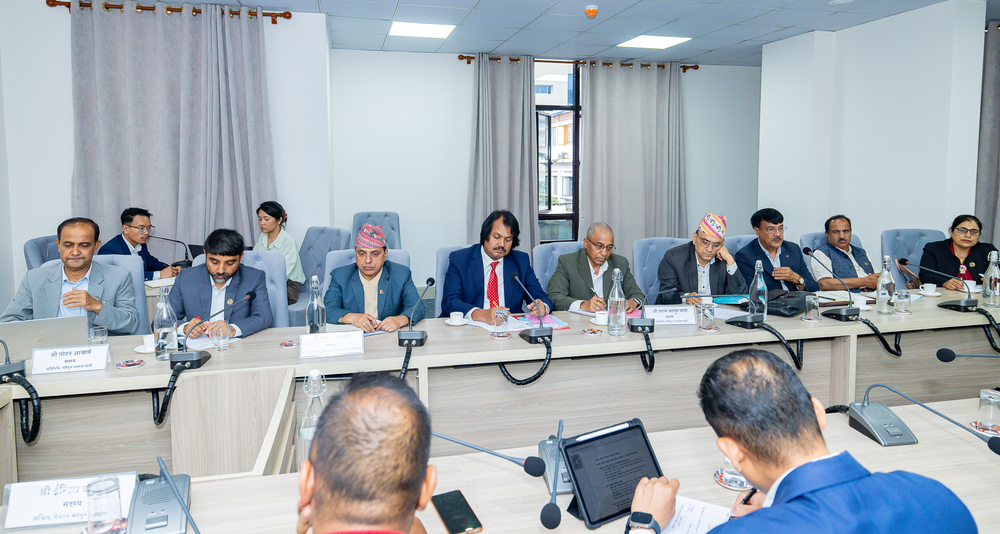
The task force led by Shah includes Mohanlal Acharya from the Rashtriya Swayamsevak Sanghariya, Bhishma Raj Adhikari from the UML, Dev Prasad Gurung from the NCP, Dhruv Raj Rai from the Shram Sanskriti Party, and Gyan Bahadur Shahi from the RPP. The Congress has not sent a representative. Law Secretary Pushkar Sapkota from the Prime Minister's Office and Secretary of the Law Commission Indira Dahal are also members of the task force.
The Congress has formed a separate task force of constitutional experts under the leadership of senior advocate Pushpa Bhusal. The NCP has formed a task force and started discussions. The UML, on the other hand, has not formed such a committee. The task force had discussed with the political parties in two phases and asked them to give their written opinions. Earlier, on 17 Ashad 2081, the Congress and the UML had agreed to amend the constitution while forming an alliance. But the process for that had not been taken forward.

