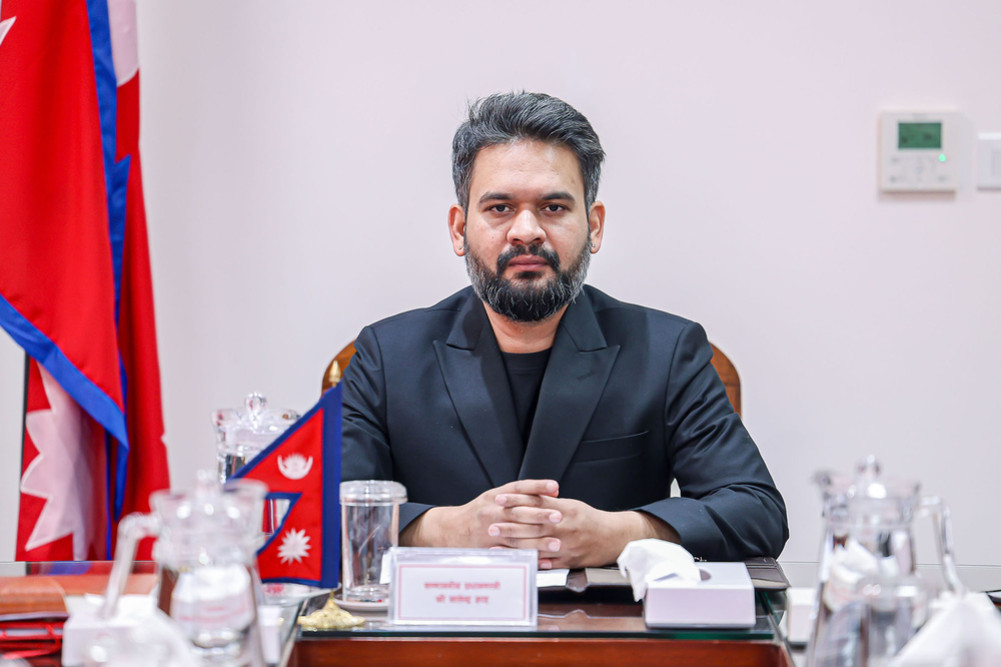
Analysts say that former prime ministers who never tire of speaking include KP Sharma Oli, Pushpa Kamal Dahal, Madhav Kumar Nepal, and Jhalanath Khanal.
We use Google Cloud Translation Services. Google requires we provide the following disclaimer relating to use of this service:
This service may contain translations powered by Google. Google disclaims all warranties related to the translations, expressed or implied, including any warranties of accuracy, reliability, and any implied warranties of merchantability, fitness for a particular purpose, and noninfringement.
The opposition blocked the parliament on 30th Baisakh, demanding that Prime Minister Balendra Shah answer the questions raised on the government's policies and programs presented in the parliament by President Ram Chandra Poudel.
Although it is a tradition that the Prime Minister should answer the questions raised on the government's policies and programs, Shah broke it. While the opposition was protesting in the parliament, Finance Minister Swarnim Wagle answered the questions raised in the parliament on behalf of the Prime Minister. Then on 1st Jestha, the government's policies and programs were passed by the parliament with a majority despite the opposition's protests.
After being elected as the Prime Minister on 13th Chaitra, Shah has addressed a formal program only once. He was seen on the social media network Facebook on 25th Baisakh and 2nd Jestha. On 25th Baisakh, he posted a photo wearing a white shirt and striped pants, and on 2nd Jestha, he posted a photo with products of the government-owned organization DDC. That same week, the opposition was looking for Prime Minister Shah in the parliament.
It has been 54 days since Shah became Prime Minister. In the meantime, on 26 Chaitra, he addressed the convocation ceremony of newly appointed officers of the Nepal Army in Khariparty, Bhaktapur. There, he read a short written speech and urged the officers to be dutiful, disciplined and responsible in serving the nation. In addition, during the 21 Falgun elections to the House of Representatives, he also addressed election meetings organized in Jhapa, Morang, Chitwan, Butwal, Dhangadhi and Surkhet for a total of half an hour.
Although he did not answer the questions raised by the opposition in Parliament, Shah has been answering the questions raised in public in his own style on social media. He has responded to the law banning employee unions and student organizations that the government has repealed through his Facebook page.
On April 22, he said that for years, many organizations have become 'sleeper cells' of parties, more than the interests of students and employees, increasing the value of access than merit, bags and flags than ability, and this has weakened people's trust in the system itself.
'Ban party flags in schools. Ban party bags in the bureaucracy. This does not take away rights, but rather strengthens professional freedom,' he had said, 'Now the basis of appointments, transfers and promotions should not be party affiliation, but method, ability and efficiency. Our only effort is this, when students learn politics, they should learn from a teacher, not from a crowd of leaders. Employees should seek method, not the shadow of a leader.'
He argued that this was not a fight against any party and that he was trying to save the system.
Similarly, after the government used dozers in squatter settlements in areas including Thapathali in Kathmandu and Manohara in Bhaktapur in the second week of Baisakh, it also gave a clarification on social media.
On 11 Baisakh, he gave a clarification that the Nepal government had taken steps in accordance with the law in areas where there was clear evidence of unwanted encroachment on river banks and government-owned land in the Kathmandu Valley.
‘The work of collecting digital data of genuine landless citizens, verifying details and preparing records on a clear basis has been initiated. Arrangements will be made for safe and orderly relocation of citizens living in unsafe places at risk of life,’ Shah said. ‘The Nepal government wants to clarify that all the steps taken are not with the aim of removing citizens, but with the aim of ensuring the right to housing and finding a permanent solution to the problem.’
The government had expressed its full commitment to ensuring safe, dignified and permanent housing for every landless citizen.
Many are praising Prime Minister Balendra Shah for not wasting time in public programs. There are also an equal number of critics for not answering questions raised in the sovereign parliament. The opposition in particular is accusing the Prime Minister of not being accountable to the parliament. The Rashtriya Swayamsevak Sangh (RSS) has refuted this.
RSSS MP and Joint General Secretary Bipin Kumar Acharya said that Finance Minister Swarnim Wagle replied, citing the provision in the House of Representatives Rules 079 that if the Prime Minister is unable to attend the government's policies and programs, the minister designated by him should respond.
'There is a method for the minister designated by him to answer questions raised when the Prime Minister is unable to attend to answer policies and programs. The Finance Minister has answered accordingly,' he said, 'This is more than a disruption of the old tradition.'
What kind of Prime Minister is he in speaking?
If the Prime Minister works with the mandate of the people, it does not matter if he does not speak. He fulfills the commitments made to the people. - Associate Professor of Political Science Devraj Dahal Former Prime Ministers KP Sharma Oli, Pushpa Kamal Dahal, Madhav Kumar Nepal, Jhalanath Khanal were among those who spoke a lot during their tenure. They were criticized for giving many speeches as Prime Ministers but gave little results. As Prime Ministers, they used to give speeches in the Lamala. They used to participate in long question-and-answer sessions in Parliament, and also explained and satirized the government's policies and programs.
Former Prime Ministers Krishna Prasad Bhattarai, Manmohan Adhikari, Girija Prasad Koirala, Manmohan Adhikari, Sushil Koirala and Baburam Bhattarai spoke only as needed. They expressed their views on Parliament, international forums, and issues of national importance. Former Prime Minister Sher Bahadur Deuba was also known as a Prime Minister who spoke little. He would finish his speech in Parliament and forums of national importance for around 10 minutes. Analysts say that the results given by the government are important even if the Prime Minister has his own style of speaking less or more. However, they suggest that it would be appropriate to answer the questions raised in the sovereign Parliament.
Associate Professor of Political Science Devraj Dahal says that there is no need for the Prime Minister to speak much if he can show work. He says that the main question is how much the commitments he has made have been fulfilled. ‘If the Prime Minister works with the ‘mandate’ of the people, it does not matter if he does not speak.’ He said that if the commitments made to the people are fulfilled, ‘if the work is done as per the commitment, then the work itself is speaking.’ However, he says that it would be appropriate for the Prime Minister to answer the questions raised in Parliament.
Another analyst, Sanjeev Humagain, said that the work should be more transparent than the Prime Minister’s speech. ‘It is not an important issue how much the Prime Minister has spoken. What is the government doing? Which ministry is doing what? The common citizen should know about this,’ he said, ‘The decisions, activities and processes taken by the state should be made transparent. Whether or not the complaints of the citizens have been heard? The government should give an answer.’
But he said that the Prime Minister, who is responsible to the Parliament, should answer the issues raised there. ‘We are in a parliamentary system. The minimum principle of the Parliament is that the government should be responsible to the Parliament,’ he said, ‘Since the Prime Minister is elected from the Parliament, he should answer there. The dignity of the Prime Minister does not decrease when he answers in the Parliament.’
He said that in the world’s major democratic countries, there is a tradition for the Prime Minister to answer questions raised in the Parliament.
The Prime Minister of the government before the Gen-G movement, KP Sharma Oli, used to address public programs almost every day. His style was to give long speeches at government and party programs.
After becoming Prime Minister for the first time in Asoj 2072, he not only opposed the Indian blockade, but also repeated speeches such as bringing a high-speed train from China and operating Nepal's own ships. Then in 2074, as the Prime Minister of a government of about two-thirds (UML-Maoist), he put forward the ambitious main slogan 'Prosperous Nepal, Happy Nepali'. At that time, Oli was criticized for 'showing too many dreams, but getting too few results'. The last time, in Asaj 2081, as the Prime Minister of a strong Congress-UML government, he spent a lot of time giving speeches at formal programs.
Oli was Prime Minister from 31 Asaj 2080 to 26 Bhadra 2082, from 3 Falgun 2074 to 30 Baisakh 2078, from 30 Baisakh 2078 to 29 Asaj 2078 and from 25 Asaj 2072 to 19 Shrawan 2073.
NCP coordinator Pushpa Kamal Dahal became Prime Minister 3 times. After being criticized for giving too many speeches in the first and second terms, he announced that he would focus on work rather than speeches in the third term. However, he could not control himself and spent a lot of time on speeches in public events every day.
Dahal was Prime Minister from 10 Paush 2079 to 31 Asar 2081, from 19 Shrawan 073 to 23 Jestha 2074 and from 31 Shrawan 065 to 20 Baisakh 066.
Former Prime Minister Sher Bahadur Deuba, who was Prime Minister for five times, spoke only when absolutely necessary. When he was Prime Minister, he gave very few interviews. He could express his views in parliament and public events for around 10 minutes.
He was the Prime Minister from 24 Jestha 074 to 2 Falgun 2074, from 29 Asar 078 to 10 Magh 079, from 21 Jestha 061 to 19 Magh 061, from 11 Shrawan 2058 to 18 Asoj 059 and from 27 Bhadra 2052 to 29 Falgun 053.
Former Prime Minister and Congress President Girija Prasad Koirala used to make short statements as needed. But, he used to pay close attention to the meaning of every word. He used to make short statements in Parliament, national and international forums. If he had to give a big political message, he would go to Koirala's residence in Biratnagar. There he would make statements of political importance.
He was the Prime Minister from Jestha 048 to Magh 2051, from Ashad 054 to Asho 2055, from Asho 2055 to Asho 2056, from Ashad 19 to Asho 4, 2058 and for the fifth time from 27 Baisakh 063 to 30 Baisakh 065.
Congress leader and former Prime Minister Krishna Prasad Bhattarai used to express his views in a humorous style. He did not give long speeches. He became the Prime Minister of the interim government for the first time after the success of the 2046 Baal Jana Andolan. He was the Prime Minister from Baisakh 047 to Jestha 048 and from Jestha 056 to Chaitra 056.
The then President of the Congress and former Prime Minister Sushil Koirala was the Prime Minister from 28 Magh 070 to 24 Asho 072. He is among the leaders who give short written opinions.
Former UML President Manmohan Adhikari led the communist government for the first time. He led the government from 14 Mangsir 051 to 26 Bhadra 052. He was a Prime Minister who spoke with consideration. He would make statements within the party's policy.
Former Prime Minister Baburam Bhattarai had a policy of emphasizing work over speech. He was the Prime Minister from 12 Bhadra 068 to 30 Falgun 069. Former Prime Minister Jhalanath Khanal was the Prime Minister from 23 Magh 067 to 11 Bhadra 068. However, he also spent his time giving speeches at public programs.
Another former Prime Minister Madhav Kumar Nepal is among the leaders who give long speeches. He was the Prime Minister from 11 Jestha 066 to 22 Magh 067.
After the Gen-G movement of Bhadra 082, former Chief Justice Sushila Karki became the Prime Minister of the electoral government. She was the Prime Minister from 27 Bhadra 082 to 13 Chaitra 082.
Former Chief Justice Khilraj Regmi, who became the Prime Minister for the second Constituent Assembly election, became the Prime Minister from 1 Chaitra 069 to 28 Magh 070. The Prime Ministers of both the electoral governments weighed their positions.