An ordinance is as valid as an act. However, its life is limited. It must be presented in the first session of Parliament after it is convened. If it is rejected by both houses or revoked by the President, it automatically becomes inoperative.
We use Google Cloud Translation Services. Google requires we provide the following disclaimer relating to use of this service:
This service may contain translations powered by Google. Google disclaims all warranties related to the translations, expressed or implied, including any warranties of accuracy, reliability, and any implied warranties of merchantability, fitness for a particular purpose, and noninfringement.
The government's recommendation of ordinances to amend nearly 20 laws by postponing the already called parliament session is currently under discussion and controversy. While the ruling party, the National Independent Party, is calling it a necessary step for reform, the opposition Congress, UML and NCP are opposing it as a direct interference in the parliamentary system. However, this controversy is not new - the tendency to defend ordinances when in government and oppose them when in opposition is deeply rooted in Nepal's parliamentary history. Under what circumstances does the government choose the path of ordinances? Let's understand in five questions:
What is an ordinance and what is its provision in the constitution?
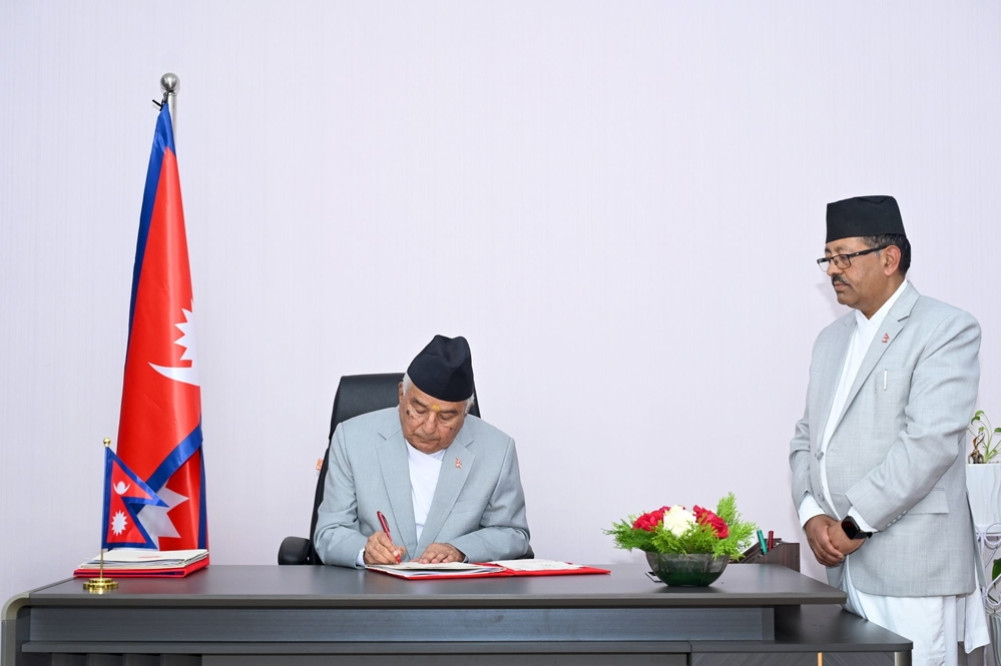
The basic principle of the parliamentary system is that the parliament makes laws, the government implements them and the judiciary reviews them. However, in practice, not all situations can be predicted in advance. In some cases, immediate legal intervention is necessary. Ordinances have been provided for such situations. According to Article 114 of the Constitution of Nepal, if something needs to be done immediately when both houses of the federal parliament are not in session, the President can issue an ordinance on the recommendation of the Council of Ministers.
Such an ordinance is valid as an act. However, its life is limited. It must be presented in the first meeting after the parliament convenes. If both houses reject it or the president rejects it, it automatically becomes inoperative. In simple terms, an ordinance is not a permanent law, but only a temporary measure.
What is the history of ordinances in Nepal?
Looking at past practices, it seems that the use of ordinances in Nepal has changed over time. Only five ordinances were issued during the tenure of the first elected Prime Minister BP Koirala. According to the study report titled ‘Ordinances in Nepal: System and Practice’ of the Federal Parliament Secretariat, 2079, 23 ordinances were issued in the 10 years from 2048 to 2059. In 2053 and 2056, not a single ordinance was issued.
This shows that there was moderation in the initial parliamentary practice. However, after the dissolution of the House of Representatives in 2059, it seems that the government was run through ordinances increased. 7 ordinances were issued in 2059, 27 in 2060, 33 in 2061, and 79 in 2062. After the promulgation of the interim constitution in 2063, only 39 ordinances were issued until 2072. After the promulgation of the constitution, no ordinances were issued in 2072 and 2073.
However, after the 2074 election, the trend of ordinances increased again. It seems that 31 ordinances were issued during the term of KP Sharma Oli, who was in charge of the second and third consecutive terms as Prime Minister from 2074 Falgun to 2078 Asar. 15 ordinances were issued during the subsequent term of Sher Bahadur Deuba and 3 ordinances were issued during the term of Pushpa Kamal Dahal.
Then, the KP Sharma Oli-led government formed with the support of the Congress brought 5 ordinances. After Sushila Karki became the Prime Minister amidst the political turmoil following the Gen-G movement, the government brought forward some important ordinances. On the recommendation of the Council of Ministers, the President issued ordinances amending the Nepal Special Service (Second Amendment) Ordinance, 2082, the House of Representatives Member Election (First Amendment) Ordinance, 2082, and the Voters' Roll Act, 2073. But the ordinance related to the Constitutional Council recommended at the same time was not approved by the President.
What are the ordinances that the Balendra Shah-led government is going to bring and why are they controversial?
The government has proposed to amend about 20 acts including universities, health sciences institutes, cooperatives, land, public procurement through ordinances through the Council of Ministers. Preparations are underway to amend 16 acts under universities and 7 under health sciences institutes.
The government argues that these ordinances were brought with the aim of making the appointment process transparent, ending party interference in educational institutions, returning the money of cooperative victims and making service delivery effective. However, the opposition has argued that there is no reason to bring the ordinance 'immediately'. They argue that bringing the ordinance by postponing the already called session is against the spirit of the constitution.
Why has the ordinance related to the Constitutional Council become the most complicated issue?
Among the ordinances that the government has tried to bring, the ordinance related to the Constitutional Council has become the most complicated. According to Article 284 of the Constitution of Nepal, the Constitutional Council, which is formed under the chairmanship of the Prime Minister, recommends the appointment of heads and office bearers of constitutional bodies.
According to the current act, a majority of 6 members, i.e. the support of 4, is required for any decision. The government is trying to change that provision and bring a system that allows decisions to be made with fewer members. The background to this is even more interesting - a bill with a similar provision had previously been sent back by the President saying that it would 'weaken the principle of majority'. Last November, the Sushila Karki-led government also tried to introduce the same provision through an ordinance, but the President blocked it.
Currently, both the Prime Minister and the Speaker of the Council are from the National Independent Party. However, the Speaker of the National Assembly, the Leader of the Opposition and the Deputy Speaker are considered to be from the opposition camp. Considering the Chief Justice as neutral, the Prime Minister is in a minority in his proposal. Therefore, this ordinance is seen as an attempt to change the constitutional structure itself.
How does the frequent use of ordinances weaken the parliamentary system?
In a parliamentary system, the executive should be accountable to the legislature. However, this relationship is reversed when governing through ordinances. The executive, which is supposed to implement the law made by the legislature, is trying to make its own law, which is like an examinee making a question paper and writing the answers.
When a law is made through an ordinance, the processes of debate, amendment, committee process, and stakeholder participation in parliament are bypassed. There is a high possibility of errors when a law is made through the decisions of a limited number of people. Moreover, since the ruling party's MPs prefer to remain silent and the opposition MPs limit themselves to formal protests, the parliament itself appears to be inactive.