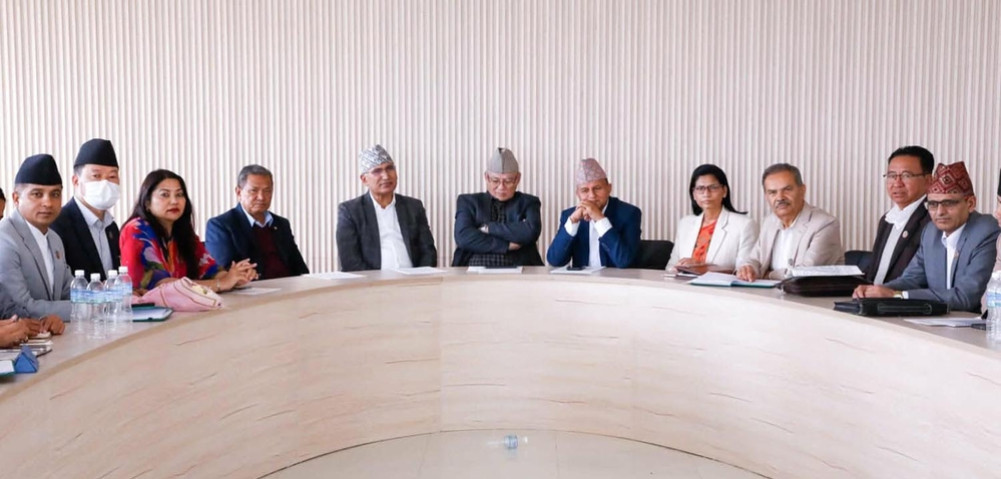
The UML establishment has said that any campaign against the party and leadership while the chairman is in custody will be seriously reviewed.
We use Google Cloud Translation Services. Google requires we provide the following disclaimer relating to use of this service:
This service may contain translations powered by Google. Google disclaims all warranties related to the translations, expressed or implied, including any warranties of accuracy, reliability, and any implied warranties of merchantability, fitness for a particular purpose, and noninfringement.
UML has started informally collecting signatures demanding a special general convention. Leaders of UML's mass organizations, ANNFSU, Youth Association, and Intellectuals' Council have started an informal signature campaign.
The signature campaign demanding a special general convention was launched as part of Chairman KP Sharma Oli's strategy to pressure him to pave the way. The campaign addressed to Chairman Oli has not been registered with the central office.
Article 72 of UML's statute contains a provision regarding a special general convention. If two-thirds of the district committees or a majority of the National General Convention Representative Council demand a special general convention in writing, showing a concrete agenda and reasons, the central committee has a provision to call a general convention within six months of registering the demand.
If a special general convention is not called within six months as demanded by the majority of signatories, there is a provision in the statute that the demanding party can call it itself. ‘If the Central Committee does not organize it, the demanding committee or the National General Convention Representative Council may organize a special general convention by forming a general convention organizing committee,’ the statute states.
Leaders from non-establishment parties have launched a signature campaign by putting pressure on leaders who are in police custody on charges of negligence in the Gen-G movement.
‘I have heard that a spontaneous signature campaign has been started for a special general convention,’ said leader Karna Thapa, ‘this has put pressure on the party to restructure.’
A majority of the general convention delegates must sign to demand a special general convention. A majority of the 2,263 delegates at the 11th general convention will have to demand a special general convention.
Since the establishment party has more general convention delegates than the majority, it is not easy to go to the special general convention. A thousand one hundred and thirty-two people need to sign for the special general convention. There were about 600 general convention representatives from the panel of Ishwor Pokharel, the chairman's competitor in the 11th general convention. A leader who launched the signature campaign claimed that 450 signatures have been received.
The signature campaign addressed to Chairman Oli has demanded a special general convention, saying that it has brought the weakest election results in parliamentary politics since 2048 BS to 2082 BS.
It is mentioned that getting only 9 (5.45 percent) votes out of 165 seats in the direct election and 13.43 (percent) votes in the proportional representation has revealed the people's distrust in the current overall committee system and leadership of the UML.
The demand for a special convention has been made as per Article 73(a) of the UML Statute, 2049 (with amendments of the Second Statute General Convention 2082 and the 11th National General Convention 2082). ‘We, the representatives of the 11th National General Convention, have signed for the protection and welfare of the communist movement and UML and demand a special convention through the Central Committee as soon as possible,’ the letter prepared informally states.
After the party was reduced to a small size in the elections, the leaders who have stood in favor of party reorganization include Vice President Bishnu Poudel, Deputy General Secretary Yogesh Bhattarai, former Vice President Surendra Pandey, leader Karna Thapa, Anand Pakhrel, and others.
Non-establishment leader Anand Pokharel said that even if there is a campaign for party reform by party leaders and cadres, it would be appropriate for the core leadership to accept it. ‘Leaders and cadres are requesting for party and leadership reorganization. Only if the leadership accepts it, it will be finalized,’ he said, ‘The responsibility of reorganizing the party or not is with the core leadership.’
Somewhere, the Oli faction has realized that the establishment will not be done in the old way. The leaders who benefited from Oli have realized that the party will not be built in this way. If there is a serious debate on this, it will be impossible not to address the new voice of leadership reorganization - Jhalak Subedi, political analyst The UML establishment party has said that any campaign against the party and leadership will be seriously reviewed while the chairman is in custody. ‘Unauthorized signatures made when the party chairman is in custody and the party is in crisis have no meaning. There will be a serious review of this,’ said Secretary Bhanubhakta Dhakal, ‘Everyone has the right to talk about party reform. But, should we raise the issue through methods and procedures or from somewhere outside?’
Political analyst Jhalak Subedi said that those within the establishment party feel that it will be difficult to run the party in the old way. ‘Somewhere or other, the Oli party has realized that the old way is not possible.’ The leaders who have benefited from Oli have realized that the party will not be formed in this way,’ he said, ‘If there is a serious debate on this, it will be impossible not to address the new voice of leadership reorganization.’ But he understands that the leaders are afraid that trying to remove Oli at this time will lead to a split in the party.’
‘There is a fear that trying to remove Oli now will lead to a split in the party. It is not possible to say how far the signature campaign for the special general convention will go. However, a debate has begun within the UML on the leadership option,’ he said, ‘If the change is not realized, the UML will go the way of Mohan Bikram (Masal General Secretary). If you want to remove those who disagree, you have to go that way. It seems that Oli's strength will be taken on the path of Mohan Bikram.''
After the 11th general convention in Bhadra, dissatisfaction has been growing in UML. After the ticket distribution, proportional list and a huge defeat in the election held on 21 Falgun, an alternative to Chairman Oli has been sought. Recently, although it is under pressure, a signature campaign has been launched for a special general convention.
While the election results were coming in, Vice Chairman Bishnu Poudel had publicly expressed his commitment to take the initiative to restructure the policy, leadership, organization and working style. 'I express my commitment to take the initiative to seriously review the mistakes and weaknesses made on our part in the past, to transform ourselves according to the people's expectations and to restructure the policy, leadership, organization and working style of UML in accordance with the people's expectations and to continue to serve the people and the nation without wavering,' he said.
Oli did not just object to his statement, but told his close leaders to seek clarification from Poudel if necessary. Poudel has already embarked on a campaign to find an alternative to Oli. A leader said that he had informal discussions with party officials on this matter.
The selection of Vice President Ram Bahadur Thapa as the parliamentary party leader has also highlighted the growing controversy within the UML. Vice President Bishnu Poudel, Vice President Gokarna Bista, and Deputy General Secretary Yogesh Bhattarai were opposed to the selection of Thapa, who has a former Maoist background, as the party leader. Poudel, who had previously been in favor of the establishment, opposed it. The non-establishment faction wanted to make Suhang, son of Constituent Assembly Chairman Subhash Nembang, the party leader's candidate.
Suhang had claimed the party leader position at the central secretariat meeting last Wednesday. However, the party officially proposed Thapa as the party leader. After Suhang expressed his importance, the election process went ahead, but Suhang did not even get proposers and supporters.
In this, Deputy Secretary General Bhattarai had commented, ‘The method and style adopted to select the leader of the UML parliamentary party has further worried the entire party’ and ‘It is not good to put pressure on the MPs instead of reaching a high-level understanding through discussions between the party leadership and the honorable MPs.’
The unauthorized signature made when the party president was in custody and the party was in crisis has no meaning. This will be seriously reviewed. Everyone has the right to speak for party reform. But, should we raise the issue through the method and procedure or from somewhere else? - Bhanubhakta Dhakal, Secretary, UML On Thursday, UML Working President and Parliamentary Party Leader Thapa’s statement in Parliament regarding the election results sparked controversy. He had raised questions about the election results targeting the Nepali Army, bureaucracy and non-governmental organizations.
Vice President Bishnu Poudel had publicly objected to his statement. His objection was that ‘the views expressed by Ram Bahadur Thapa as the party leader of the UML in the meeting of the House of Representatives are against the established policies and beliefs of the party.’
The next day, on Friday, the Central Secretariat meeting held a discussion for about 6 hours regarding Thapa’s statement and Deputy General Secretary Yogesh Bhattarai’s statement on the selection of the party leader.
The meeting stated that serious attention had been drawn to the comments made on the selection of the party leader and stated that it was done through democratic methods.
‘The election of the party leader was conducted through democratic methods in accordance with the party’s statute.’ The election committee has declared the party's vice-chairman and honorable Ram Bahadur Thapa elected unopposed after completing the prescribed process,' said a statement issued by General Secretary Shankar Pokharel. 'This meeting wants to make it clear to everyone that there was no direction, control or interference from the party in the election.'
Similarly, the party leader Thapa's statement in parliament was reviewed and corrected. However, parties outside the establishment had demanded that Thapa 'introspect'. 'Our party's relations with all security agencies of the state, including the Nepal Army, the civil administration (bureaucracy) and the international community have been and remain friendly and such relations will be strengthened further in the future,' the decision said.
However, Thapa had expressed his views on behalf of the party in the first meeting of parliament as directed by Chairman KP Sharma Oli.