The NCP, which was expected to win more than 30 seats directly before the election, was reduced to 9 seats. The party has concluded that there are 11 internal and 6 external reasons for this defeat.
We use Google Cloud Translation Services. Google requires we provide the following disclaimer relating to use of this service:
This service may contain translations powered by Google. Google disclaims all warranties related to the translations, expressed or implied, including any warranties of accuracy, reliability, and any implied warranties of merchantability, fitness for a particular purpose, and noninfringement.
The Nepali Communist Party (NCP) has concluded that there were internal and external reasons behind the unexpected results in the House of Representatives elections held on 21 Falgun. Before the elections, it had claimed that it would bring better results than in the past by bringing together 2 dozen parties and groups, including the Maoists and the Unified Socialists.
The NCP had analyzed that it would get more than 30 lakh votes in direct elections and at least 1.7 million votes in proportional elections before the elections. However, it got 8 lakh votes in direct elections and 8 lakh 11 thousand 577 votes (9 seats) in proportional elections.
NCP leader Prakash Jwala said that the report was prepared to make a program in the coming days by reviewing the election results realistically. 'This review is realistic.' Based on this, we will make a program,' he said, 'Even if the result is not pleasant for us, it is a commitment to move forward with education.'
'During the election, there will be competition between 4 parties. We had estimated that we would get at least more than 30 seats directly and 1.7/1.8 million votes through proportional representation. Congress, UML and Rashtriya Swayamsevak Sangh (RSS) would each get 40-50 seats,' said the report presented by NCP coordinator Dahal at the work coordination committee meeting at the central office on Thursday. 'According to reports from constituencies during the election campaign, it was seen that the party could win up to 60 seats. The results did not come as per our estimates and we could not even get second place in many areas where we said we would win.'
Dahal has cited 11 internal and 6 external reasons for the NCP's defeat. The lack of economic and social transformation after the revolution is mentioned as number 1 among the internal reasons. 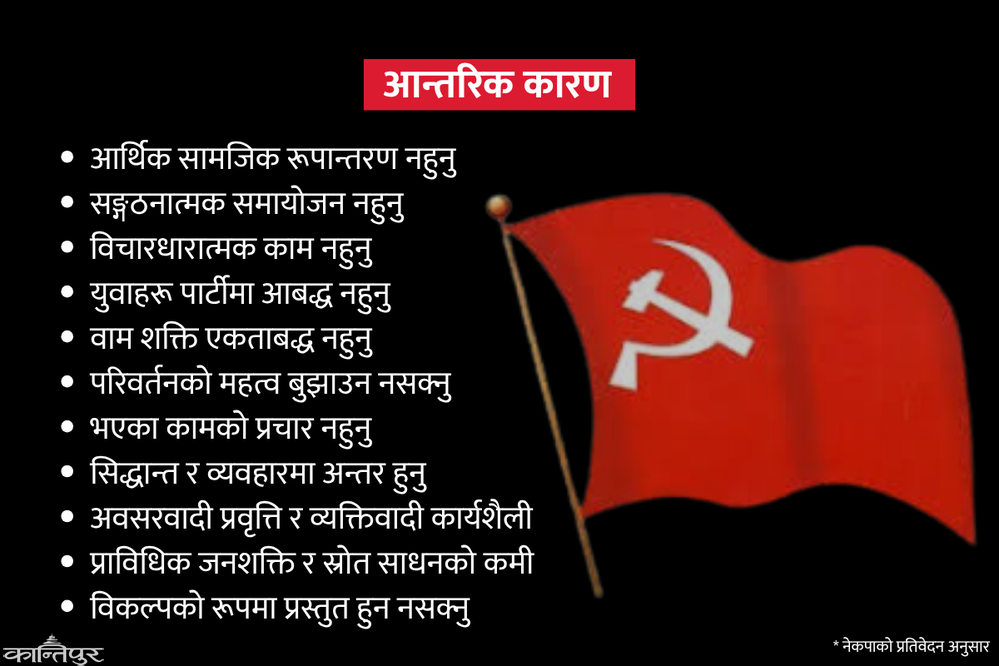
Even though the people gave the communists about a two-thirds majority in the first general election held in 2074 after the promulgation of the constitution, it is mentioned that the government formed at that time failed to launch an economic-social-cultural transformation campaign. ‘Since that government did not work in accordance with the party’s policy and people’s expectations, a fierce dispute arose in the party, which led to the dissolution of party unity and the collapse of the government.’ The report states, ‘The governments formed after the collapse of the KP Oli-led government also did not launch an economic-social-cultural transformation campaign.’
Dahal has argued that although the government led by him has taken forward some work on corruption control and good governance, it has stalled after the coalition government of the two largest parties in parliament, the Congress and the UML, was formed.
‘The people were disappointed after the Congress-UML coalition government, which had formed a coalition government with about two-thirds of the seats, did nothing to control corruption, good governance, service delivery and development,’ the report says. ‘The old parties did nothing about it. Even though the system changed, the situation did not change. The propaganda added fuel to the fire.’ The result was seen in the elections.’
The NCP lacked organizational adjustment and local cadre mobilization in the elections was weak. It is claimed that internal differences among local leadership, factional activities and indiscipline in some areas also affected the elections.
Similarly, the lack of ideological work and the youth not joining the party have been shown as reasons for the defeat. It is mentioned that the NCP achieved poor results due to the lack of unity among the left forces.
‘The lack of unity of the left is also one of the reasons why the communist parties lost the elections,’ says the report. ‘The proportional votes received by the nine communist parties that contested the elections alone are more than 4 million. If the left had been united, even more votes could have been attracted.’
Dahal has admitted that the voters were not pleased with the failure to explain the importance of change to the voters, the lack of publicity for the work done by the left government, and the voters being confused in power-centric politics.’
‘While running the government, there was a lack of good governance in a way that the people could feel and when in the opposition, there was a lack of strong voice on issues of public concern.’ Dahal writes, ‘As a result, the people’s trust in us decreased.’
The opportunistic tendencies and individual working style, lack of technical manpower and resources in the NCP, The failure to present itself as an alternative has been cited as the reason for the election defeat. ‘We were unable to counter the negative propaganda being spread against us. We were unable to present ourselves aggressively,’ the report says. ‘Like the UML and the Congress, we were defensive. We were unable to show ourselves different from the UML and the Congress by breaking the propaganda that all the old ones are the same.’
External reason for the election defeat: Geopolitical and external power centers’ maneuvers 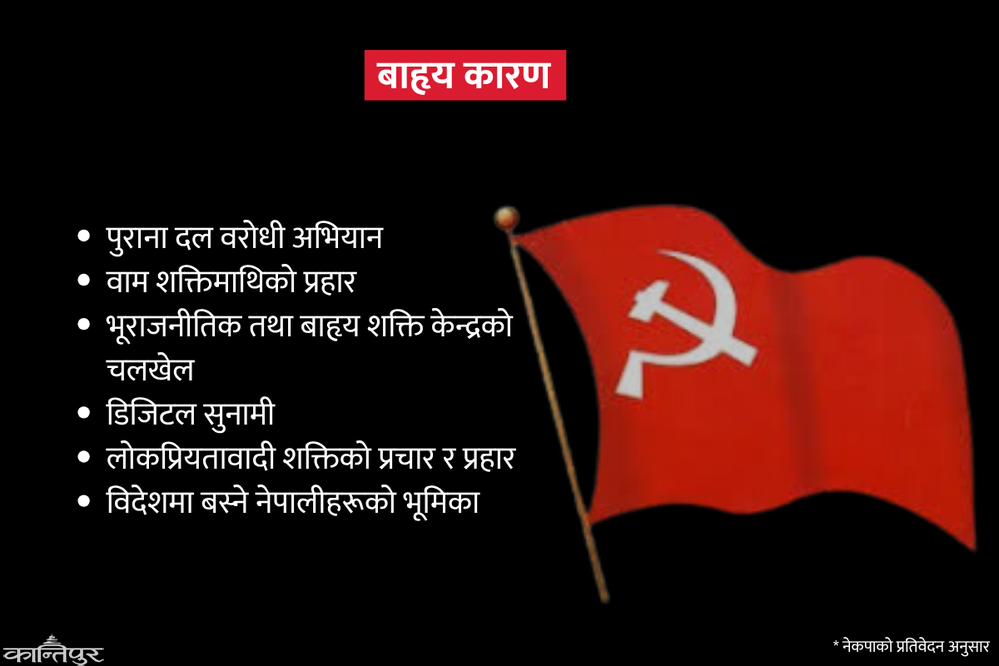
The NCP has claimed that another reason for the election defeat is geopolitical maneuvers. ‘The maneuvers of geopolitical and external power centers have increased in our country. Various power centers have tried to form a government in their favor,’ the NCP report says. ‘For that, organizations operated by external forces and sources were mobilized.’ They attacked and defamed the old political parties here, especially the leftist political parties.’
The NCP has claimed that Western media and digital platforms have influenced the election by negatively influencing opinion polls and voters and strengthening prejudices. It has not mentioned how active each geopolitical force was.
‘The report also mentions that the campaign against the old parties is one of the reasons.’ Similarly, the attack on the leftist forces and the digital tsunami have also been cited as the reason for the NCP’s defeat. ‘Our leaders were defamed by using fake accounts and troll groups to spread targeted propaganda.’ The trending topics on social media are mostly old parties, especially anti-leftists,' says the NCP report, 'When controversial content went viral, the image of the left power became tarnished.'
It has been concluded that the NCP was defeated due to the propaganda and attacks of the populist power, and the role of Nepalis living abroad.
Regarding the election, the NCP has concluded, 'The results of the election held in unusual circumstances have also been unusual.' This has brought the populist power to power and has weakened not only the old big parties, but also the monarchist and identity-based forces.'
The NCP report says, 'This result has shattered the idea that one party cannot bring a majority under the current electoral system.'

