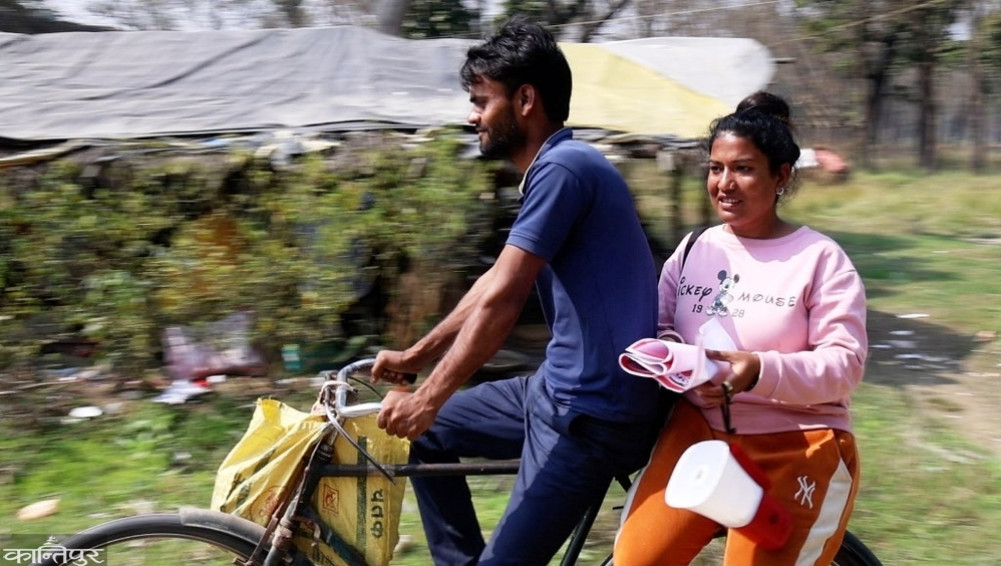
She was a Muslim woman fighter who participated in the armed war waged by the then Maoists. Skilled in using weapons in war, she is now seeking her future through the 'ballot'. She was a platoon commander in the then Maoist army and has become an independent candidate from Kapilvastu-1 in the February 21 election to the House of Representatives.
We use Google Cloud Translation Services. Google requires we provide the following disclaimer relating to use of this service:
This service may contain translations powered by Google. Google disclaims all warranties related to the translations, expressed or implied, including any warranties of accuracy, reliability, and any implied warranties of merchantability, fitness for a particular purpose, and noninfringement.
She carries a black bag with pamphlets in it. She is campaigning in the village and market with a hand microphone in one hand. While the candidates are entering the village with pomp and bustle in the election atmosphere, 33-year-old Kesar Jahan (Sakina Muslim), a resident of a 'squatter' settlement here, is busy campaigning on foot.
She is a former Maoist combatant commander. While other candidates in the district roam around in convoys and motorcades playing songs, she takes a lift from one village to another by asking for a lift from bicycle and motorcycle drivers. Known as Rabina Khan, she used to fire guns and bombs in the armed conflict. Now she is asking for votes with folded hands.
She was a Muslim female combatant who participated in the armed conflict waged by the then Maoists. Skilled in using weapons in the war, she is now looking for a future through the 'ballot'. From being a platoon commander of the then Maoist-affiliated PLA, she has become an independent candidate from Kapilvastu-1 in the February 21 House of Representatives elections.
She was from Mayadevi-3, Badki Khairati, and joined the then Maoist armed struggle at the age of 10 in 2058. A native and a member of a 'well-off' family, she said that she became a 'fighter' after the frequent visits of 'Maoist guerrillas' at home due to her childish restlessness. The same Khan is now campaigning without singing and dancing and without crowds. She is being supported by her old friends from the armed conflict and two or three leaders from the settlement. They take turns taking Rabina around the village on bicycles and motorbikes.
After the Maoists joined the armed struggle, her relationship with her family broke down. She has not been able to go home since then. Her family has not accepted her either. That is why she lives in a squatter settlement near Patna in Banganga Municipality.
She has been spending her days in the house where she took shelter during the Maoist armed struggle. She helps the villagers by farming and working as a wage laborer. Initially, the Nepali Communist Party (NCP) submitted her name to the Election Commission as the first number on the closed list for Muslim women from the proportional representation. After that, congratulations started pouring in. She started dreaming happily, thinking that Muslim women and the poor would be represented in parliament. However, she is saddened when her name was removed during the revision of the list and someone else was sent. Her name was removed and replaced with the name of Nepalgunj businesswoman Kalimiya Khatun.
After not getting an opportunity in the proportional representation, she thought of giving a ticket directly. She was also deprived of direct representation. ‘The leaders ignored the struggle and sacrifice made by leaving home,’ she said, ‘The leaders were sold out. Policies, ideals and principles became hostages.’ She still feels proud when she remembers the difficult days of the past. She said that it makes her happy. ‘It feels like I have brought about the change with my own hands,’ she said, ‘After the leaders exchanged positions for money, workers like us have nothing to worry about.’
Having worked for a long time in the Maoist Fourth Division in Jhaltung Danda, Nawalpur, her friends have provided her with financial support to print campaign materials. They have printed posters with election symbols, visiting cards and sample ballots for her at a cost of Rs 2,000 each, and she is campaigning. She takes shelter in the house of local Chandrapal Tharu and works in the constituency. She leaves home in the morning and returns only in the evening. She said that meeting old friends in this way gives her happiness and energy. She said that she laughs and enjoys reminiscing about old times when she meets friends. She said that she joined the ‘People’s Liberation Army’ within a year of joining the Maoists. ‘I was on the front lines of the fighters who made weapons,’ she said, ‘I worked with a special technical team of 11 people.’ She said that at that time she worked grinding gunpowder, making bombs, and grenades. She also worked in the furnace by melting brass and iron to make bullets. ‘During the fighting, when there was a shortage of manpower, she would carry weapons herself and serve on the front lines,’ she said, ‘I was deployed on the front lines of major attacks like Beni, Palfa, Sunwal, Taulihawa, Syangja, and Khara.’ She says that she barely survived the horrors of armed conflict and is currently deployed on election marches and testing. During the peace process, some of her fellow travelers were integrated into the Nepali Army. She, on the other hand, took voluntary retirement and joined the party’s political wing. She even became a member of the Tamuwan State Committee and a central member. Having worked for a long time in the party central office, she expresses her anger at the leader who gives away the opportunity earned by one person to another. ‘This is what hurts me,’ she said, ‘I will reveal everything when the time comes.’
She said that after being sidelined by the same system for which she fought, she rebelled in a new way. Yesterday, she had to carry a ‘pressure cooker bomb’ on the battlefield. Now, in the election front, she is going door-to-door carrying the same pressure cooker symbol. She is contesting the election by making the upliftment and development of the same community an issue by settling in the squatter settlements. She has no expenses for the election. ‘I have entered the election with zero balance,’ she said, ‘I am fighting the election at their own expense by feeding the poor and needy.’ She said that she has entered the field to show that it is possible to fight the election even if there is no money.’
Ravina said that the election atmosphere is gradually building. Friends, relatives, and associates who were left behind in the journey are gradually joining the campaign today. The society she is sheltering in is also becoming more united. She said that they are eager to cast their votes. She is not making a big commitment to the voters. She has prioritized six different issues. She is committed to solving the problems of fertilizers, squatters, women and children. She plans to take initiatives for free health and education. Her main agenda is to fight for the rights of the poor and backward castes and communities.
Her relationship with her family broke down during the Maoist movement. The family was not happy with her decision. A member of the Muslim community, she could not study or build a house. Her personal life was also falling apart. In 2069, the Chief District Officer made a lot of efforts to get her a citizenship certificate.
She said that she did not even realize that she was a teenager, a young man and a young man due to the struggle. She said that even though her personal life seemed to be under the control of the party and the movement, she was still full of enthusiasm, energy and enthusiasm that she could do something for the poor and underprivileged. Out of a total of 34 candidates in Kapilvastu-1, only 2 are women.