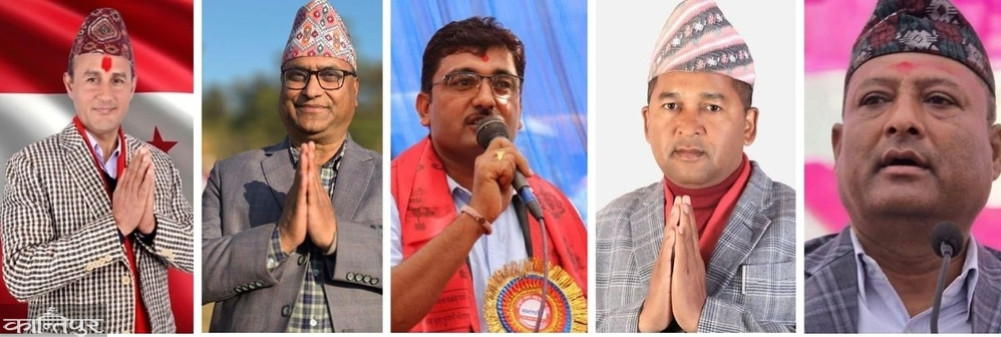
The main election competition in Surkhet-2 is between Narayan Koirala of the Nepali Congress, Kulmani Devkota of the UML, Jhak Bahadur Malla of the NCP, and Ramesh Kumar Sapkota of the Rashtriya Swayamsevak Sangh (RSS). All of them are contesting the parliamentary elections for the first time.
We use Google Cloud Translation Services. Google requires we provide the following disclaimer relating to use of this service:
This service may contain translations powered by Google. Google disclaims all warranties related to the translations, expressed or implied, including any warranties of accuracy, reliability, and any implied warranties of merchantability, fitness for a particular purpose, and noninfringement.
Political activities have increased in Surkhet Constituency No. 2, which also includes the provincial capital Birendranagar, due to daily political events. Candidates have started becoming active in campaigning, including door-to-door campaigns, voter meetings, and village gatherings.
The main election competition in Surkhet-2 is between Narayan Koirala of Nepali Congress, Kulmani Devkota of UML, Jhak Bahadur Malla of NCP, and Ramesh Kumar Sapkota of Rashtriya Swayamsevak Sangh. All of them are contesting in the parliamentary election for the first time.
Congress central member and former minister Hridayram Thani, who has been a candidate in all elections since 2051 BS, won the last House of Representatives election by securing 34,625 votes. He also won the 2056 BS and 2064 BS elections from the same constituency. But this time, after he withdrew from the candidacy due to health problems, Narayan Koirala, who has been close to him for a long time, is the candidate.
Koirala, who is also the chairman of Radio Bheri, is the former regional president of Nepali Congress and has also become the chairman of the Surkhet Valley City Development Committee. Koirala, a permanent resident of Birendranagar-9, started politics from the Nepal Students' Union. Congress District Secretary Devkumar Subedi said that his simple nature, intellectual image and honesty were the basis of his victory. In fact, Congress is in the race to win by showing its young face, strong organization and internal unity.
UML District President Kulmani Devkota is challenging him. He has been in a leadership role in the Surkhet Valley Drinking Water Consumers' Organization for a long time. He claimed that the good work done by the UML-led government has brought the people closer to their party and that they will win easily as their organization is strong even in rural areas.
‘The voice of Karnali has not yet reached the federal government, and the journey of development and prosperity is incomplete,’ he said. ‘I have a plan to connect the youth to employment, emphasize on Karnali-friendly legislation, and develop the provincial capital Birendranagar as a model city.’
Nepali Communist Party (NCP) candidate Jhak Bahadur Malla, who is contesting elections for the first time, is a former Maoist district in-charge. A central member of the NCP, he led the ‘jailbreak’ of Surkhet during the armed conflict. He was also a former combatant commander and lost his wife during the armed conflict. ‘Karnali is also the base area of the armed rebellion, there are many sufferings of the conflict-affected, injured, disabled and martyred families here, Dalits, women and tribals of Karnali have not been able to be connected to the mainstream of the state,’ he said, ‘Due to unbalanced development, the people are deprived of basic necessities, my candidacy is to solve all these issues.’
Ramesh Sapkota, district president of the Rastriya Swatantra Party (RSWP), is in the election contest. He is also a transport businessman and is the president of Kankrebihar Yatayat Pvt. Ltd., and was the secretary of the Birendranagar Nagar Committee of the Nepali Congress before joining the RSWP. He claimed that he would win because of the dissatisfaction seen among the general public towards the old parties and the party’s national agenda is in favor of the people.
‘Voters are in the mood for change and selecting capable candidates,’ he said, ‘I have mainly emphasized the issue of good governance, infrastructure and development are also my agenda.’
17 candidates, including Rastriya Prajatantra Party (RPP) district president Kaviram Puri, are in the election race in Surkhet-2. The candidates are busy formulating their election strategy by going door-to-door and meeting workers. Looking at the organizational status of the major parties, past election results and the current election atmosphere, civic leader Durga Prasad Sapkota says that the main competition in this area is between the Congress, UML, NCP and RSP.
‘Since the provincial capital is also in this region, voters are more aware here than elsewhere, so the ability and competence of the individual is considered here rather than the party,’ he said, ‘Even in that, since the election is held with special circumstances and different mandates, it is impossible to say who will win.’
Kamal Lamsal, associate professor at Madhya Paschim University, said that the most capable and qualified person should be made the winner by looking at the agendas of the parties and the competence of the candidates. ‘People’s expectations have increased significantly because the previous people’s representatives were not accountable to the voters,’ he said, ‘There is also a need to institutionalize the issues of the Genji movement, so it is necessary for voters to vote more consciously.’
Constituency No. 3, which had 3 constituencies before the federal restructuring, has also been merged into 2. 14 wards of Birendranagar Municipality, Barahtal Rural Municipality, Panchapuri Municipality and Chaukune Rural Municipality fall under Constituency No. 2. In the last provincial assembly election, UML's Yamalal Kandel won from Constituency No. 2(1) with 18,561 votes and NCP's Bindaman Bista won from Constituency No. 2(2) with 13,909 votes.
In the 2079 House of Representatives and Provincial Assembly elections, the former Maoist Center and the Nepali Congress were in an alliance, while UML contested alone. Nepali Congress won in Barahatal and Panchapuri, UML in Birendranagar, and NCP candidates won in the positions of Chairman and Vice-Chairman of Chaukune Rural Municipality.