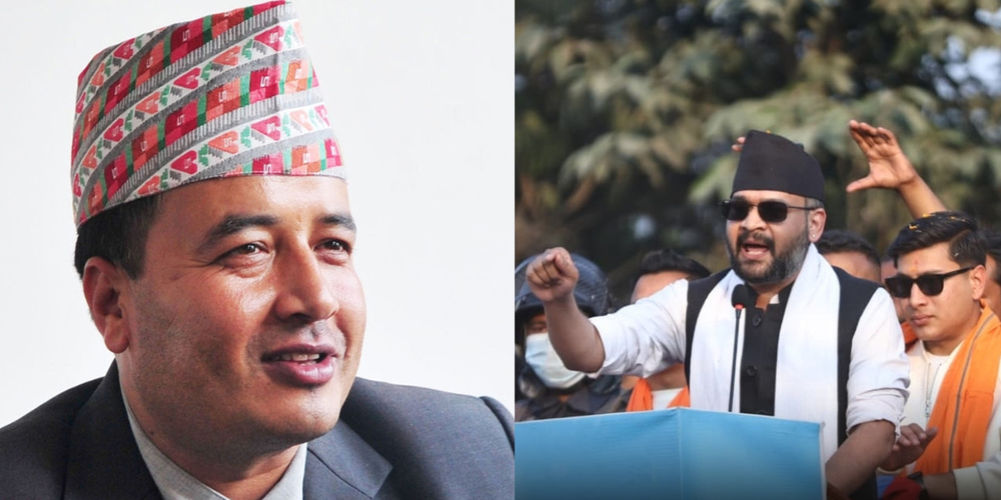
Election Commission asks Balendra Shah and Mahesh Basnet for clarification on charges of making inflammatory statements
We use Google Cloud Translation Services. Google requires we provide the following disclaimer relating to use of this service:
This service may contain translations powered by Google. Google disclaims all warranties related to the translations, expressed or implied, including any warranties of accuracy, reliability, and any implied warranties of merchantability, fitness for a particular purpose, and noninfringement.
As the House of Representatives elections approach, surveillance has been increased on those making provocative and 'inciting' statements that disrupt public peace and demean others.
Following the increase in provocative and inflammatory statements that are detrimental to election security and the personal rights of individuals, the National Human Rights Commission, the Election Commission and the Nepal Police have increased their monitoring of such activities. Some of those making such statements have been arrested, while others have been warned by the police and released on the condition that they ‘appear when called’. The National Human Rights Commission has also directed that those making provocative and defamatory statements be brought to justice.
The Election Commission has also asked some candidates for clarification for making provocative statements that would disrupt the election security plan. Nepal Police has summoned Bhadra Prasad (Sawagat) Nepal, a member of the House of Representatives from Jhapa-2 from the RPP, to the Cyber Bureau for making provocative statements during the election campaign and has released him on bail. The police arrested advocate Yubaraj Safal on Tuesday for making provocative statements.
After receiving a complaint of making provocative and hateful statements on the social media Facebook, the Election Commission has also asked Balendra Shah, a senior leader of the RPP and a candidate for the House of Representatives from Jhapa-5, for an explanation.
The Commission has sought an explanation from former Prime Minister and UML Chairman KP Sharma Oli after the issue of a ‘public debate’ between top leaders of major parties on the same platform for the House of Representatives elections was raised in public circles, saying that Shah had made inflammatory statements while ‘commenting’ on a content he had written on social media Facebook a few days ago.
Oli had posted the content saying, ‘We are ready for a public debate, all new/old parties are now engaged in the elections, in this competition between those who burn the country and those who build the country, our party is on the side of building the country.’ Shah’s comment on it was – ‘It is right to accept yourself as someone who burns the country, but where are the houses of the leaders, you knew, you yourself burned them on the 24th to hide the terrorism that killed children on the 23rd.’
Oli and Shah are contesting the upcoming House of Representatives elections from Jhapa-5. Oli lost power on the basis of the Gen-G movement on 23 and 24 Bhadra, while the House of Representatives was dissolved on the basis of the Gen-G movement and the upcoming election of the House of Representatives is being held. The Election Commission has sought an answer from Shah on whether the response given by Oli on his 'status' was his or not, and whether it was against the election code of conduct.
'It is right to accept yourself as someone who will burn the country, but where are the houses of the leaders, you knew, you yourself burned the houses on 24 to hide the terrorism that killed children on 23, when will you accept yourself as a terrorist?' The Commission has also sought an explanation about the inflammatory statement made by UML candidate Basnet of Bhaktapur-2 targeting Jhapa-5 candidate Shah. Shah had appealed to win the election by referring to himself as the 'son of Madhesh' while addressing the general meeting of the Rashtriya Swayamsevak Sangh (RSS) in Janakpur.
Basnet had targeted Shah by calling him a 'son of Madhesh' at a public event. A complaint was filed with the Commission demanding action against Basnet for insulting the word 'chhaura', which is used to address a son in Madhesh in Bhojpuri, Maithili, and Bajji languages. In this way, the series of statements made by candidates insulting each other has not stopped.
Not only provocative statements, the Commission has also increased the number of candidates involved in other incidents of violation of the election code of conduct. Medical practitioner Durga Prasai was also arrested from Pokhara following a complaint from the Election Commission after making provocative and unverified statements. Kathmandu Police has warned him and released him 'on the condition that he will appear when called'.
The Human Rights Commission has also expressed concern over the provocative statements aimed at the election. The Human Rights Commission has drawn attention to the criticism, hate speech and unfounded accusations made against each other by responsible persons of various political parties and has requested the relevant parties to campaign with restraint during the election campaign.
‘Such hate speech seems to promote chaos and even affect peace and security during the election. Although the Constitution and international laws on human rights guarantee freedom of expression and thought, issues that may hurt the dignity of others and undermine peace and security cannot be considered purely a matter of freedom of thought and expression,’ said Tikaram Pokharel, spokesperson of the Commission, in a statement on Tuesday. ‘It is necessary for responsible persons to always pay attention to the impact that may occur on the rights of others while exercising their rights.’
The Human Rights Commission has also urged political party leaders, candidates and the general public to refrain from hate speech contrary to the constitution, law and international human rights values, to be polite and dignified while using social media, to use human rights-friendly language towards each other, not to propagate hate speech and to fully comply with the election code of conduct. Stating that hate speech can spread hatred in the society and also create challenges to peace and security, the Commission has also directed the government to further strengthen peace and security.
The integrated election security action plan prepared for the election of members of the House of Representatives scheduled for 21 Falgun has also listed provocative and inflammatory speech as an election security challenge. The Election Commission has also directed the government to control such speech.
Following the Commission's directive, the Cyber Bureau of the Police has set up a police cyber cell in the Election Commission, all 77 district police complexes, provincial police units and other places and started monitoring. The Cyber Cell has started monitoring those who make inflammatory statements focused on elections and action will be taken as per the law if found involved in criminal activities, the Police Headquarters has stated.
3,213 candidates are in the fray for 110 proportional seats and 3,406 candidates from parties and independents for 165 direct seats for the upcoming elections. Although the resources/equipment and manpower to regulate and monitor the activities of each candidate are inadequate, a police official said that regulation and monitoring against inflammatory and inflammatory statements targeted for elections have been increased through the existing mechanisms.
Home Minister Omprakash Aryal visited the Cyber Bureau's office in Bhotahiti on Monday and directed to increase effective monitoring against those involved in cybercrime and those making inflammatory and inflammatory statements targeted for elections and to bring those involved to justice.