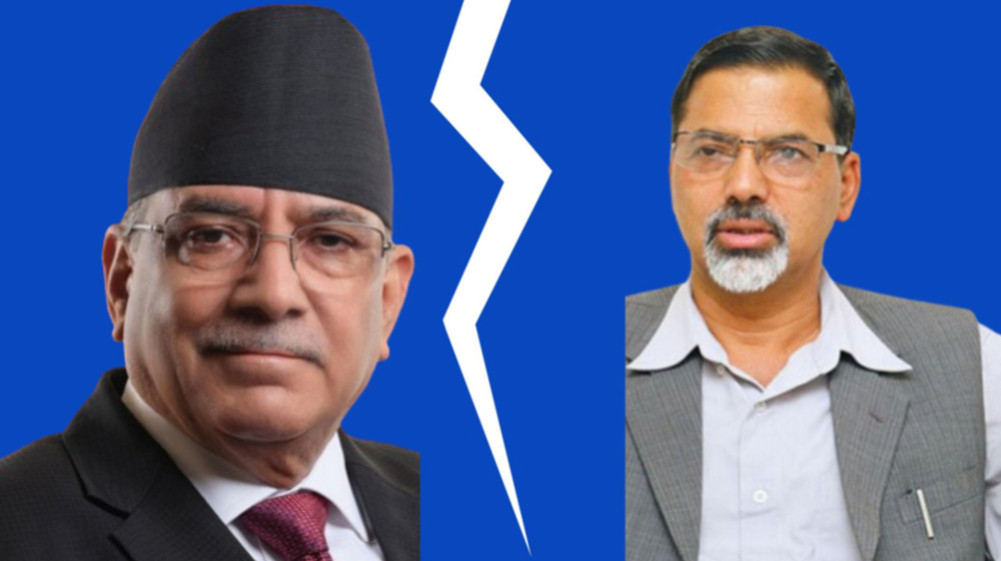
Sharma alleges that Dahal has been betrayed recently, even though he has accepted his leadership and considered him a leader.
We use Google Cloud Translation Services. Google requires we provide the following disclaimer relating to use of this service:
This service may contain translations powered by Google. Google disclaims all warranties related to the translations, expressed or implied, including any warranties of accuracy, reliability, and any implied warranties of merchantability, fitness for a particular purpose, and noninfringement.
Maoist coordinator Pushpa Kamal Dahal and secretariat member Janardan Sharma have held a farewell meeting for the party. Dahal had called Sharma on Sunday to persuade him to take a different political path after the Maoist party decided to unite with the CPN-UML and other small communist parties. The two leaders have said goodbye to each other after Sharma did not agree with his decision.
Sharma had said that he had come for a farewell meeting after merging the Maoists with other parties. ‘You merged the Maoists with Madhav Nepal’s party. I will leave while keeping the Maoists alive. I will embark on a broad communist unity campaign,’ Sharma said, ‘We will meet on some occasion after the broad unity.’
During the meeting, Dahal assured that he would hand over the leadership at the general convention to be held after the party unification, but Sharma did not believe him. ‘The Central Committee decided to hold a special general convention twice.’ He said, ‘You have been avoiding it on various pretexts,’ ‘It is not possible to believe that you will hand over the leadership after the general convention.’
The conversation did not stop there. Sharma accused Dahal of betraying him recently even though he had accepted Dahal’s leadership and considered him a leader. ‘I have been voting for party building.’ I have nothing personal with you,' he added, 'I have not taken political issues personally.' During the meeting, Sharma recalled the collaboration with Dahal since the 2046 People's Movement, ten years of armed war, the peace process, and the constitution-making. 'You and I have had such a long collaboration. I have considered you a leader. Now you have reconciled the Maoists with others,' he said, 'I will remain a Maoist.'
Dahal and Sharma met in Rukum in 2042 BS. Dahal was the 'supreme' commander of the ten-year Maoist armed war, while Sharma was one of the four 'deputy commanders'. After the peace process came to an end in 2064 BS, all the leaders, including Dahal, became public. Sharma also entered open politics. He remained close to party chief Dahal in the work of integrating combatants into the Nepali Army, the peace process, and the constitution-making. He had the status of reaching Dahal's 'bedroom' and giving him advice. Dahal also trusted him and gave him important responsibilities. Sharma became an important minister on behalf of the party several times.
Sharma was also a witness to the UML-Maoist electoral alliance in 2074 BS and then the party unity. His role in the unity process was important. But due to the power struggle between the then Nepal Communist Party chairmen KP Sharma Oli and Pushpa Kamal Dahal, the unity did not last long. While the internal conflict was raging, on 23 Falgun 2077 BS, the Supreme Court separated the UML and the Maoists in a case saying that the Nepal Communist Party was registered in someone else's name.
Leaders say that the seeds of distrust between Dahal and Sharma were sown since the eighth general convention held in 2078 BS. Sharma and Barshaman were once again aspirants for the post of general secretary in the general convention. After both Dahal's confidants Sharma and Pun claimed the post of general secretary, Dahal selected Dev Gurung as general secretary. Sharma and Pun were made deputy general secretaries. After that, Sharma, who became dissatisfied, began demanding internal democracy and leadership transfer in the party. Dahal had been taking this demand as a challenge to himself. The distrust between them gradually increased. After Deputy General Secretary Sharma submitted a 14-page long written dissenting opinion at the standing committee meeting held in Shrawan 2081, relations between the two leaders became even colder. Sharma had argued that the system in the party was not democratic, that leadership should be transferred, and that the ideological policy should be clear. After that, Dahal stopped inviting Sharma to important discussions and meetings.
It is not that there were no attempts to improve relations between the two leaders. However, in 2082 Baisakh, when the campaign focused on the Mid-Hill Highway reached Rukum West, Sharma became angry after Dahal said in the first week of Jestha, ‘If some people go astray, the party will not go astray.’ He demanded a serious review of Dahal’s statement that he was asked to leave the party when he was bidding farewell to Rukum. ‘I was asked to leave the party repeatedly.’ I kept saying that we should stay in the party and form a party, but it was not listened to,’ Sharma said.
Dahal has been accusing ‘foreign powers of elevating Janardan.’ And, he claims that it will not make a difference if Sharma leaves the party. In Sharma’s understanding, Dahal has adopted a strategy to survive by pitting his own leaders against each other. Dahal has been leading the party since 2045.
Sharma on the path of Vaidya, Bhattarai and Gujral
None of the leaders who challenged Dahal in the Maoists have survived . Sharma is the latest example . Yan Prasad Gautam, known as 'Comrade Alok', challenged Dahal during the armed war . Maoist leaders say that he was killed in a 'mysterious' manner while he was in action during the war .
After joining the peace process, the then Vice President Mohan Vaidya expressed a different opinion against the then Maoist Chairman Pushpa Kamal Dahal in the Kharipati meeting of Balaju and Bhaktapur in 2065. He expressed a different opinion saying that Dahal had abandoned the policy of mass rebellion . But when Dahal did not abandon the path of peace and constitution-making, the Maoists split under Vaidya's leadership in Asad 2069 . Currently, CP Gajurel is leading the party . After the Vaidya group left, Dahal did not have to face internal conflicts . Dahal and then Vice President Baburam Bhattarai worked together for some time after agreeing on the peace and constitution-making policy of the then leader. But Bhattarai had a different opinion against Dahal during the armed conflict. Bhattarai was taken into custody by the 'Jana Sena' after expressing his written disagreement against Dahal in a meeting held in Rolpa in 2061 Asoj. He was threatened with 'physical action' at any time.
In Asad 2068, a power struggle between Dahal and Bhattarai intensified. After pressure came from the party, Dahal agreed to make Bhattarai the Prime Minister in Bhada 2068. Bhattarai was elected Prime Minister. Even after their separation in 2072, the struggle between the two leaders continued. After that, Bhattarai formed the Naya Shakti Party and left the Maoists. Bhattarai played an important role in helping Dahal win from Gorkha-2 in the 2079 general election. But the cordiality between them did not last long. Shortly after that, the distance between Dahal and Bhattarai began to grow. And, currently, the two do not have a cordial political relationship. Secretariat member Janardan Sharma, who has been challenging Dahal in recent times, has also finally severed ties with Dahal.