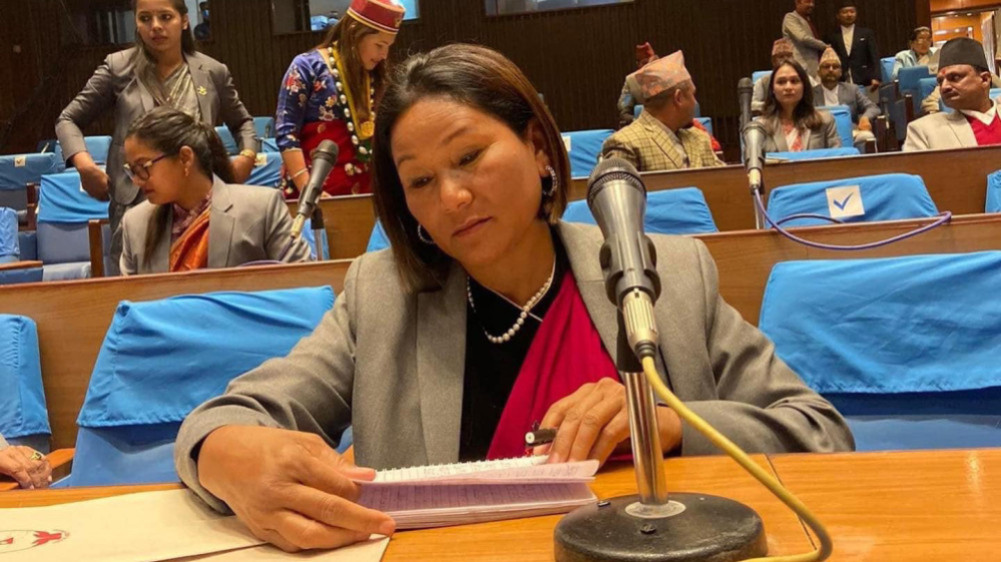
In the absence of two-thirds of the ruling coalition, the support of the smaller parties has decided to remove the Deputy Speaker.
We use Google Cloud Translation Services. Google requires we provide the following disclaimer relating to use of this service:
This service may contain translations powered by Google. Google disclaims all warranties related to the translations, expressed or implied, including any warranties of accuracy, reliability, and any implied warranties of merchantability, fitness for a particular purpose, and noninfringement.
The two ruling parties Nepali Congress and CPN-UML have started the process of removing Deputy Speaker Indira Rana.
Although the ruling coalition does not have a two-thirds majority, the government is about to remove him from office with the help of other small parties. This is the second time that the Deputy Speaker is about to be removed from the post. The previous attempt failed due to lack of majority. But this time, the stake of getting majority is on the side of power.
According to the constitution, a two-thirds majority of the parliament, i.e. 184 votes, is required to remove the speaker or deputy speaker. Congress has 88 seats and UML has 77 seats in the 275-member House of Representatives.
These two parties have a total of 166 MPs and need 20 more MPs for two-thirds. UML MP Top Bahadur Rayamazhi and Congress MP Mohan Bahadur Basnet are under suspension and will not be able to participate in the voting process. This situation has forced the majority to rely on other parties.
Why the government wants to remove
The main reason for trying to remove the deputy speaker is the constitutional appointment. Chairman of Nepali Congress Sher Bahadur Deuba informed in Tuesday's official meeting that Prime Minister KP Sharma Oli has asked for help to remove the Deputy Speaker as he did not have a majority in the Constitutional Council and also talked to other parties. The ruling party has argued that it is going to be removed because it does not have a majority in the Constitutional Council.
Article 284 of the Constitution provides for the Constitutional Council. It is mentioned in the article that there will be a Constitutional Council under the chairmanship of the Prime Minister to recommend the appointment of the Chief Justice and the heads and officials of the constitutional bodies. The Constitutional Council consists of Prime Minister KP Sharma Oli as Chairman, Chief Justice Prakashman Singh Raut, Speaker of the House of Representatives Devraj Ghimire, Speaker of the National Assembly Narayan Dahal, Leader of the Opposition Pushpa Kamal Dahal and Deputy Speaker Indira Rana as members.
The Prime Minister and the Speaker were the only two members of the ruling coalition in the Constitutional Council. The opposition has three members namely the Speaker of the National Assembly, the Deputy Speaker and the Leader of the Opposition. The Prime Minister is in the minority as the Chief Justice is neutral. Thus, Prime Minister Oli had a discussion with Nepali Congress Chairman Sher Bahadur Deuba when the ruling coalition would not make a favorable decision when the Constitutional Council meeting was convened.
Some constitutional bodies, including the Election Commission, are vacant. Another reason for the sudden removal of the Deputy Speaker is that the National Independent Party has been continuously protesting in Parliament for the past few days.