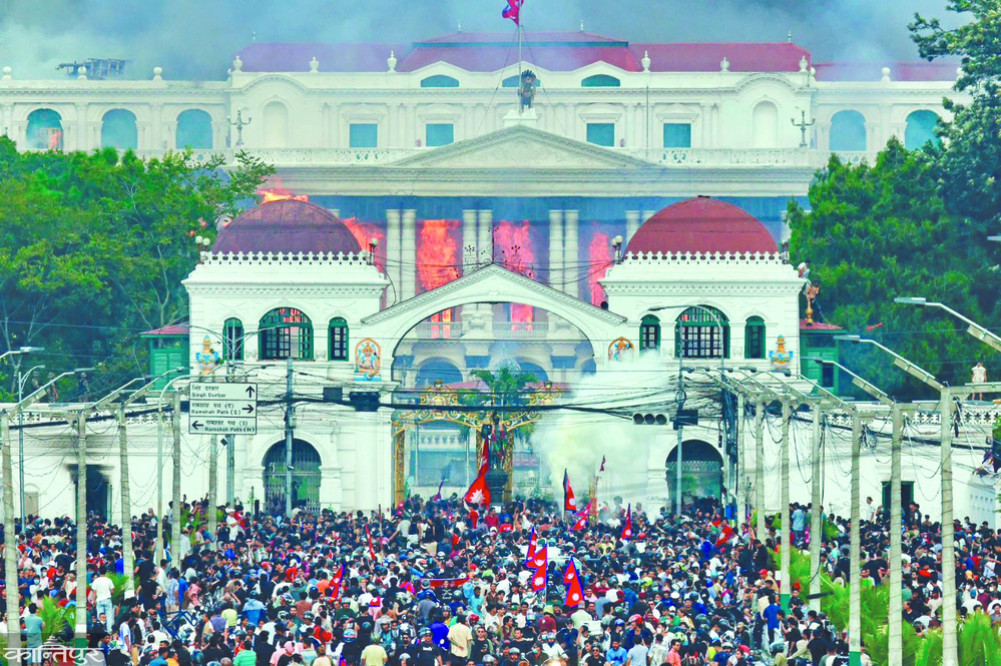
The incident of the burning of Rome comes to mind regarding the tragic incident caused by the power grab of the current rulers and administrators.
We use Google Cloud Translation Services. Google requires we provide the following disclaimer relating to use of this service:
This service may contain translations powered by Google. Google disclaims all warranties related to the translations, expressed or implied, including any warranties of accuracy, reliability, and any implied warranties of merchantability, fitness for a particular purpose, and noninfringement.
When there are incidents of heinous crimes and protests against state oppression in the country, then the memory of history also keeps moving in the mind. History sometimes reminds us of such mirrors, in which the pain, deformity, and inconsistency of the present are also reflected.
The events of August 23 and 24 reminded me of Rome, Bangladesh and Sri Lanka in history, and I was forced to make some reminders. About 1,500 years ago, when the Roman Empire fell, Rome was burning, but Nero was busy playing the flute.
The ongoing political revolution in the Roman Empire could not touch Nero. The proverb that identifies it is still famous. As a result, about the tragedy caused by the power struggle of the current rulers and administrators, the burning of Rome is remembered.
Rome was actually burning, but its ruler, Nero, was ignoring such a terrible event and playing the flute. As a result, in September 476, the power of the last emperor of Rome fell. According to the historian Theseus, Christians were viewed with hatred. Later Nero began to order them to be arrested for setting the fire. And made them throw their dead bodies in front of some wild animals.
After learning that Nero was hiding in a castle outside the city of Rome, he brutally committed suicide before his guards could chase him down. Thus we can read the history of the end of a cruel ruler. But the sentence he said a few moments before his death, "I died as an artist even in my death", makes people's hearts still emotional.
Similarly, in July last year, the then Prime Minister Sheikh Hasina went abroad due to the arbitrary trend of power in Bangladesh, the need to cut down the existing fixed quota system for government jobs and the protest of students demanding good governance.
Now she is forced to live in exile in India. Similarly, due to the economic crisis in Sri Lanka, the series of downfalls of President Rajapaksa began with the occupation of the Rashtrapati Bhawan due to the anger of the common people against the arbitrary power of those in power.
In this way, the political parties of Nepal also knew why and how to tell the path of the downfall of the neighboring countries, and it often appeared in the media that Nepal was now considered to be a country with a lot of corruption and it could not be said that the leaders of this country would be forced to leave power due to people's opposition like in Bangladesh and Sri Lanka. That's what happened after all. On August 23 and 24, the movement in the name of Gen-G generation in Nepal threw the ruler out of power. -Khimraj Giri, Kathmandu