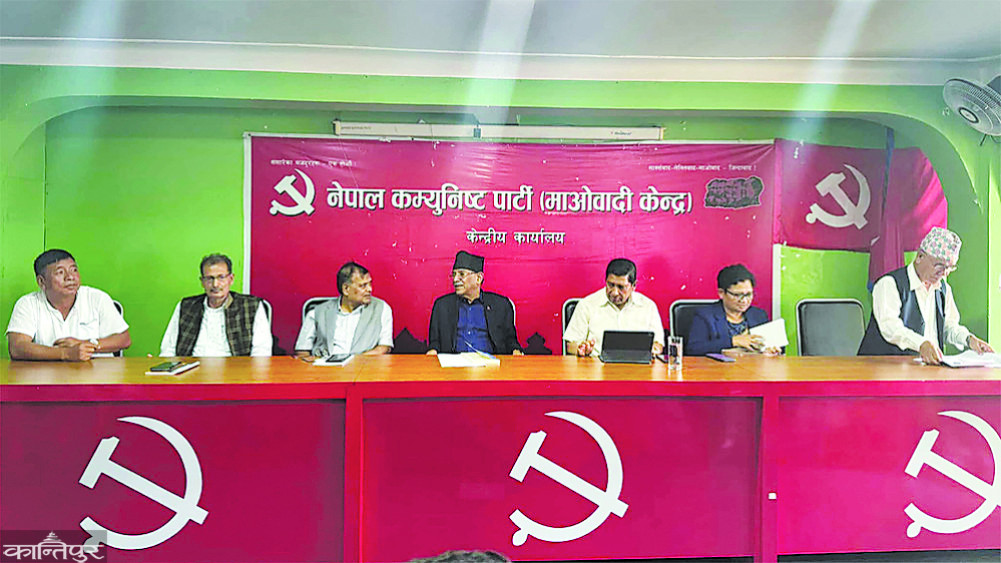
Tendency to curtail democratic practice and free expression of opinion within the party
We use Google Cloud Translation Services. Google requires we provide the following disclaimer relating to use of this service:
This service may contain translations powered by Google. Google disclaims all warranties related to the translations, expressed or implied, including any warranties of accuracy, reliability, and any implied warranties of merchantability, fitness for a particular purpose, and noninfringement.
Coming from the background of people's war, Maoists have a history of transforming armed insurgency into peaceful politics by advocating democratic values, freedom and equality.
However, the recent activities have shown that there is an increasing trend of curbing the democratic practice and the expression of independent opinion within this party.
Maoist Center's Standing Committee meeting decided not to criticize the party and leadership in the public forum and attempts to restrict personal freedom in the name of controlling the tendency to create factions and sub-factions have raised serious questions. There is concern that this trend is a sign of dictatorial mentality.
The cornerstone of democracy is free expression and critical debate. Any political party that claims to be democratic must be able to accept internal dissent and criticism. The latest decision by the Maoists indicates an attempt to stifle criticism within the party and maintain the supremacy of a single leadership. Forbidding criticism of leadership in the public forum means depriving activists and leaders of expressing their views freely. This move undermines the internal democracy of the party and also raises questions about the process of holding the leadership accountable. Deputy General Secretary Sharma has expressed his commitment to unite the party, which sounds positive. However, unity is not a uniformity of thought, but rather a process of progressing towards a common goal by encompassing diverse thoughts.
Trying to suppress individual freedom and different opinions in the name of controlling the tendency to create factions or sub-factions has raised questions about the revolutionary identity of Maoists. Historically, Maoists had given slogans during the People's War to fight against the dictatorial structures in the society. However, it is ironic to see such a trend in ourselves today.
The Constitution of Nepal guarantees freedom of expression. Maoists have been presenting themselves as a democratic party within the limits of the constitution. In such a situation, the decision to curtail freedom of expression within the party calls into question its credibility. The leadership should take seriously the fact that trying to stifle criticism will not only weaken the party, but also damage its credibility in the eyes of the public.
leadership should encourage open debate and criticism while respecting worker voices. Only in this way can the Maoists establish themselves as a truly democratic and dynamic force. Otherwise, this path of authoritarian tendencies will jeopardize both Maoist identity and relevance.
– Santosh Simkhada , Tokyo, Japan