We use Google Cloud Translation Services. Google requires we provide the following disclaimer relating to use of this service:
This service may contain translations powered by Google. Google disclaims all warranties related to the translations, expressed or implied, including any warranties of accuracy, reliability, and any implied warranties of merchantability, fitness for a particular purpose, and noninfringement.
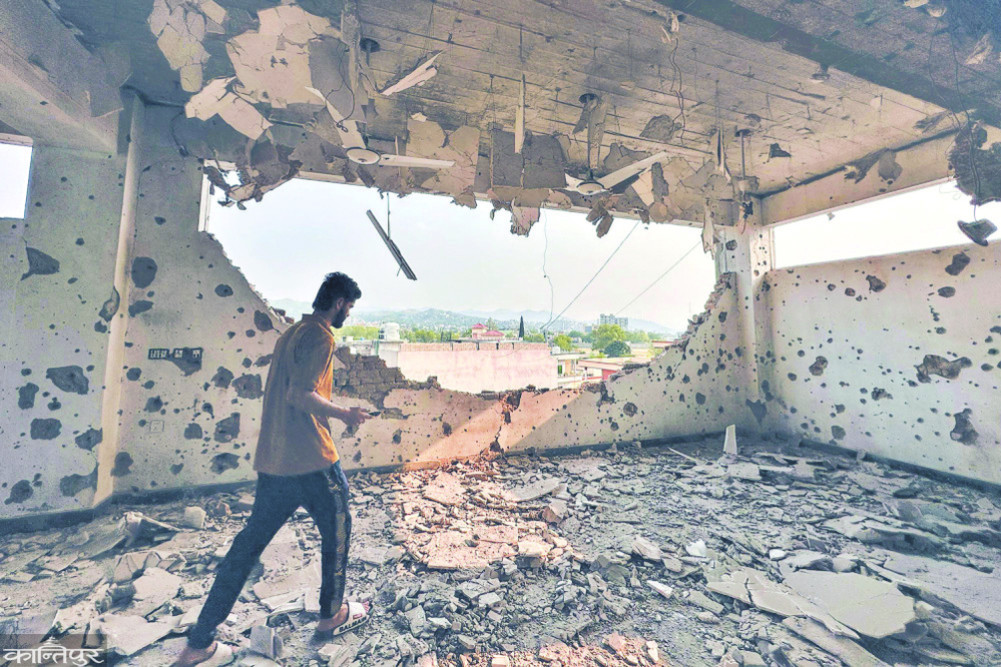
India's recent missile attack on Pakistan has once again reeked of gunpowder across the Asian subcontinent. This military action will neither weaken the enemy nor secure the border.
Rather, it is sure to create a storm of fear, doubt and panic in the minds of millions of citizens. While India portrayed the move as a specific 'surgical strike', in reality it was more of a political message than a show of force. Which, like in every war of the past, will lead the people to deep thoughts even now.
Whatever decision is taken in the name of war, it is the youth standing across the border, the children shivering at the sound of missiles covering the sky, and the ordinary citizens who are looking for peace who will pay the price. India and Pakistan have fought three major wars in history, experienced dozens of minor skirmishes, but neither a permanent solution nor an end to the conflict. Instead, this vicious cycle of conflict and suspicion has put not only the two countries at risk, but the entire South Asia.
The most worrying aspect in this regard is the role of the media. News headlines are being limited to words like 'India's retaliation' and 'Pakistan's reply', where the voices of peace dialogue, diplomatic initiatives and long-term solutions are lost somewhere. In such a situation, it is very unfortunate that the media is not selling 'information' but 'stimulation'.
Nepal has always raised its voice in favor of regional peace. The introduction of Buddhajanmabhoomi has also given us intellectual responsibility, where we can stand for the truth without being neutral. Today, we urge the leaders of India and Pakistan to start dialogue, not war. End the missile-launching contest and engage in diplomatic negotiations on behalf of the people. Rather than showing strength, it is the duty of today's leadership to show moderation.
South Asia is already plagued by problems like poverty, unemployment, and health crisis. Moreover, the ammo game will make these problems worse. War wins no one, it only loses humanity.
We also understand that the decision to go to war is always made by the leader, but it is the soldiers, poor farmers' children and hut dreamers who reach the grave. That's why we insist - peace is bravery, dialogue is the solution. Let's embark on a journey of cooperation and peace, not war.
– Santosh Simkhada , Tokyo, Japan
A war between India and Pakistan and that too between a country with nuclear power is not fair in any way. No matter how much one condemns this senseless and deplorable act. The peace-loving world must be able to speak strongly against war and in favor of peace. Because we have seen from the events of Hiroshima and Nagasaki how terrible the situation would be if nuclear weapons and bombs were used. Not only millions of people were killed by the bombs called Little Boy and Fat Man, which were launched by the US, but even until the 50th year, the people there were suffering from problems like cancer and infertility.
In a world fighting against hunger and malnutrition, spending billions on war is not worth it. Both India and Pakistan need to understand this in time.
India has stopped the water of the Indus River flowing through Pakistan. What can countries like Nepal and Bhutan learn from this? Because, the water of Nepal and Bhutan is going to India for free. When India tried to divert the Kaligandaki river to provide irrigation to other areas of Nepal, India protested that it was trying to stop the water coming to its country. What is this double policy of India that it is right when it stops water in Pakistan and it is wrong when it stops irrigation in Nepal? This also needs to be reviewed.
– Gopal Devkota , Kamanpa-7, Chabhil, Kathmandu