We use Google Cloud Translation Services. Google requires we provide the following disclaimer relating to use of this service:
This service may contain translations powered by Google. Google disclaims all warranties related to the translations, expressed or implied, including any warranties of accuracy, reliability, and any implied warranties of merchantability, fitness for a particular purpose, and noninfringement.
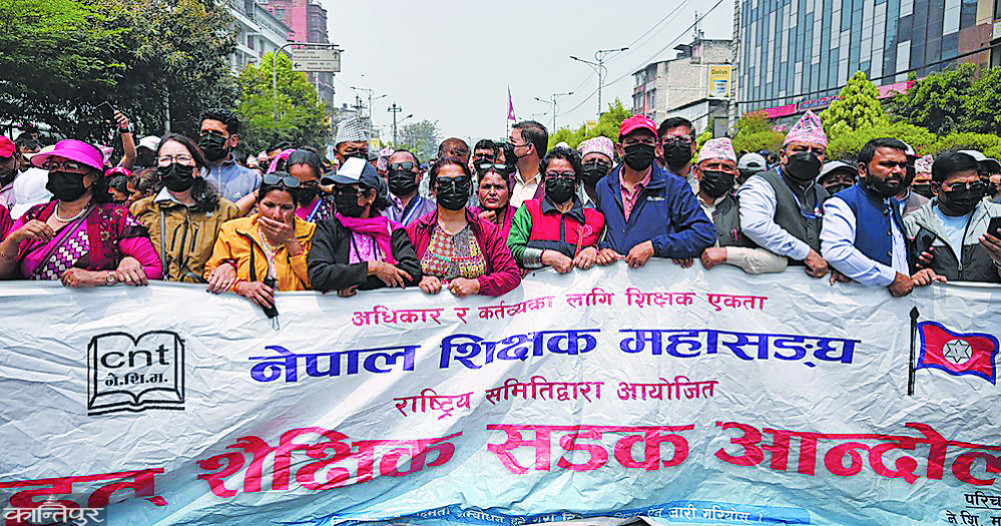
The current government of Nepal, which claims to be the servant of the people and the carrier of progressive power, looks at the indifference and incompetence shown towards the teachers' movement, and it seems to be nothing but a model of corrupt and worthless administration. As the teachers continue to stand on the streets for the fifth day demanding justice, the government is busy staging talks and feigning public appeals.
The commitment to issue the Education Act to implement the agreements made in 2075, 2078 and 2080 has only been kept as a paper horse, which has raised a big question mark on the credibility of this government. Instead of listening to and solving the demands of the teachers, the government seems to be using a strategy to tire them out and suppress the movement.
All over the country, school educational activities are at a standstill, answer sheet tests of 500,000 students participating in SEE have been affected and the schedule for publication of results is in shambles - but this administration does not have the guts to take responsibility for all of this. Why is the government unable to create an atmosphere of dialogue with teachers? Because the priority of this government was never education and the respect of teachers - instead, it is enjoying itself in the web of power selfishness, chair games and corruption.
When listening to Prime Minister Oli's expression 'We listen to the voice, we talk', both laughter and anger arise. If they really wanted to listen, why did the teachers have to stand in the hot sun and dust of Kathmandu? The teachers taking to the streets is a result of the government's betrayal and neglect, which is evident in the delay in the implementation of the August 2080 agreement.
Teachers' demand is not just a matter of professional rights – it is also a sensitive issue linked to the educational future of the country. Demands such as not being subordinate to the local level, maintaining the district education office, and making temporary teachers permanent reflect the practical problems of teachers and the search for constitutional rights. But this government, which is adept at fulfilling its own interests by trampling the essence of the constitution, is determined to suppress the legitimate voice of teachers.
As teachers are on the streets during the end of the March academic session and preparation for the new session, the government should immediately issue the Education Act to bring them back to the classroom, comply with the agreement and fulfill their responsibilities.
– Santosh Simkhada , Tokyo, Japan