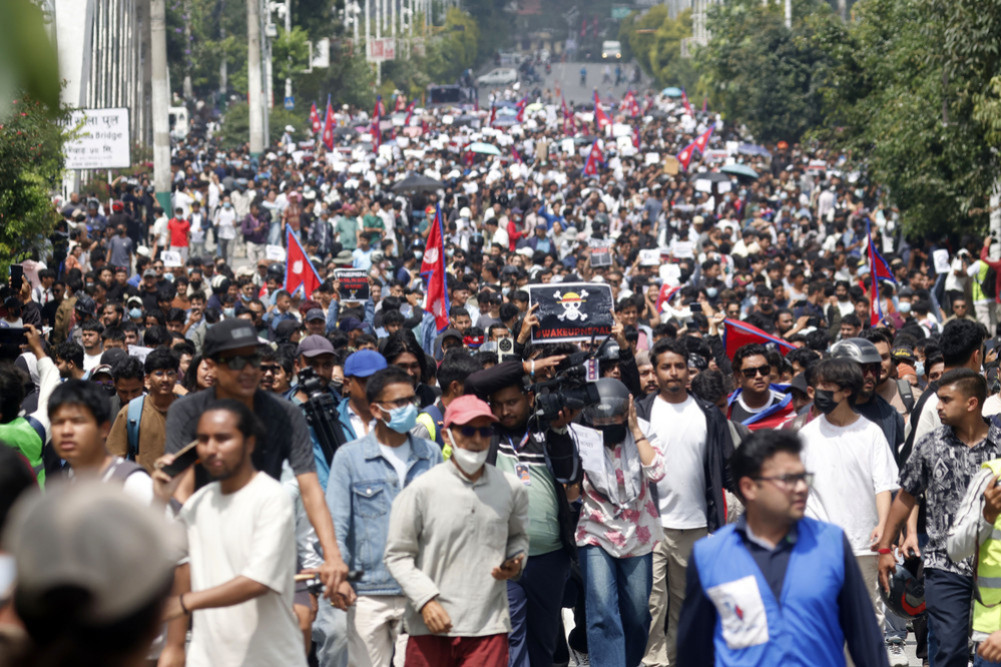
Young faces are visible in Nepal's power structure, but the spirit of youth is fading. If institutions established for youth are left neglected, it raises serious questions about the legitimacy of that leadership.
We use Google Cloud Translation Services. Google requires we provide the following disclaimer relating to use of this service:
This service may contain translations powered by Google. Google disclaims all warranties related to the translations, expressed or implied, including any warranties of accuracy, reliability, and any implied warranties of merchantability, fitness for a particular purpose, and noninfringement.
Nepal stands at the crossroads of the greatest political, social, and demographic transition in its history. On one hand, about 42.56 percent of the country’s total population is comprised of youth, while on the other, there is also an unprecedented presence of youth at the leadership level of state governance. The power structure of Singha Durbar, which had been controlled by the same generation for decades, is now claimed to be youth-oriented. The presence of 61 parliamentarians under the age of 40 in parliament, a majority of young ministers, and a comparatively youthful government leadership are all intended to signal that Nepal is now in the hands of a new generation.
The ‘Youth and Gen-Z Movement’ of Bhadra 23–24 was not just a street protest—it was also a rebellion of generational change. That movement represented the explosive voice of youth against dissatisfaction with old political culture, anger over unemployment, lack of opportunity, corruption, and political neglect. The political environment created after the movement made it easier for the younger generation to enter parliament and government. On this very foundation of change, the recently held House of Representatives election established the youth generation in national politics in an unprecedented way.
Today, the country’s prime minister is 36 years old. There are ministers in the cabinet around the age of 30. Important ministries such as law, education, and labor are being handled by the younger generation. It seems that the era of youth has begun in Nepal. But the reality is different from what is imagined. A serious and paradoxical question now stands before the country—if the country is under youth leadership, why are government structures created for youth being dismantled one after another? This question is not just an administrative issue, but one tied to Nepal’s future direction and generational justice.
According to the Government of Nepal’s Rules of Business Allocation (2083), the Ministry of Youth and Sports has been dissolved. Youth affairs have been limited under the Ministry of Labor and Employment, while important bodies like the National Youth Council have been left in a state of unclear structure. This means the state is ceasing to view youth as an independent policy sector. Now, youth are being confined to the narrow subject of ‘employment’ alone.
Is youth only a matter of employment?
Youth issues are linked to employment. But the existence of youth is not limited to jobs alone. Youth are connected to many subjects such as education, leadership, innovation, mental health, political participation, digital transformation, entrepreneurship, social awareness, climate justice, cultural transformation, and democratic participation. A labor ministry can look after foreign employment and job management, but it cannot formulate long-term policies for the overall future and generational development of youth. That is why most countries in the world have taken youth as a separate policy priority.
The most dangerous mistake currently being made in Nepal is interpreting youth only as ‘productive labor force.’ The state’s recent structural decisions send the message that youth are viewed more as ‘manpower to be sent for foreign employment’ than as citizens, innovators, or policymakers. This is an extremely dangerous mindset. Because if the country’s most energetic human resources are confined only to the labor market, the nation is effectively ending its own potential.
Thousands of youth are leaving the country every day. The departure lounge of Tribhuvan International Airport has now become Nepal’s largest ‘youth center.’ Every day, young people are forced to leave behind their families, villages, dreams, and even the country itself. The reason is the same—the state has not been able to show them possibilities here. If Nepal had a strong youth ministry, an effective youth commission, and an active National Youth Council, it would have been possible to formulate long-term national strategies for youth.
Ups and downs at the National Youth Council
In the past four fiscal years, there have been significant fluctuations in the budget allocated for the National Youth Council and youth mobilization programs. In fiscal year 2079/080, the total budget was 107.8 million rupees, which decreased to 74.7 million rupees in 2080/081. In 2081/082, the budget increased significantly to 162.7 million rupees, but in 2082/083, it dropped again to 104.1 million rupees. In fiscal year 2083/084, with youth affairs integrated under the Ministry of Youth, Labor, and Employment, only a total of 63.5 million rupees has been allocated for current and capital expenditures, the lowest budget in the past four years.
These statistics show that although youth are discussed as the country’s main human resource and foundation of development, there is a lack of continuity and stability in budget allocation. Even though sufficient and long-term investment is necessary for youth capacity development, entrepreneurship, job creation, leadership development, and promotion of innovation, the budget fluctuations raise questions about government priorities.
In the past, the National Youth Council played an important role in building youth networks up to the local level, leadership development, volunteer campaigns, promotion of entrepreneurship, and policy debates. But today, that very council is in a state of unclear structure. Creating a situation where it does not fall under any ministry, its authority is unclear, and it remains in budgetary uncertainty means weakening the institutional voice of youth.
The political culture of using youth only during movements and neglecting them after gaining power has pushed Nepal far behind. The tendency to want youth on the streets but not in policy-making still persists. If the representation of 61 youth in the federal parliament is considered an achievement, then let us stop all debates and advocacy for youth; otherwise, policy structures are the need of the hour. Today, unemployment, frustration, mental stress, foreign migration, social insecurity, and political distrust are rapidly increasing in Nepal. The solution is not simply to increase the number of people going for foreign employment. Youth must be given opportunities, ownership, and respect within the country itself. For that, structural commitment is needed. A strong youth ministry, an empowered youth commission, and an autonomous National Youth Council are the foundations for this.
The need now is not just a Ministry of Sports—but a modern structure such as a ‘Ministry of Youth, Education, Sports, Innovation, and Entrepreneurship.’ The National Youth Council should be revived with clear authority, budget, and autonomy. Policy participation of youth must be made mandatory from the local to the federal level. Young parliamentarians and ministers must raise strong voices within parliament and government on behalf of their own generation. Nepal’s future will not be determined by political stability alone, but by the state and opportunities of its youth. If youth are structurally weakened, today’s political change will also fail. Because no country changes just by changing faces—it changes only when policies, structures, and mindsets change.
Today, the face of youth is seen in the power structure in Nepal, but the soul of youth is disappearing from the state structure. This is the greatest contradiction of the present. Having a government led by youth is a matter of pride. But if the institutions created for youth are themselves neglected, then the very legitimacy of that leadership comes into serious question.
Nepal must decide—will it consider youth merely as manpower to be sold in the labor market, or as the main force of nation-building? If the answer is the latter, then youth structures must be immediately restored. Otherwise, the new political chapter created in the name of youth will also end up as another unfulfilled promise in history.