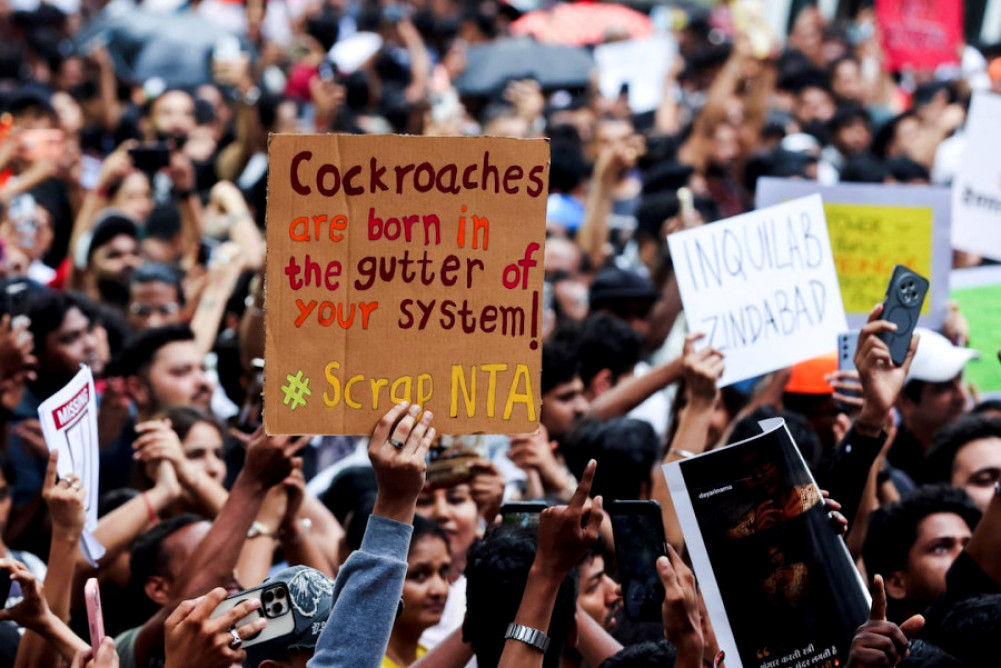
The Cockroach Janata Party is a unique product of its own kind and its own time. It is a rebellion of vulnerable youths confronting a ruthless and vengeful government. The government, for its part, has already demonstrated just how merciless it can be toward its opponents.
We use Google Cloud Translation Services. Google requires we provide the following disclaimer relating to use of this service:
This service may contain translations powered by Google. Google disclaims all warranties related to the translations, expressed or implied, including any warranties of accuracy, reliability, and any implied warranties of merchantability, fitness for a particular purpose, and noninfringement.
For the first time in years, I feel proud to be Indian. Just when all hope seemed lost, they arrived. From the union of a judge and a joke, the ‘Cockroach’ was born across India.
Chief Justice of India Suryakant had made insulting and arrogant remarks, calling unemployed young Indians ‘cockroaches’. In response, a student living in Boston, Abhijit Deepke, wrote on Instagram, ‘What would happen if all the cockroaches gathered in one place?’
Millions of people responded to this. Thus, the ‘Cockroach Janata Party’ (CJP) was born. Deepke became the ‘Pied Piper’ of the cockroaches. Its first demand was the resignation of Education Minister Dharmendra Pradhan. He was sitting proudly in a corrupt and rotten ministry (Pradhan resigned on Saturday). Question papers for public exams have been regularly leaked from this very ministry. According to opposition parties, about 152 question papers have been leaked since 2014. The lives of millions of young people who spent years preparing for exams have been ruined by these leaks. After the recent leak of the National Eligibility cum Entrance Test (NEET) question paper, 12 victimized and frustrated students committed suicide.
As the outrage of the ‘cockroaches’ grew online, Deepke returned from Boston on June 6 and went straight from the airport to Delhi’s famous protest site, Jantar Mantar. Renowned activist and education reformer from Ladakh, Sonam Wangchuk, also joined him and announced an indefinite hunger strike. Six university students (Neha Bora, Manish Kumar, Amin Amitosh, Danish Ali, Rishikesh, and Deepak) from the student organization of the Communist Party of India (Marxist–Leninist) Liberation, the ‘All India Students Association’, also announced they would join the hunger strike and took their place beside the stage. Protests began in other cities as well. As the health of those on hunger strike deteriorated, young people who had been active online began to show up in person at Jantar Mantar. The ‘Cockroach Janata Party’ announced a ‘Parliament March’ on July 20, the day the monsoon session of Parliament was to begin. Two days before the scheduled march, Sonam Wangchuk was removed from the stage by police. He was first kept under house arrest in a government hospital and later, at his wife’s request, in a private hospital. After the government assured two demands of the protesting students (compensation for those who committed suicide after the NEET question paper leak and no action against those arrested during the protests), he ended his hunger strike on the 26th day last Thursday.
Last Monday, the ‘cockroaches’ swept the capital city like a storm. They arrived by train, bus, airplane, and metro. Their numbers grew by the hour. Hours before the monsoon sky over Delhi brightened, tens of thousands began gathering at Jantar Mantar. By sunrise, it was clear—a generation of disappointed and angry youth, who had seen their future destroyed before their eyes, was coming to reclaim what their parents and grandparents had lost. They want to uphold our dignity as a people and as a nation. Through their immense courage, composure, and sense of humor, the protesters dispelled the fear of the government that had become second nature to all of us. By the end of the day, it was clear that this protest had become much bigger than the issues raised by the protesters or their leaders. The issue was no longer limited to Dharmendra Pradhan’s resignation. The entire system of governance, from top to bottom, was clearly corrupt and had begun to stink like a rotting corpse.
But both the police and the Home Ministry completely underestimated the capacity of the crowd that would surround Delhi on Monday. They tried every measure. They stopped buses, roads, and metro stations. It did not help. They tried to jam the internet. But the youth flooded the internet with memes and videos, making this effort fail as well. Of all places in the world, in Delhi, young women participating in the protest said they felt safe in the crowd. However, some did complain of police misconduct. We saw Muslims, Hindus, Christians, Sikhs, Buddhists, people of every caste and class coming together, helping each other, and protecting one another when facing the police. Instead of preaching or giving grand speeches, they demonstrated the beautiful India of our dreams.
Seeing this as a threat, the police welded their barricades together and used previously tested methods. They brought in trucks filled with stones and already damaged vehicles, so it could be shown that the youth had committed violence and the police were acting in self-defense. The police brought in a force of plainclothes thugs armed with sticks and iron rods. Before taking action, the Rapid Action Force (RAF) removed name tags from their uniforms. Loyal mainstream TV channels were lined up, ready to report lies. Some even hurriedly reported incidents that never happened. (In India, news is often about predictions of the future rather than the present.) But none of these methods worked.
The police and RAF indiscriminately beat people with sticks, breaking children’s heads and limbs. They fired tear gas. But the youth kept marching straight toward Parliament. As they approached Parliament, security personnel took position, aiming their AK-47s. Still, the ‘cockroaches’ kept advancing. And as they marched forward, they exposed the true nature of this government. A group of cruel people who do not understand the history and diversity of the country they rule is in power here. They only know how to hate, but not how to love or think.
As the marchers approached, the boastful Prime Minister was taken to a safe place. MPs were prevented from leaving the Parliament building. Their main objective seems to be to weaken the Constitution on a daily basis.
By evening, the police had destroyed the main stage at the protest site. As night fell, the youth reclaimed it once again. As the police retreated during the night, the ‘cockroaches’ stood and clapped sarcastically to honor them for beating children with sticks. Wah Modi ji π Wah π
It would be foolish to expect a major political change from this. But it would also be foolish to dismiss it as just an intoxicating moment. The TV channels broadcasting live kept spinning one conspiracy theory after another, claiming the movement was being run with foreign support. In India, this is nothing surprising. As a proud ‘andolan-jeevi’ (the mocking term Modi used for people like me), I have been worried about this movement since it began. I was concerned that we might be heading toward another Anna Hazare moment. The so-called anti-corruption movement of Anna Hazare in 2011 (whatever its initial intentions) ultimately gifted three terms of power to a political party that destroyed every institution in the country. This party neither respects the country nor its citizens. It has shamed us internationally and brought India to its knees.
But my doubts about the Cockroach Janata Party (CJP) were dispelled when I saw the hostility of the mainstream media toward them. Its founder, Abhijit Deepke, is from the Dalit community. And I was even happier that no one made caste the main issue.
I heard him speak only recently. He said, ‘If my name were Khalid or if I were Muslim, I would already be in jail.’ He had the courage to expose India’s ugliness. In our country, nothing (especially the law) applies equally to everyone. Everything depends entirely on your religion, caste, class, ethnicity, and gender. This was a deep observation, presented simply.
I also knew that when Deepke chose the name ‘Khalid’, he might have been referring to Umar Khalid. Umar Khalid is a scholar from JNU. He, along with Sharjeel Imam and many others, has been in jail for about six years without any charges. What was Umar’s crime? During the 2020 protests against the Citizenship Amendment Act, he urged protesters to remain non-violent. One appeal after another for his bail has been rejected by judges. Those judges seem to have lost the courage to distinguish right from wrong.
As the ‘cockroaches’ marched and their numbers grew, I found myself thinking—by God’s grace, most of them are not Muslim, Sikh, Christian, or Adivasi. Otherwise, they would have already been shot or jailed. By God’s grace, they are not Kashmiri. They could have been blinded (though some have been hit by pellets). Thank goodness most of them are Hindu. This shows how tragic this moment is in India. However, the context can change in a minute.
We say we are in a ‘developing situation’. Reports are coming in that thousands of paramilitary forces are being flown in from other states. We do not know what will happen in the coming days. Where does all this leave us? The 24-hour TV channels have not prioritized the movement that has lasted for weeks. The Cockroach Janata Party has only itself and the internet to rely on. Unlike the Anna Hazare movement, which was infiltrated and captured by the Rashtriya Swayamsevak Sangh, with the BJP under Modi gathering at the gates and TV-generated frenzy ready to be exploited electorally, the ‘cockroaches’ are not even organized.
This cockroach rebellion is just one of many protests happening across India. Adivasis in Madhya Pradesh are protesting the Ken–Betwa river-linking project. Villagers in Uttarakhand are protesting the mass felling of trees. Some people are protesting the environmental destruction of the Great Nicobar Islands. Manipur is boiling. Jobs are disappearing. Prices are soaring. Anger is rising. And the BJP–RSS’s ‘God’ game is being exposed—it is a sham, a thug-run gold rush. The loot of the Ram Temple in Ayodhya has given us the plot of a bad movie. This story is unfolding before our eyes—shiny godmen and corrupt politicians are building hotels, amassing property, riding around in SUVs, and attacking the faith of the poor and innocent. The tentacles of corruption and daylight robbery have spread to the highest levels.
Can the energy of the ‘cockroaches’ pull us out of this pit? It is not easy. The outcomes of mass movements in India are not encouraging.
In the 1960s and 1970s, various movements, including the armed Naxalite rebellion, demanded redistribution of property and land to those who tilled it. But they were suppressed. In the 1980s and 1990s, social movements (including the Narmada Bachao Andolan and later the struggles of Maoists in Andhra Pradesh, Chhattisgarh, and Jharkhand) fought against the displacement of farmers and Adivasi tribes from their land. In other words, they wanted to prevent the poor from being robbed of what little they had. But they too were suppressed.
By the 2000s, people were forced to settle for the National Rural Employment Guarantee Act. This law gave the right to three months of employment at minimum wage. The amount earned from this is equal to the price of a meal at an expensive city restaurant. Even that law has been sidelined by this regime. Instead, people are being thrown rations (bags of food grains with Modi’s face on them) from moving cars, as if giving alms to beggars, as if giving gratitude and votes.
As the economy declines, even this basic relief is at risk.
Today, in 2026, we are being forced to fight for our right to vote and for our citizenship. The Citizenship Amendment Act (CAA) and National Register of Citizens (NRC) are the ‘Hindu Rashtra’ version of Nazi Germany’s 1935 Nuremberg Laws. Under those laws, German citizenship was granted by the ‘Third Reich’ based on ‘ancestral documents’.
After the killing of protesters and imprisonment of activists, the anti-CAA–NRC movement weakened, and the pressure of the movement forced the government to slow the implementation of those new laws. But now, the CAA–NRC has returned in the form of the ‘Special Intensive Revision’ (SIR) of the voter rolls, which many understand to be targeted at Muslims.
We have been told that even our passports are not proof of citizenship. Millions of people are being removed from the voter rolls, and the entire country is wandering in search of ‘ancestral documents’. We do not know where we stand. Are we legal or illegal? Do we have any rights? Who among us will have to live in those large detention camps built for ‘doubtful citizens’? Will we spend our days running to tribunals? Because fascists always love chaos and confusion.
Our fear and pain may make us overly optimistic about the ‘cockroach’ rebellion. Some have already compared it to the youth uprisings that brought regime change in Bangladesh, Nepal, and Sri Lanka. Some have compared it to the movement led by Jayaprakash Narayan, which brought down Indira Gandhi in 1977. But these comparisons are not relevant. The Cockroach Janata Party is a unique product of its own kind and its own time. It is a rebellion of weak youth facing a ruthless and vengeful government. The government, for its part, has already shown how merciless it can be toward its opponents.
Where does such confidence come from in a ruler losing popularity, who gives no concessions to the people who vote for him? Perhaps he believes he has successfully turned the electoral business in his favor. He has the machines under control. There are flaws in the process of forming the Election Commission, and now it cannot be trusted to be impartial. Electronic voting machines have been manipulated. Millions of real people have been removed from the voter rolls, and millions of fake names have been added. The officials overseeing the elections are fully complicit. The courts may delay or turn a blind eye to serious irregularities. The police do not know what impartiality means. On the other hand, the media bows its head the moment anyone in power points a finger.
The ruling party, the Bharatiya Janata Party (BJP), is restructuring constituencies to its own advantage. So what does the ruling party have to fear? Why should it listen to anyone? It is the richest political party on earth, supported by the world’s wealthiest industrialists. It can buy anything and anyone.
But can this game go on forever? Can all the people be fooled forever? Can a country of 1.5 billion people be dragged along like a corpse forever? No, it cannot. The ‘cockroaches’ have already come out. Farmers have once again begun marching toward Delhi. This time, they are protesting the US–India agreement.
The city’s borders have been ‘sealed’, but that is unlikely to stop them. The youth have given us a gift, and it is the responsibility of each of us to make their actions meaningful.
Once the Prime Minister flees physically, the day he flees politically will not be far off. But this regime will not go easily. This power is not ready to be humiliated in the capital city. There is every possibility that we will see bloodshed. The patience of the youth is breaking. In that young and agitated crowd, how long will it take for someone to lose their composure and give the police an excuse to open fire? They will do everything they can to break us, so we must do everything we can to stop them.