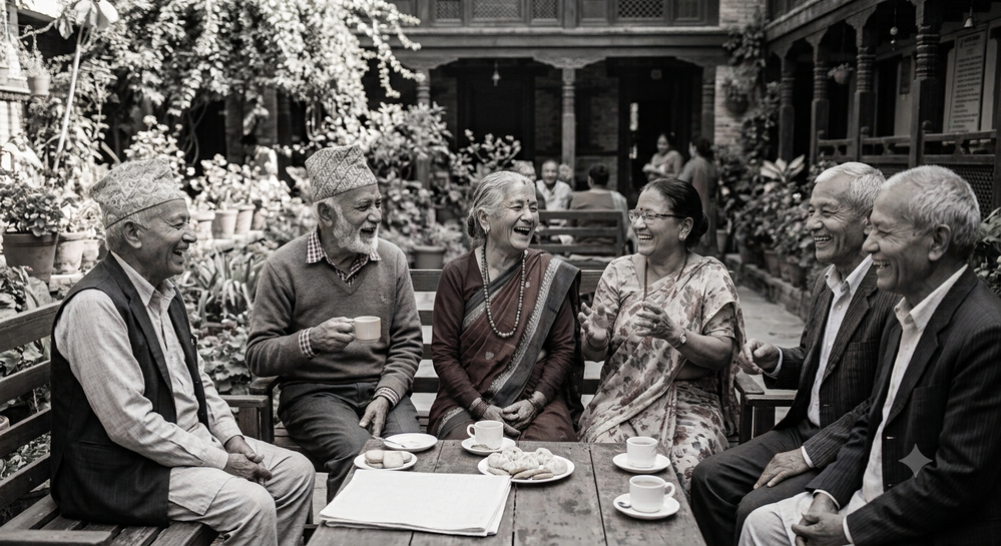
The monetary assistance that has been provided to the elderly until now is necessary, but it is not sufficient. In the days ahead, an integrated social security policy that includes not only financial support but also family care, respect, hospitality, compassion, and social harmony will be the sustainable path.
We use Google Cloud Translation Services. Google requires we provide the following disclaimer relating to use of this service:
This service may contain translations powered by Google. Google disclaims all warranties related to the translations, expressed or implied, including any warranties of accuracy, reliability, and any implied warranties of merchantability, fitness for a particular purpose, and noninfringement.
The World Health Organization (2014) and Nepal’s Senior Citizens Act (2062 BS) define citizens aged 60 years or above as elderly. However, for the sake of social justice, Nepal provides monetary support in the form of social security allowances to senior citizens based on two age thresholds: 60 years for Dalits and those from remote areas, and 68 years for non-Dalits. This difference in age groups clarifies the concept of positive discrimination. In the fiscal year 2081/82 BS, approximately 1,692,163 senior citizens received old-age allowances.
Since 1994, Nepal has been providing cash assistance under non-contributory social security programs to targeted groups as specified by law. In the early days, only citizens above 75 years benefited from this service, but over time, the age threshold was reduced to 70 and then to 68 years. The past practice of lowering the age threshold and increasing the cash amount has placed a financial burden on the national treasury. As the government has begun to discuss raising the age threshold again, this program has become a contentious issue.
Is it appropriate to raise the age threshold?
There are two types of intellectual arguments behind this debate. The first, put forth by various economists and policymakers, argues that the age threshold should be raised by comparing it to the national average life expectancy. They contend that in countries like Nepal, which have limited resources, lowering the age for non-contributory social security allowances sharply increases the number of beneficiaries, placing a heavy financial burden on the state treasury and reducing opportunities for investment in productive sectors. As the average life expectancy of Nepalis increases, raising the age threshold would boost national capital formation and provide greater opportunities for investment in employment-generating sectors. Therefore, it is argued that increasing the eligibility age from 70 to 75 would reduce the long-term financial burden on the state and make the service more sustainable.
Demographers and development economists of the second school of thought argue that the issue should be viewed from the perspective of social justice and that the age threshold should not be raised. They assert that as the state treats all citizens equally, the development of the well-off and the disadvantaged cannot proceed at the same pace, and the gap between the two groups will widen. According to their argument, the disadvantaged are mainly affected by economic hardship, loneliness, physical weakness, powerlessness, low income, social exclusion, and voicelessness. They argue that the state should ensure these groups experience social justice to mitigate such social problems. Data from the National Statistics Office (2078 BS) shows that the average life expectancy of people from remote areas, Dalits, Madhesis, Muslims, and minority communities is about 3 to 5 years lower than the national average. The study by Ranabhat (2076 BS) shows that the work capacity of the poor in remote and marginalized areas, who work as daily wage laborers, declines before the age of 65, and that raising the age threshold puts the greatest risk on the elderly from poor, disadvantaged, and marginalized groups.
Contributory or non-contributory?
The allowance provided under Nepal’s social security system is non-contributory. However, there is currently a debate about contributory services. The contributory system reduces the state’s financial burden and is sustainable in the long term. However, in Nepal, 65.5 percent of the population over 10 years of age is economically active. Of these, 84.6 percent of the labor force is engaged in the informal sector. They mainly work in unorganized sectors and have not yet been able to join the contribution-based social security fund. If the age threshold is raised for those unable to participate in contributory social security, they will be at even greater risk.
International practice
Japan is the country with the world’s oldest population. In the first six months of 2024, 37,227 elderly people in Japan were found to have died alone, most of whom were over 65 years old. Of these, the deaths of 3,936 people went unnoticed for one to three months, according to a study by Jinhu (2025). Such deaths are referred to as dying alone (kodokushi in Japanese).
The monetary assistance provided to the elderly so far is necessary, but not sufficient. In the coming days, an integrated social security policy that combines financial assistance with family care, respect, hospitality, compassion, and social harmony will be a sustainable path. According to his study, the reasons for this situation in Japan include the rapid change in the traditional three-generation family system following the fast economic development after World War II, urbanization promoting small families and solitary living, young people migrating to big cities, and the breakdown of community ties despite sufficient government care (such as nursing homes and home health services), resulting in elderly people becoming socially isolated. The size of Japan’s old-age allowance is many times greater than that of our country, and health services are also excellent. However, solitary deaths have not been prevented.
Norway ranks among the world’s happiest and most egalitarian countries. It also has a high elderly population. However, the welfare measures for the elderly there are exemplary. Under Norway’s Nordic welfare system, a universal, non-contributory pension is provided from the age of 67. The most important aspect is the tradition of informal solidarity in Norwegian society.
There, in restaurants and cafes, there is a “suspended meal” (pay it forward) system where someone pays in advance for another person’s food or coffee. Then, if a helpless or elderly person wishes, they can receive a free meal.
In South Korea, after the problem of godoksa (solitary death) spread, the government introduced a basic pension scheme. Under this scheme, the poorest 70 percent of the elderly receive assistance. In Thailand, although there is a separate allowance for poor elderly people alongside the national savings fund, problems with implementation and access are evident. According to the UK Office for National Statistics 2024, despite the provision of health services and state pensions, incidents of loneliness and solitary death among the elderly have increased due to budget cuts for service improvements.
Conclusion
The age threshold in Nepal should be redefined. Setting the minimum age threshold at 68 and distributing financial assistance allowances through a three-tier age group (68–70, 70–75, and above 75) could be just and rational from social, economic, and political perspectives. This is because as people age, they require additional services and facilities. In addition, to reduce the financial burden of non-contributory financial assistance programs on the state, it would be appropriate to adopt a multi-option policy such as providing financial assistance to the most disadvantaged and marginalized communities based on identification, and senior citizen allowances based on economic status.
The monetary assistance provided so far is necessary but not sufficient. In the coming days, an integrated social security policy that combines financial assistance with non-monetary services such as family care, respect, hospitality, compassion, social harmony, high moral values and norms, and community support could be sustainable. Therefore, social security services should be provided based on economic deprivation, social exclusion, geographical remoteness, and mental and physical disability rather than age threshold alone. Providing these services through a mix of economic and non-economic support appears to be beneficial for Nepal.
Institutional capacity development, policy reform, community participation, revival of informal networks, and easy access to the state through cooperation among the government, community, cooperatives, and the private sector are the sustainable alternatives for social security.