The political culture that the Rashtriya Swayamsevak Sangh (RSS) is trying to build is an advanced democracy. What will happen if disorder grows within the party with the idea that breaking one culture means breaking another?
We use Google Cloud Translation Services. Google requires we provide the following disclaimer relating to use of this service:
This service may contain translations powered by Google. Google disclaims all warranties related to the translations, expressed or implied, including any warranties of accuracy, reliability, and any implied warranties of merchantability, fitness for a particular purpose, and noninfringement.
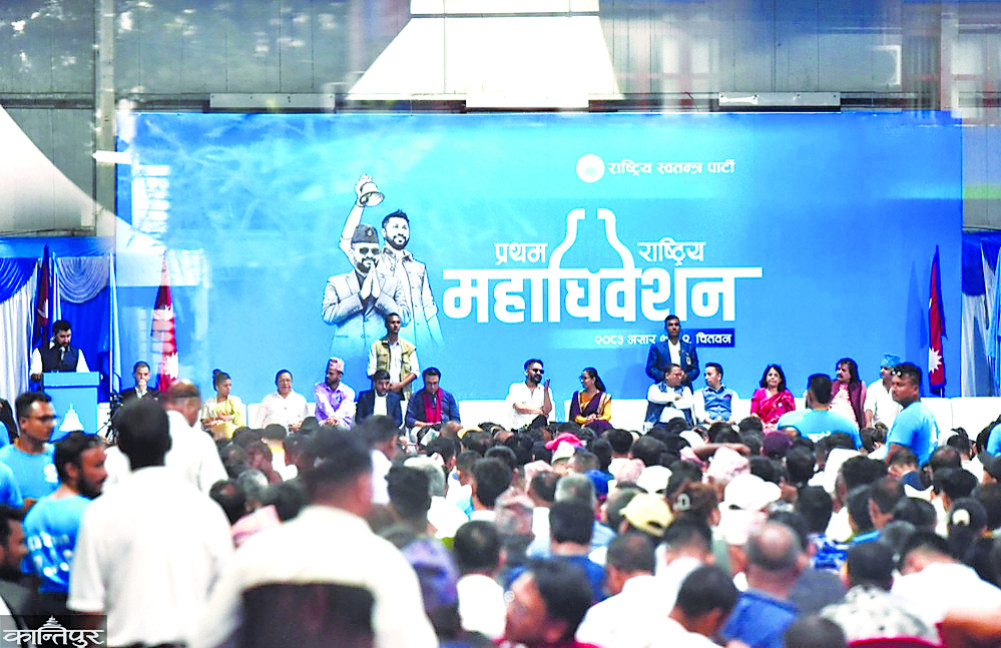
The floor was blue, the chairs on the carpet were blue, the walls of the hall were blue, and the banner hung on the stage was blue. Amidst such uniformity, all the sofas on the stage where the top leaders were seated were attractively white.
The above brief description is of the first historic general convention of the National Independent Party in the closed session.
There were/are many things to be proud of in being a Rashtriya Swatantra Party. I especially liked the new culture that the party was trying to create and the members who followed it.
The Rashtriya Swatantra Party had broken the distorted practice of placing special chairs or sofas on the stage and making half the people present at any event take their seats by adding the adjectives of guest, special guest, chief guest, allowing everyone on the stage to speak, the speaker addressing everyone on the stage by name, and making long speeches.
In any internal program of the party from the ward to the center, the central chairman was not present on the stage, and he was not allowed to take a seat . He was present or introduced in the foreground like a general member . No one was called or considered a guest, special guest, or chief guest in any program. He was called a speaker or chief speaker .
It was understood that keeping someone special on a high stage in a program and keeping others down in front was a continuation of feudal culture and class division Very few people spoke openly about what they did not like, and some even rejected it in their hearts but did not express it outwardly.
When the leaders were sitting in their own circle, everyone liked it down to the ground floor, so no one dared to reject it.
I remember vividly that during the 2079 House of Representatives elections, Speaker Ravi Lamichhane would come to Jhapa and address voters at some places. We said, ‘If you speak standing on the ground, people in the crowd cannot see you from a distance. A small stage can be built for eight thousand rupees, and we will spend it ourselves.’
‘The Speaker will address voters standing in the vehicle he is riding in, do not spend unnecessarily,’ was the center’s reply.
However, when the district convention was held on 23 Jestha 2083, in some district conventions, there were sofas on the stage and leaders and MPs were seen sitting on the sofas with their legs crossed. At the Koshi Pradesh Committee convention, dozens of leaders were seated on dozens of blue chairs on the large stage of the hall. All of them sat more prominently than their front-line colleagues.
Perhaps the same thing happened in other provinces and it was not noticed.
Since the inaugural session of the general convention was held on Asad 7, it was obligatory to do it as per tradition as guests from other parties besides the Rashtriya Swayamsevak Sangh were present.
On Asad 9, when the closed session of the general convention began. In the audience hall below, ministers, MPs and central members were allocated seats in the front and others in the back. The central office bearers, including the chairman and the prime minister, were seated on the white and special sofas described in the first paragraph above.
The leader who wrote the status at the airport not to bring food and garlands, not only accepted the stage, chairs and leader's seats used in the district and provincial conventions, but also used them himself in the general convention. This is a distorted culture that we have destroyed. The culture we have created is different, let's follow it, didn't anyone tell us?
President Ravi Lamichhane, who had the special seat reserved for him removed when he went to various programs as the Home Minister, also naturally took a seat on the white sofa of the stage.
The party of the poor, UML, collapsed after coming to power and reached its current decline. The Maoists' blood revolution, including the campaign against drugs and gambling, collapsed after the government's treason. And, they found that they could not carry the name of the party in the rest of their days, and they buried it in the skull of history. And, we all know that BP Koirala's love for farmers and the politics of the ideal faction of a handful of soil have made it a mess.
The political culture that the Rashtriya Swayamsevak Sangh is trying to build is advanced democracy. It is also to criticize one's own leader if you don't like it. It is to demonstrate behavior against nepotism and favoritism. It is to choose those who know. And, to give responsibility based on merit.
The political culture that the Rashtriya Swayamsevak Sangh (RSS) is trying to build is advanced democracy. It is also to criticize one's own leader if you are not satisfied. It is to demonstrate behavior against nepotism and favoritism. It is to choose those who know. And, to give responsibility based on merit. This political past is worth abandoning, not imitating. It is to become a fire from a spark, so not only this writer, but the fate and trust of the entire country are afraid of the beginning that seems like a spark.
If one of these customs is broken, why not break the other? If such thoughts continue to increase, what will happen?
Is breaking one's own customs different from strangling one's own children? Were those exemplary rituals only for gaining power?
What can be the correct answer to this question?
Giving up the desires to consider oneself special, to become luxurious, to look like a ruler can be the best answer. It is necessary to be serious about building a culture of virtue and sacrifice for development.
Only those who run the party-organization efficiently, run the country efficiently. This truth should always be kept with them when taking and giving responsibility.
With the success of the RSVP in 2079, added to the study of political science, there is no doubt that simplicity rituals will also become an important lesson along with two-thirds of 2083.
But, why did the culture that it had built itself suddenly collapse? The RSVP has come to build new rituals and culture by breaking the disorders and distortions in politics or adding them as needed. This was the belief of about 5.2 million votes. If the common people understand that everyone will abandon the ideals they demonstrated to get votes after coming to power, where will the level of mass depression reach?
Mass depression can affect others, just as it happened on Bhadra 23 and 24, 2082. Individual depression can affect oneself, whether Prem Acharya or Ganesh Nepali will emerge as the future leader.
The lesson that some leaders of the Rashtriya Swayamsevak Sangh (RSS) have failed to learn from the past and others is the illusion that they need a separate team to become strong.
In the digital voting for the selection of proportional candidates, leaders from other parties who were unconditionally integrated into the party were voted in and won. No one had given any instructions or circulars about it, it was the discretion of the party members. Despite such a close fact, the method of selecting candidates for direct elections was suspended. And so on and so forth was done.
Many leaders, MPs and ministers who joined the party just before the elections were elected as central members by the general convention delegates. Some may not have filed their candidacies because they thought they would lose due to this illusion.
The people gave two-thirds of the vote because they believed that Ravi Lamichhane and Balen Shah should come together. Party members who want Ravi and Balen to unite will never play the two leaders. This was the message of proportional candidate selection and the general convention. But why is there news of division of votes in the nomination of 51 central members and office bearers?
Is this just a game of those who want to play by tearing apart the historical political alternative and do not want the good of the country? Or have our top leaders been infected with the old chronic disease of choosing their own people?
Is the method of preventing the formation of panels at the convention and the instructions of both leaders false so that factions do not form? The answer to this question should be seen in the 51 members and office bearers nominated by the Speaker.
One of the main political reasons for the country not being able to become a country is factions. The Rashtriya Swayamsevak Sangh (RSS) was born on the same fertile soil and the collapse of Bhadra 23 and 24 is due to that. This is the people's wish that the Rashtriya Swayamsevak Sangh (RSS) should not become similarly fertile and no one else should be born on its soil.
Is what we have seen, written and spoken in line with the rhythm of the journey we have just been on? Let us close our eyes and contemplate. If the rhythm is in line with the rhythm, let us inform everyone and increase the speed. If not, let us return to the rhythm.
Even the parties with millions of determined and committed members amid a long history, struggle, sacrifice and a long journey, if they were to be left alone, the people would crush them like a pestle.
If the same story is repeated, the sins of the blood of the children shed on Bhadra 23 and 24 will be transferred from one place to another without being washed away. The Rashtriya Swayamsevak Sangh (RSS) will prove to be the biggest traitor and criminal in Nepali politics.
The nearly 5.2 million votes cast for the RSS are mixed with faith in a virtuous, selfless, honest, characterful, moral, and united politics. That is why the RSS has no excuse for committing this unforgivable crime.
Everyone who votes for the RSS and those who do not vote for it is unanimous that the establishment of the standards of the culture and tradition of the political party will never happen if it is not done now. If the people's confidence cannot be increased now, it will never happen.