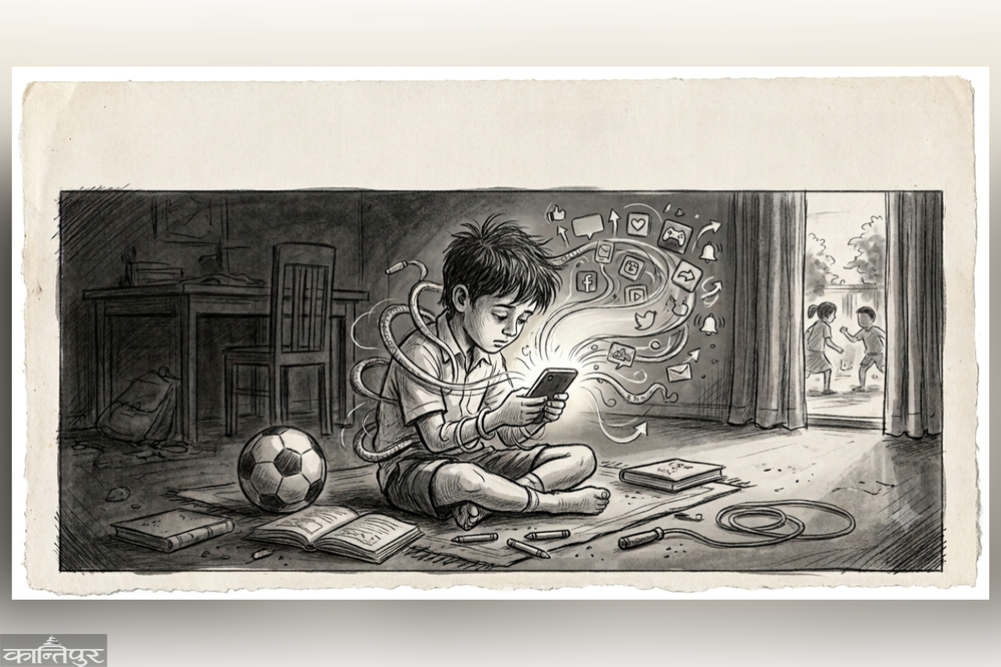
The need of the day is to become 'skilled' parents who teach their children the art of life, rather than just being 'good' parents who love them.
We use Google Cloud Translation Services. Google requires we provide the following disclaimer relating to use of this service:
This service may contain translations powered by Google. Google disclaims all warranties related to the translations, expressed or implied, including any warranties of accuracy, reliability, and any implied warranties of merchantability, fitness for a particular purpose, and noninfringement.
The parents of 7-year-old Arav, who was studying in Class 2 at a well-known private school in Kathmandu, were shocked after seeing the results and behavior of his son. ‘Your child has a severe lack of concentration, does not pay attention in class and never completes the experimental projects given for homework,’ the teacher said in the ‘Teacher-Parent Chautari’, while his head was bowed in shame and worry.
They had chosen the school for their son’s bright future based on the expensive fees, large building and English medium environment, but the same school had now become the main cause of daily stress for them. The school used to burden even the youngest children with excessive homework and difficult home projects to show their results, which Arav’s mother herself was forced to become a ‘part-time teacher’ every night to complete.
In fact, this problem is growing in cities today due to the increasing prevalence of urban life, single families and working parents. Today's parents are forced to completely depend on daycare centers or early childhood development centers (pre-schools) as soon as their children are born. A bitter truth is hidden in the busyness of urban life - today's children are looking for real parents, not just guardians, in their parents. But ironically, they are either locked in the room of the daycare center or in someone else's new arms. This is a deep emotional search for them, which requires the parents themselves to be close to them and spend time together.
Today's modern education system has changed. Experiential learning, the use of technology, and online work are prevalent. In this changing system, the direct participation of parents is sought around the clock. This is where today's parents are under the spell of 'good parents' and 'skilled parents'. Yesterday's time and education system were completely different. The old education system was very straightforward, simple and rustic, where only emphasis was placed on memorizing and scoring high marks in exams. And, after the parents admitted them to school, the rest of the work was left to the teachers. Children of that time grew up in joint families, where even when their parents went to work, they had the direct supervision and care of their grandparents, uncles, or aunts. After returning from school, those children of the older generation did not immerse themselves in any expensive equipment or visual aids, but rather learned social skills and cooperation naturally with their peers by playing with mud, stones, sticks, or flying kites in the yard. At that time, there was neither such a burden of homework, nor did parents have to stay up all night to complete project work.
However, today's modern education system has changed. Experiential learning, use of technology and online work are prevalent. In this changing system, direct participation of parents is sought around the clock. Here, today's parents are in the crosshairs of 'good parents' and 'efficient parents'. Today's parents are 'good parents', but in this complex world, they have failed to become 'efficient parents' who understand the psychology of the child, balance the use of technology and have practical skills in proper collaboration with the school. The main reason for this is today's modern digital lifestyle, i.e. the 'world of screens' and the serious impact it is having on the children's brain. Children do not go to the market and buy modern devices or smartphones themselves, but rather parents are becoming the 'first medium' to gift gadgets or internet content to their children for the first time or to show them videos.
Excessive exposure to visual media hinders the natural development of a child's young brain, resulting in a serious decline in language learning style, emotional balance and ability to concentrate. Its direct impact is seen in school studies. In the absence of this guidance, affection of a joint family and proper supervision, other serious negative behaviors and habits also start to flourish in children. When children do not get the right culture, time and quality communication at home or school, they develop the bad habit of teasing, belittling and mentally harassing their friends. Sometimes they learn obscene or vulgar words from the Internet, social media or the surrounding environment and use abusive language in the family and even at school. To correct such behavioral problems, it is necessary for both the school and the home to take steps 'jointly'.
Today, not only parents but also teachers are equally caught up in this cycle. The saying ‘Parents feel burdened, teachers too’ has become a bitter truth in today’s education sector. On the one hand, parents are stressed that half of the school work has been shifted to home amidst the busyness of work, on the other hand, teachers are also under mental pressure not only to teach, but also to continuously evaluate each child, prepare teaching reports and respond immediately to messages from hundreds of parents. In this way, due to the excessive workload on both sides, the harmonious coordination that should have been between them is turning into a ‘mess’.
Rather than just being ‘good’ parents who love, the need of the day is to become ‘skilled’ parents who teach children the art of living. The real solution to this problem can only be found when the distance between school and home is bridged and an environment is created where both sides can ‘win’. Teachers and parents are not competitors, but rather two fishermen in the same boat, whose common goal is the all-round development of the child. For this, schools should not burden children with difficult and burdensome projects that cannot be done at home, and parents should not make their children slaves to technology under the pretext of being busy.
Parents should set a positive example in front of their children by reducing their screen time. No matter how busy they are, they should completely turn off communication devices for at least half an hour a day and create an environment where they can sit on the floor with their children and play, listen to or tell stories. Modern technology should be banned from the dining area and bedroom at home.
To become an effective parent, a reward system based on the child's life skills and the right investment in real skill development should be made. Instead of giving chocolates, expensive toys or computer games as a temptation, rewards should be linked to the gift of experience and time. For example, going hiking together on Saturdays, teaching swimming or drawing, or giving the responsibility of helping in the kitchen to cut salads and decorate dishes safely. This increases self-reliance, choice of the right language, and decision-making ability in the child.
Paying expensive school fees or buying material comforts is not just an investment. Skilled parents should teach children financial literacy to manage their expenses from an early age. Instead of letting them step in and solve problems when a toy breaks or when they have a fight with a friend, they should make them think and develop the skills to solve problems on their own. And, when a child gets angry or cries, they should also be taught to manage their emotions through calm behavior without getting angry.
When parents invest their time, skills, joint practical efforts, and right values in their children instead of material goods, then the burden of school is also reduced and peace reigns at home. This is the real and beautiful solution of modern education.