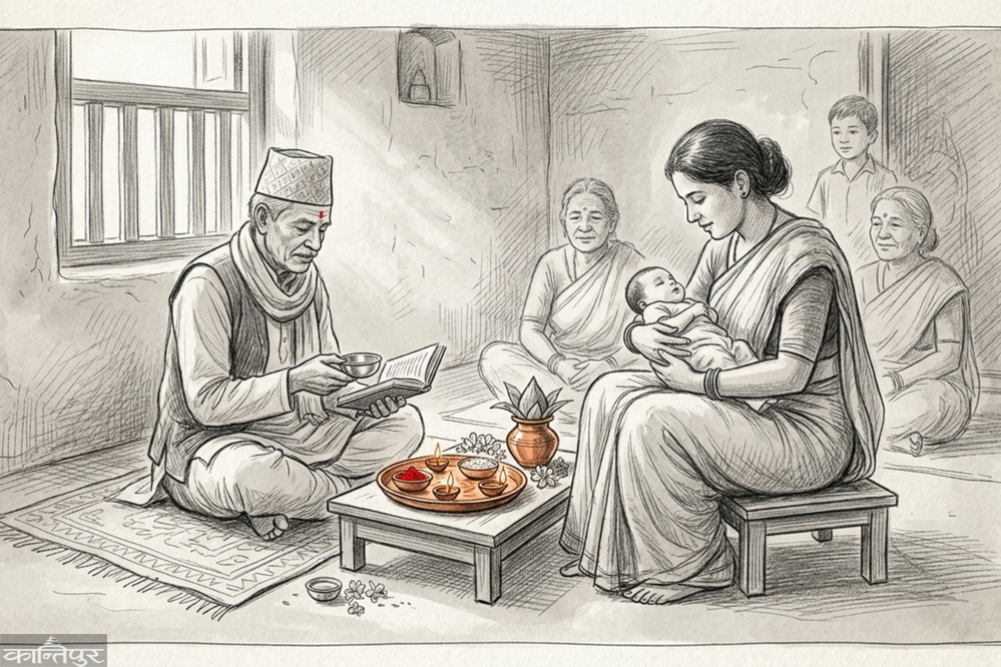
If marriage is an important ritual, why is it that even today, in some places in Karnali, girls are not married? The remnants of Chhaupadi and child marriage in Karnali are different forms of unequal thinking.
We use Google Cloud Translation Services. Google requires we provide the following disclaimer relating to use of this service:
This service may contain translations powered by Google. Google disclaims all warranties related to the translations, expressed or implied, including any warranties of accuracy, reliability, and any implied warranties of merchantability, fitness for a particular purpose, and noninfringement.
The first of the sixteen rituals of Hinduism is the formal ritual – Nwaran. This ritual, which is performed on the eleventh, twelfth or twenty-first day after the birth of a newborn baby according to family tradition and local customs, is not just a naming ceremony – it is also the first method of accepting the baby religiously, socially and culturally. According to Hindu religious beliefs, it is believed that after Nwaran, the family can begin religious and social work. Therefore, Nwaran is also the first social and religious right that a boy or girl receives at birth.
But, if Nwaran is such an important ritual, why is Nwaran not performed on girls even today in some places in Karnali? Why is the same ritual celebrated when a son is born and not considered necessary when a daughter is born? Who gave society the right to honor one of the two children born from the same womb and deprive the other of it?
Religion has not made any such discrimination. It is not written in any Hindu scripture that ‘daughters should not be given alms’. Rather, religion has given women the highest place of respect – ‘Wherever a queen is worshipped, there the gods are worshipped.’ If religion has taught women to respect women, why was the first rites of passage for daughters stopped?
This is not a problem of religion, but of society. This is not the fault of scripture, it is the weakness of our consciousness. Religion has not taught us to discriminate against daughters, society has.
This is a picture of the society that I have seen with my own eyes. I am the daughter of that society, where when a son is born, the whole village is happy, but when a daughter is born, there is silence within the house. I have seen with my own eyes – in a house where there was no celebration when three daughters were born, when a son was born as the fourth child, relatives from all over the village were invited and the ceremony was held with great pomp and show. Why is the joy that is not shared when three daughters are born divided when only one son is born?
This may seem exaggerated to some readers. However, it must be said with sadness that this is still the reality of many villages in Karnali. It is not written in any Hindu scripture that ‘daughters should not be given birth’. Rather, religion has given women the highest place of respect – ‘Yatra Naryastu Pujayante Ramante Tatra Devta:’ If religion has taught women to respect women, why was the first ritual of a daughter stopped?
We say – daughters and sons are equal. The constitution has given equal rights. However, in practice, this is not the case. If daughters are not given the same respect as sons, then the talk of equality is limited to paper only. Discrimination against daughters does not start by not sending them to school, it does not start by not giving them rights to property. Discrimination begins within a few days of birth, when the first rites of passage are not performed.
Today, it is said that literacy has increased in Karnali. Schools have opened, roads have been laid, and access to communication has expanded. But, if education cannot change thinking, what is the meaning of that literacy? Knowing letters and being aware are not the same thing. Getting a degree and abandoning discrimination are not the same thing. If even after studying, the birth of a daughter is not considered necessary, then where has the purpose of education been fulfilled?
The saddest thing is that such thinking is not limited to uneducated society. Even educated, wealthy, city-dwelling and modern people put their sons above their daughters in their own homes. The people who speak about women's rights and write in favor of equality are repeating the old discrimination in practice. So I ask again - if education cannot change thinking, then for whom is that education?
Even today, it is easily heard in society – daughters are a caste that goes to strange houses. This one sentence has changed the direction of the lives of thousands of daughters. Due to this thinking, enthusiasm for the birth of a daughter is reduced, investment in education is reduced, property rights are weakened and in some homes, even her first rites are not considered necessary. Who gave society the right to make a daughter born from the same womb a stranger in her own home?
We hear over and over again – sons are needed to continue the lineage, to perform funerals, to give a funeral. However, one question is always missing – does a daughter not serve her parents? Has religion rejected the work done by a daughter? If not, on what basis are we considering a daughter less?
Not giving birth to a daughter is not only skipping the normal religious process – it is also weakening the first social identity of a daughter. This is putting her existence as a second priority from the day of birth. This discrimination then spreads to education, property, marriage, employment and decision-making rights. Problems like Chhaupadi, child marriage, domestic violence and untouchability are also different forms of this unequal thinking.
The government has introduced programs like 'Save the daughter, educate the daughter', scholarships, daughter insurance, 'Bihebari Bis Barsha Pari'. However, policies alone cannot change the mindset until the daughter is given equal respect on the day of birth. Change does not start with speeches, but with behavior within the home. Change starts when the birth of a daughter is celebrated equally as much as the birth of a son.
I grew up in this society, I have seen the reality of this society, I have felt the pain of this society. And, I am also one of the daughters who were not given birth.
I leave the society with one question – where does a society that cannot give the birth of its own daughter the same respect as a son, a society that cannot even perform her first rites of passage equally, get the right to call itself civilized, developed and egalitarian?