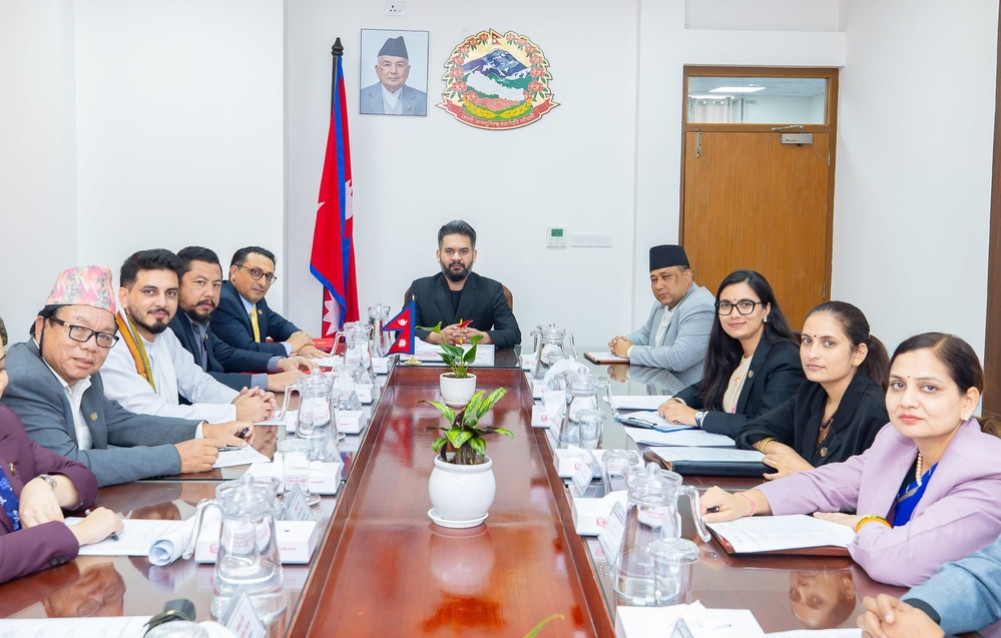
If we are to congratulate the government on reaching 100 days, it should not be out of enthusiasm, but as a sign that it has started its journey in the right direction. And if we are to ask questions, it should be out of expectation for better governance, not out of opposition.
We use Google Cloud Translation Services. Google requires we provide the following disclaimer relating to use of this service:
This service may contain translations powered by Google. Google disclaims all warranties related to the translations, expressed or implied, including any warranties of accuracy, reliability, and any implied warranties of merchantability, fitness for a particular purpose, and noninfringement.
After 100 days of government in Nepal, a question inevitably arises - has the government succeeded or failed? But this question is incomplete.
100 days is not the right time to make a final assessment of any government. But 100 days is enough time to understand in which direction the government wants to move, what its priorities are, what is the style of governance, and how strong the political will for reform is.
No government can change the country in 100 days. It would be impractical to find solutions to economic, administrative, and political problems that have accumulated over decades in 100 days. But this does not mean that 100 days are of no importance. 100 days show the government's thinking, working style, and approach to governance more than its achievements. Therefore, I have taken 100 days of government as an indication of the government's direction rather than a list of achievements.
In many democratic countries of the world, the first 100 days of government are seen as an important political and administrative indicator. It is said that the practice of looking at 100 days of government began during the time of US President Franklin D. Roosevelt. After he rapidly implemented legal and administrative reforms in the first hundred days during the Great Depression in 1933, the ‘first hundred days’ became a benchmark for measuring the direction, decision-making capacity, and political will of a government. Since then, in many democratic countries, the first hundred days have been evaluated as an initial indication of the government’s priorities, working style, and direction of reform. The same approach is needed in Nepal. Let us neither make the first hundred days an opportunity to exaggerate achievements nor a basis for a final verdict of failure. Instead, let us make it an opportunity to review whether the government is moving in the right direction based on facts.
Nepal has changed many governments in the past decades. The prime minister has changed, the ministers have changed, the coalition has changed, and the slogans have changed. But the state that citizens experience has not changed. Problems such as slowness in government offices, ambiguity in decision-making processes, the suffering they experience while receiving services, political interference, and lack of accountability have not changed even when the government has changed. This is why the perception has been formed among Nepali citizens that the governance will not change even if the government changes. This disappointment was also the main factor that made Nepalis frustrated. The Nepali citizens expected the government formed after the 21 Falgun elections to change that disappointment. Therefore, it is necessary to look at the first hundred days in this context.
In my opinion, the first and biggest achievement of this government is not a single policy or decision. The biggest achievement of this government is to rekindle the citizens' trust in the state. Making the citizens hopeful about the state is the achievement of this government in its first hundred days. The young generation has started to monitor the government's decisions. What the ministry did, what the cabinet decided, what issues are being discussed in the parliament, and what the pace of reforms is are starting to come to the center of public debate. And, the largest number of young people are involved in this debate. This is not a change that can be ignored in democracy. Democracy weakens when citizens stop expecting from the government. In that sense, rebuilding public trust is a great political capital.
The 100-point action plan for good governance and administration reform that the government made public soon after its formation is also an attempt to send a message to instill trust and confidence in the government among the citizens. Commitments and practices such as setting deadlines for ministries and results, making service delivery effective, expanding the digital system, reducing administrative delays, increasing transparency, and strengthening accountability have brought governance reform to the center of the national debate. In Nepal, political debates often focus on power relations, party competition, and individuals. However, in the last 100 days, this debate has focused on good governance, service delivery, administrative reform, and accountability. The focus on citizen convenience rather than political party squabbles and power relations is the first sign of change.
Through the 100-point action plan for good governance and administrative reform, which the government made public within 48 hours of its formation, the government tried to present itself as a reform-oriented government by prioritizing issues such as ‘administrative restructuring, review of ministries, digitization of public service delivery, time-based performance, frugality in government spending, corruption control, and accountability of public officials.
This brought good governance to the center of the national debate and also raised expectations among citizens. But the value of any action plan is determined not by its announcement, but by its implementation. Although initial signs of some improvements have been seen in the first 100 days, some commitments have not been implemented on time and there is still a gap between the announcement and the performance. For this reason, the government should not make new announcements in the next 100 days, but should focus on strengthening the citizens' trust in the government by transforming the commitments made earlier into results.
Another notable aspect of these 100 days is the effort to send a strong message against corruption. The commitment to take action against misuse of public office, property investigation, and irregularities has raised expectations among the citizens. However, the campaign against corruption should not be limited to individuals but should be carried out through legal process, impartial investigation, and strong institutions. Otherwise, the work done with good intentions today cannot be free from accusations of political vendetta tomorrow. In a democracy, the process adopted to reach that result is equally important along with the result. Therefore, the process must be completed in any type of legal action. Otherwise, there is a risk of being labeled as political vendetta. Good governance should not be a political slogan of any government or party, but should be focused on creating a permanent culture of the state.
There are also some serious questions about the government. As strong as the commitment to good governance has been, the pace of institutionalizing it has not been strong. There was a lack of adequate public dialogue in some decisions. The government appeared to be more defensive than necessary on some issues. Political silence was felt more than accountability on some issues.
A change of government means not just a new face, but also a new political culture. Therefore, the government must show maturity to accept criticism as an essential part of democracy, not discomfort. The rule of law must be made to feel that it applies equally to everyone. The process must be placed above the individual. Only if the government itself can become its harshest critic will the hope seen by citizens be transformed into long-term trust.
The common citizen has not yet felt a major economic change in their daily lives. The market remains sluggish. The private sector is not yet fully confident. It will take time to see clear positive signs about job creation, production growth, investment expansion, and the future of the youth. The debate on good governance is important, but until citizens feel its impact in their own lives, good governance is just a slogan.
Many of the reform plans announced by the government are still in the implementation stage. In Nepal, the tradition of governments making many announcements but being weak in implementation is not new. If the gap between announcement and implementation cannot be reduced, the rhetoric of reforms risks being as limited as the previous government's announcements. In a democracy, citizens evaluate the results more than the government's intentions.
In my opinion, the biggest test of this government begins now. Because initial enthusiasm is always high. Real leadership is proven through difficult decisions, continuous implementation, and institutional reform.
In this context, a serious question arises, are we again looking for the rule of a good person, or are we building a good system? Nepal's politics has long been person-centered. We have repeatedly looked for honest leaders, popular leaders, and powerful leaders. But no person is permanent. The government changes, the leadership changes, but the institution must survive. If the reforms that have begun now are limited to the working style of one prime minister, those reforms may weaken with the change of government. But if those reforms are transformed into laws, procedures, digital systems, administrative culture, and public institutions, their impact will last for years.
Therefore, if we are to congratulate the government on the occasion of reaching 100 days, it should not be for enthusiasm, but as a sign that it has started its journey in the right direction. And, if we are to ask questions, it should not be for protest, but for the expectation of better governance.
However, expectations are still high.
On the issue of Sukum residents, we expect the government to find a balance between human sensitivity along with the implementation of the law. We hope that the Prime Minister will be established as a more open, more accountable and able to listen to criticism. We expect the government to make any decision based on the constitution, law and its own conscience rather than the zeal, frenzy and power of the government. We want the opposition to be more effective, fact-based and result-oriented. And, the biggest expectation is with us citizens – let us not be blind followers of the leaders, but conscious guardians of democracy.
Because, in a democracy, not only the government is under surveillance, the conscience of the citizens is also constantly tested. As the voice of the streets, we are still on the streets. We are not on the streets just to applaud or throw stones, but to support when necessary, to warn when necessary. We are closely monitoring this journey of change, taking note of every decision of the government.
Citizens who can praise good work and point out weaknesses when they make mistakes are the guardians of democracy. The government should be given time to work, but accountability cannot be postponed in the name of time. Similarly, it is not fair to declare all the efforts made by the government as a failure just because not all problems were resolved in 100 days.
The 100 days have made one thing clear – the expectations of the citizens of Nepal have increased again. Citizens have now started demanding speed, transparency, accountability and results from the government. This is a positive sign for democracy. Now the responsibility of the government is to continuously convert those expectations into results.
And, the responsibility of the citizens is equally great. We must learn to evaluate the government not on the basis of individuals, but on the basis of building a system. Because, a prosperous democracy is built when good governance is based on strong institutions, not on the goodwill of any one person.
Perhaps the biggest message given by the first 100 days of this government is this – Nepal is now searching for a new governance culture, not just a new government. Whether that search will be successful or not, the next hundred days will tell.