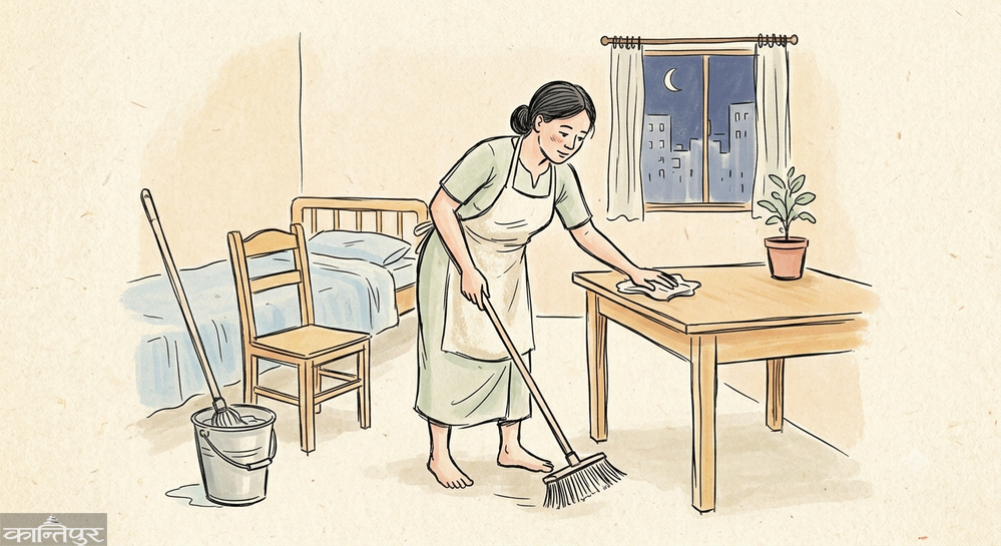
Many domestic workers still do not have effective access to labor protection, social security, occupational safety and health, written contracts, and mechanisms for filing complaints against violence and exploitation. The scope of the minimum wage remains the biggest weakness.
We use Google Cloud Translation Services. Google requires we provide the following disclaimer relating to use of this service:
This service may contain translations powered by Google. Google disclaims all warranties related to the translations, expressed or implied, including any warranties of accuracy, reliability, and any implied warranties of merchantability, fitness for a particular purpose, and noninfringement.
Fifteen years ago, on a sunny day in June, millions of domestic workers around the world received long-overdue recognition in Geneva. The adoption of the Domestic Workers Convention, 2011 (No. 189) by the International Labour Conference was a historic achievement. For the first time, domestic work was recognized as work equal to any other, deserving the same rights, protection, and dignity as other forms of employment.
Domestic workers play an extremely important role in sustaining families, society, and the economy. They clean homes, cook meals, take care of households, and tend to gardens. They care for children, the elderly, and persons with disabilities, enabling millions of people to participate in the labor market and community life.
Yet, despite such significant contributions, domestic workers are among the most undervalued, least protected, and least represented workers in the world. The majority are women. Most work in informal arrangements, where their access to labor rights, social security, and safe workplaces is limited.
The Domestic Workers Convention, as an international labor standard, established the principle that domestic workers are entitled to the same rights and protections as other workers by recognizing them as workers.
In the fifteen years since the Convention was adopted, there has been some progress. By 2021, the number of domestic workers covered by labor laws worldwide had increased by 15 percentage points. Many countries have expanded legal protections, improved working conditions, and strengthened institutions that enforce workers’ rights. However, this progress has not reached everyone.
Millions of domestic workers still face long working hours, low wages, unsafe working conditions, and exclusion from social security systems. Because much domestic work is informal, many workers remain vulnerable to workplace injuries, illness, and poverty in old age.
For migrant domestic workers, these challenges are even more complex. Restrictive migration policies, recruitment costs, language barriers, dependence on employers, and fear of losing legal status put them at greater risk.
Today, the protection of domestic workers is more urgent than ever. Due to population aging, changes in family structure, and increasing participation of women in the workforce, the demand for domestic work and care services is rising rapidly. Meanwhile, digital transformation, climate change, and conflict are reshaping labor markets and creating new risks. Without decisive action, more than 75 million domestic workers worldwide could be at risk from deteriorating recruitment processes and working conditions, as well as increased vulnerability to child labor and forced labor.
Millions of domestic workers still face long working hours, low wages, unsafe working conditions, and exclusion from social security systems.Nepal has made significant progress in recognizing domestic workers. The Labor Act’s recognition of domestic work as a special category of service, provisions in the Civil Code regarding minimum age, compulsory education, and employer obligations, the role of local governments in registration, and recent initiatives to include informal workers in social security have laid the groundwork for greater alignment with ILO Convention No. 189.
These reforms have laid the foundation for greater protection and recognition of domestic workers as workers in Nepal. However, a recent analysis of Nepal’s legal framework compared to the standards of the Domestic Workers Convention reveals that significant gaps remain. Many domestic workers still lack effective access to labor protection, social security, occupational safety and health, written contracts, and mechanisms to file complaints against violence and harassment. The scope of minimum wage remains the biggest weakness.
Domestic workers often work in informal arrangements, which leaves them vulnerable to exploitation and makes it difficult to enforce their rights. Concerns also persist regarding child domestic labor, barriers to collective bargaining, caste-based discrimination, and additional risks faced by migrant domestic workers.
These findings highlight an important reality: recognition is the first crucial step, but it must be linked to implementation, monitoring, and reform to ensure that domestic workers receive the same rights and protections as all other workers. Therefore, the next phase of reform must focus not only on recognition but also on enforceable rights, concrete plans, and action.
Despite progress, the question now is: how can change be accelerated over the next 15 years? The way forward for Nepal is clear. Domestic workers must be fully recognized and protected through comprehensive legal and policy frameworks that reflect the realities of their work and respect their rights. This should include clear and consistent legal definitions, written contracts registered at the local level, minimum wages, working hours, overtime, equal treatment in rest and leave, social security, maternity protection, and effective access to occupational safety and health.
Special protection measures are needed for child domestic workers, live-in domestic workers, and Nepali migrant domestic workers. This should include the right to return home, protection against employers retaining documents, and strong monitoring mechanisms. It is equally important that domestic workers are able to organize, be represented, and participate meaningfully in social dialogue. These measures are not just legal reforms; they are investments in dignity, equality, and decent work.
To advance these goals, ratification of the Domestic Workers Convention remains of central importance. But ratification is not the end of the journey. It is a democratic commitment—a pledge that domestic workers are included within the structures of rights, representation, and social justice.
Therefore, this anniversary is not just an occasion for remembrance, but also a call to action. At the current pace of progress, it could take another 85 years for all domestic workers worldwide to receive adequate labor protection. That is far too long.
Domestic workers are the backbone of our economy. They provide essential care services that enable millions of women and men to participate in work, family, and community life. They should not have to wait decades more for the rights and protections they deserve.
The time is now to ensure that domestic workers themselves have a strong foundation for decent work. Our collective well-being depends on it.