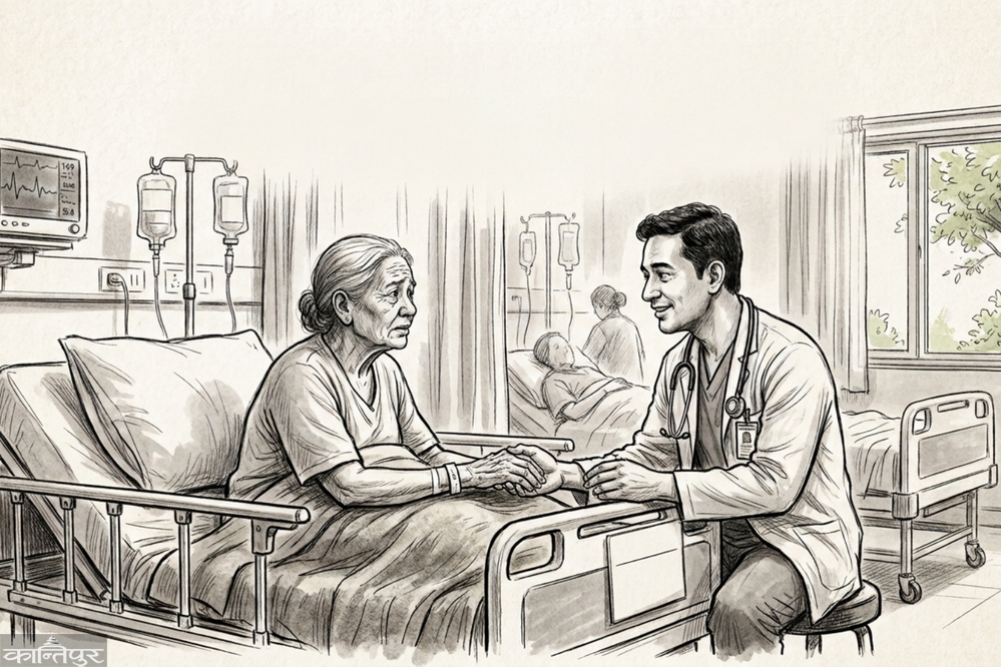
Patients arrive at the hospital carrying not only their illness, but also fear, worries about the future, countless questions, and hope for survival. Reports may reveal the disease, tests may confirm the diagnosis, and medicine may provide treatment—but the first experience of care begins with communication.
We use Google Cloud Translation Services. Google requires we provide the following disclaimer relating to use of this service:
This service may contain translations powered by Google. Google disclaims all warranties related to the translations, expressed or implied, including any warranties of accuracy, reliability, and any implied warranties of merchantability, fitness for a particular purpose, and noninfringement.
A few days ago, I read an experience on social media. In that account, writer and advocate Durga Karki wrote about how, over the past few years, she and various members of her family had to visit numerous doctors due to health problems. Her complaint was not about the effectiveness of medicine, but about the lack of communication—doctors getting irritated when asked questions, not clarifying the reasons for tests, and feeling rushed when trying to understand reports! The comments section of Karki’s post was even more meaningful. There, other people were also sharing their experiences—the stories were different, but the feelings were the same.
People who fall ill and go to the hospital are not just looking for medicine. They want to understand what is happening in their bodies. The journey of treatment is not just about diagnosing a disease, but also about trying to understand the changes occurring within oneself. However, in our health system, this understanding is often left out of the formal treatment process. That is why many people complain not about the doctor’s knowledge, but about the lack of communication.
Patients do not need to know all the answers, but they do need a basic understanding of why a test is being done, what the possibilities are, and what the next steps might be. Providing information about the reasons, possibilities, and conditions is not a difficult exam like defending a viva, nor does it require a lot of time. In fact, this small effort wins the patient’s trust and makes them feel that they are not just a case number. Ultimately, it makes the doctor–patient relationship more humane, trustworthy, and meaningful.
Meanwhile, there has also been a change in the way people seek treatment. Before going to the hospital, people search on Google, talk to AI about their symptoms, and only then go to the doctor. For many, this has become the first stage of treatment. This does not mean people are looking for alternatives to doctors. Rather, it is an attempt to gain an initial understanding of their bodies, organize their questions, and go to the hospital with less fear.
AI cannot feel our pain. It has no human relationship with our health. But it does not interrupt, does not get irritated, and answers as many times as you ask. That is why some people feel heard when talking to a screen.
In modern society, people are gradually turning from relationships to processes. In school, a student becomes a result. In the office, an employee becomes a performance indicator. For the state, a citizen becomes a statistic. In the hospital, a patient becomes a case. Tests, reports, and biological indicators become the basis of treatment, but in that process, the story, fears, and social context of the person living with the disease can be overshadowed. The problem is not that doctors do not want to see the patient, but that the structure of medical practice has taught them to see the disease more than the person.
However, this problem is not just a personal shortcoming of doctors. It is also the result of professional and structural limitations of the medical system. They themselves work within a complex system. Medical education is extremely competitive, rigorous, and demanding, producing skilled doctors through years of study and continuous evaluation. Medical students are taught to cope with difficult situations and to be emotionally strong. This is necessary for performing surgery or handling emergencies. That is why medical science has made extraordinary progress today. But increasingly, another question is being raised worldwide—while producing excellent doctors, has equal priority been given to the skills of communicating with patients, understanding their social context, and explaining complex medical information in simple language?
On the other hand, the number of specialist doctors in Nepal is lower than needed. In government hospitals, it is normal to have to see hundreds of patients in a single day. Amid limited manpower, administrative responsibilities, legal risks, and rising social expectations, doctors are constantly working under pressure. In such circumstances, time becomes the most scarce resource. And when time is short, the first thing to be sacrificed is communication, even though its importance in treatment is no less than that of any test or medicine.
Medical science is not just a biological science; it is also a science related to people. Because of this understanding, in recent years, many medical schools around the world have begun to include the humanities as an important part of health education. Subjects like literature, sociology, philosophy, history, ethics, and psychology help future doctors understand not just the disease, but also the person living with the disease. The perspective of seeing the body and society not as separate, but as interconnected realities, is becoming equally necessary for medical practice.
Communication is not an extra courtesy; it is an important part of treatment. Patients are often not looking for miracles. They are looking for a clear explanation of their condition. Even basic information such as why a test is necessary, why a definite conclusion cannot be reached right now, and what the next stage of treatment is can greatly ease the mental burden. Sometimes it takes time for a disease to heal, but a few minutes of communication can be enough to reduce uncertainty.
However, it is not enough to look at this relationship only from the doctor’s side. In our society, the tradition of calling doctors ‘God’ is still strong. Although this sounds like a language of respect, it creates an uncomfortable distance. Doctors are professionals working with limited time, limited resources, and complex decisions. Putting them on a pedestal may look like respect, but ultimately it creates a culture that reduces the possibility of human communication. On the other hand, patients also hesitate to ask questions. Some even feel uncomfortable trying to understand their own bodies. But today’s educated and information-accessible generation does not just want to take medicine—they want to be partners in their treatment process.
Now, a new tension is emerging between these expectations and the old medical culture. This is a combined result of the health system, medical education, and our social mindset. The solution must be equally collective. Time allocated for communication in hospitals should be accepted as an integral part of treatment. In medical education, the practice of understanding the humanities, communication skills, and the patient’s social context should not be considered less important than scientific knowledge. Patients should be encouraged to have both the right and the responsibility to ask questions about their treatment. A social perspective that respects doctors not as gods, but as responsible and sensitive professionals, is equally necessary. Looking at the history of medicine, trust, communication, and relationships were also tools of healing.
Ultimately, a patient does not enter the hospital carrying only a body—they arrive carrying their fears, family, worries about the future, countless questions, and hope for life. Reports can show the disease, tests can confirm the diagnosis, and medicine can provide treatment. But the first experience of healing often begins with communication. Modern medical science has already achieved extraordinary capacity to fight disease. If that can now be connected with the ability to listen to people’s stories, treatment will not only be successful, but more complete, trustworthy, and humane.