Football is a business catalyst. During the World Cup, sales of blue, yellow, and red jerseys with sky-blue stripes on a white background are incalculable. When you add up the sports kits, sports shoes, commercial advertisements, live telecast rights, and souvenirs, the World Cup's revenue reaches billions and trillions of dollars.
We use Google Cloud Translation Services. Google requires we provide the following disclaimer relating to use of this service:
This service may contain translations powered by Google. Google disclaims all warranties related to the translations, expressed or implied, including any warranties of accuracy, reliability, and any implied warranties of merchantability, fitness for a particular purpose, and noninfringement.
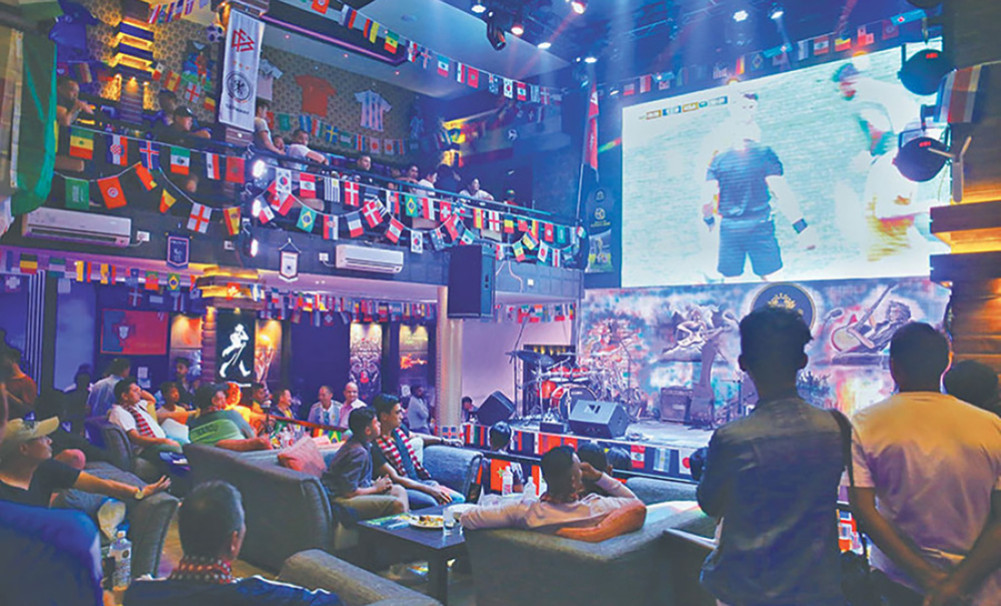
As the World Cup football tournament continues, fans are following their teams, sacrificing hunger, sleep, and thirst. There is no shortage of people wearing jerseys to support their team. It is an incredibly busy time for fan followers, in assessing the win-loss and calculating the possible goal difference. What is even more fun is that debates and arguments continue in tea shops or gatherings - regarding the referee's decisions and the results of the win-loss.
The beauty of football is that the game can be played anywhere. Even in the mountains, on the slopes, as soon as you find a little space, you can play by burying two poles. It is not necessary to have a well-equipped stadium measuring 100 meters by 64 meters as seen on the TV screen. What about open fields? It can be played anywhere - in the desert, on the beach, on a snowy field.
Football is a disciplined and regular practice. The feet should be used mainly, with the exception of the use of hands for the goalkeeper and the use of the head for others. There are countless rules in football, not all of them were created in one day and at once. Some rules that were made centuries ago have been removed over time, and some are still being added. Take the latest example of the end of the golden goal and this time the hydration break. It is said that rules are made to be broken. That is why as soon as the referee's attention on the field is shifted by an inch, the mischievous ones who start throwing punches, pulling the opponent's jersey, and making him jump start a fight. That is why there are referees like Pierluigi Collina of Italy in the history of football to maintain discipline in the dugout boxes of the twenty-two players on the field and the dugout boxes of the teams. Now, with the introduction of ultra-sensitive chips called VAR, the rules of goals, offsides, and penalties have been turned upside down, and so have the chances of winning trophies. If VAR had been around like it is now, what would have happened to Diego Maradona's 'Hand of God' in the 1986 World Cup? Would England have won the 1986 World Cup?
Football brings more than just joy and happiness. In 1970, a dispute after a World Cup qualifier escalated into a 100-hour war between El Salvador and Honduras, leaving hundreds of people dead. In the 1954 World Cup held in Switzerland, the match between Brazil and Hungary was so violent that it was nicknamed the 'Battle of Bern'. There is a known rivalry between Holland and England and between Real Madrid and Barcelona at the club level. Due to World War II, it was possible to host the FIFA World Cup in 1950, after 1938. From the beginning of the World Cup, it was customary for one country to not host the other team due to the US-backed NATO and the then Soviet Union-backed Warsaw Pact.
There are many such accidents in the world. The incident in which six young players of ANFA Academy died during the massive landslide in Sisneri on 12 Asoj 2081 can be considered a black day for Nepali football. The Dasharath Stadium incident after the storm on 29 Falgun 2044 can be taken as a context for such a bad day for Nepali football.
Football can be considered an image of Mount Everest. For every country and player, there is its own Mount Everest. Winning the World Cup against Brazil, Argentina, and France would be like successfully climbing Mount Everest, while winning the SAFF Championship for Nepal could be an equal achievement. There are similar stories and sorrows, for some countries winning the Continental Cup, for some teams winning the Champions League, for some passing the group stage of the World Cup, for some becoming district or city champions. The situation is similar for individual players! For some, winning the Ballon d'Or may be climbing Mount Everest, while for others, being declared the best player in a particular sport.
Football is a business 'catalyst'. Imagine how many jerseys with the number 10 on a white background are sold worldwide now? There are also blue, yellow, and red jerseys. When you add up sports kits, sports shoes, commercial advertisements, live telecast rights, souvenirs, and so on, the World Cup's budget is worth billions, trillions of dollars.
Most forwards want to wear number 10, perhaps this legacy that started with Pele seems to stretch through Maradona, Messi, Michel Platini, Zinedine Zidane, Ronaldinho, Neymar, and Roberto Baggio.
In the context of football, it would be unfair if two or four goalkeepers are not named. There was a goalkeeper of the then Soviet Union, Lev Yashin. His goalkeeping was so good that he was nicknamed the Black Spider. Remember the hero's ability in the Hollywood movie 'Spiderman'. Yashin also made his opponents nervous in the 1958, 1962 and 1966 World Cups. In the 1990 World Cup, Sergio Goicoechea came in as a replacement after Argentina's regular goalkeeper was injured. In the quarter-final and semi-final, he showed such magical goalkeeping skills in the tiebreakers against Yugoslavia and host Italy that Argentina almost won the 1990 World Cup.
A lot happened in the 1990 World Cup, just like in the current World Cup. In the 1990 World Cup, Italian goalkeeper Walter Zenga kept a clean sheet for 5 consecutive games, or 517 minutes, which was broken by Spanish goalkeeper Unai Simeone in this World Cup. Another exemplary goalkeeper at that time was Colombia's Rene Higuita, who would reach the center of his goalpost, the box, and the center of the box. Once, while he was almost showing similar heroism in the center, the same Roger Milla of the opposing team took control of the ball and pushed it towards Higuita's goal post, while Higuita was following behind.
It is also a pillar of football records. Since 1930, various countries and players have been trying to carve their names here. Talking about the World Cup alone, eight countries have so far, of which six were the hosts, some countries were on different continents, some countries defended their titles and some were former winners, and some returned home from the group stage.
However, this time Messi, Cristiano Ronaldo, Kylian Mbappe, and Lamine Yamal did not come to play individually, but rather to plant flags in their own names. Messi is trying to set long-term (i.e., unbreakable) records like getting tattoos. It seems that Mbappe and Ronaldo are trying to beat him.
Football is also a passion. Since the 1986 World Cup, Nepalis started watching World Cup football, with a limited audience in Kathmandu. At that time, the World Cup was also held in Mexico. And, the winner was Argentina inspired by Diego Maradona. What was the sentiment at that time? The then West Germany was like a symbol of capitalism, while Argentina was marginalized. Nepalis did not even have a 'sister who sold a cow's sign' with Argentina, but as the saying goes, 'first impression is last impression' in love, since then the Nepali audience's fandom towards Argentina has continued. If we remember the Falkland Islands incident, Nepalis should have paid homage to Argentina. That is why it is said that ‘Everything is fair in love and war’.
Small nations but big dreams! The underdog team’s success at times In the 1990 World Cup, Roger Milla of the unknown African country Cameroon stunned the defending champions Argentina in the first game. The sight of Roger Milla scoring an unexpected goal and celebrating on the field is still fresh in the minds of millions of viewers. Senegal created a similar situation for the defending champions France in the 2002 World Cup. This time too, Cape Verde defeated Spain, Uruguay and Argentina, Congo defeated England, Paraguay defeated Germany, Morocco defeated the Netherlands, Norway defeated Ivory Coast, and Belgium defeated Senegal.
When the team they supported lost in the World Cup final by a tiebreaker, a golden goal, and the title, the heart of the fan is broken. However, with a broken heart, the fans do not fall into depression because of the hope that 'they will show us another time'. And, they keep their jerseys for the next match. After all, this is the beauty of football.