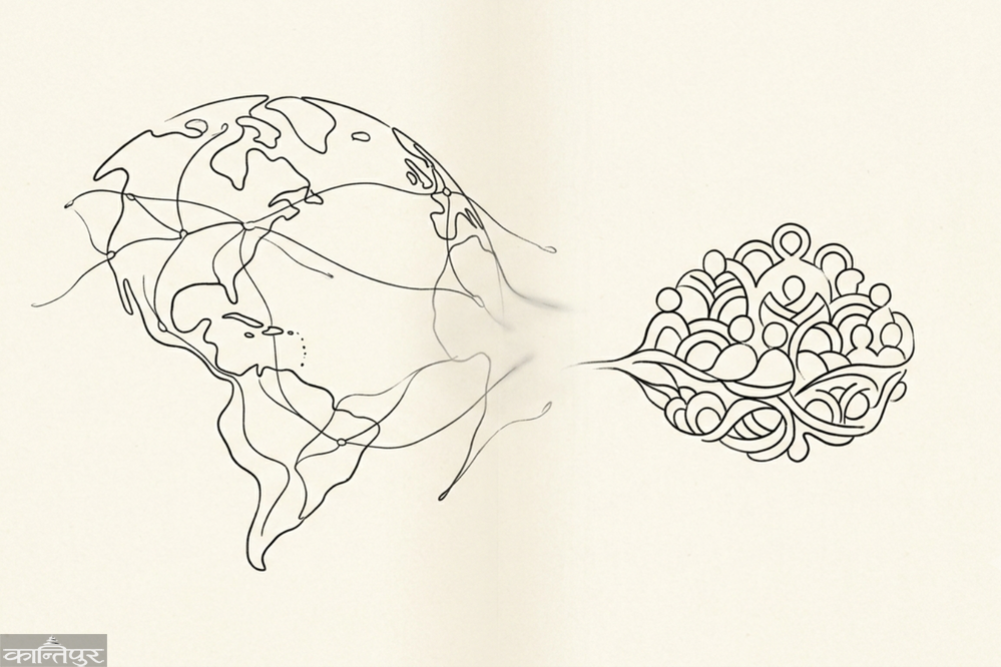
Losing a language also means losing the stories, lifestyles, and collective memories that have been stored for generations. So how do we understand the tendency to belittle those who don't speak English and to view our own language as weak?
We use Google Cloud Translation Services. Google requires we provide the following disclaimer relating to use of this service:
This service may contain translations powered by Google. Google disclaims all warranties related to the translations, expressed or implied, including any warranties of accuracy, reliability, and any implied warranties of merchantability, fitness for a particular purpose, and noninfringement.
My father was a Nepali teacher. In his free time, he would also do Puretyain around Dharan. That is, Baba was also fond of Sanskrit language.
After my brother was born, the atmosphere in our house was gradually changing. At home, we did not talk only in normal Nepali language like before. Baba would translate even small topics into English and explain them to us. He would make us speak in English. Even when asked simple questions, he would ask us to ask in English. We would get confused, laugh, and sometimes even get angry. At that time, I found it strange that Baba himself, being a Nepali teacher, made us speak English.
I studied in English medium till class 7. In boarding school, speaking English was given priority from a young age. Or rather, we were told not to speak Nepali. If you spoke in Nepali, you had to pay a fine. Perhaps understanding this, Baba started the English campaign from home for practice. Even when relatives gathered at family gatherings, Baba would encourage us to speak English. We spoke broken English, our pronunciation was bad, and our sentences were half Nepali and half English mixed. Some would joke, some would look at us sideways. But we, being wise, kept on mumbling in 'broken English', obeying Baba.
I realized even more clearly after my recent trip abroad that knowledge of language is essential. I went to Germany. During my stay there, I came back with a deeper understanding of the fact that language is not only a means of communication but also an important bridge to connect with new cultures, societies, and people. Days passed. We started to learn to speak English a little bit. But, gradually we forgot to put meaning in Nepali. At school, our friends knew that our Baba was a Nepali teacher. So when I had to put some Nepali meaning in, they would ask me. When I didn't know, they would tease me saying, 'I don't know much as a Nepali teacher'. When I didn't know the answer, I would ask my mother rather than Baba.
Today, it has become a common saying that people are completely left behind if they do not speak or understand English. With our mobile phones, computers, and the social networks we scroll through every day, English has become a password to connect with the world. From the thoughts of Japanese writers to the struggles of African youth, we find various references from around the world on one screen. English has also been a great help in understanding the entire cinema by reading the subtitles of foreign films. As I write this sentence, I realize that most of our vocabulary is only in English, which has become a foreign word and has become essential to assimilate.
I realized even more clearly after my recent trip abroad that knowledge of language is essential. I went to Germany. During my stay there, I came back with a deeper understanding that language is not only a means of communication but also an important bridge to connect with new cultures, societies, and people.
While I was there, English was my only means of communication for about 6 months and helped me move forward with confidence. I felt that language also teaches me to consider myself a small but conscious part of the world's larger community. I also tried to learn the local language. However, it would be very difficult to learn a new language at such a young age. If my father had forced me to speak German from a young age, I would have been even happier in Germany. Anyway, I was amazed by the German language and its politeness. Many of their words cannot be translated into any other language.
In Nepali society today, those who can speak English fluently are considered more educated and modern. My father understood this social reality at that time and was also a part of it. Perhaps he wanted his children not to lag behind because of the language. However, I find an uncomfortable truth in this memory. In normal circumstances, when listening to someone's broken English, the tendency to correct the grammar or make fun of those who speak a little more English is increasing.
However, similarly, we do not care much when Nepali grammar is not correct. Even though most people in Germany can understand and speak English, they speak German in their daily lives. Not only in Germany, but also when I visited other European countries, I realized that people have not fully adopted English. When I think about it, it seems that the language of a powerful nation is gradually becoming a symbol of superiority in other societies.
There are an increasing number of institutions teaching foreign languages in Nepal. In the era of globalization, it is necessary to learn English or another language after leaving the country because not knowing the language means facing many difficulties. However, the joy of meeting people from your own country abroad and speaking Nepali makes you realize the importance of your own language even more.
There are people in the world who know at least four or five languages, but we are in a race to adopt other things, considering our own language as inferior. Moreover, even though the national language is Nepali, the original local and mother tongues are gradually being forgotten in the younger generation. Losing a language means losing the stories, lifestyles, and collective memory associated with it. So how do we understand the tendency to underestimate those who do not know English and consider our own language weak?
Today, I look at Baba's instructions from that time from a different perspective. We are living in a world where globalization has made it extremely important to understand each other, to increase human sensitivity and relationships. Learning languages, especially being proficient in international languages, is essential to connect with this world. However, at the same time, we should never make the mistake of considering our own language, identity, and cultural self-esteem as weak.
Now, if we could include the study and teaching of local and mother tongues in Nepal from the primary level in a more systematic manner, perhaps our perspective towards mother tongue would be broader?