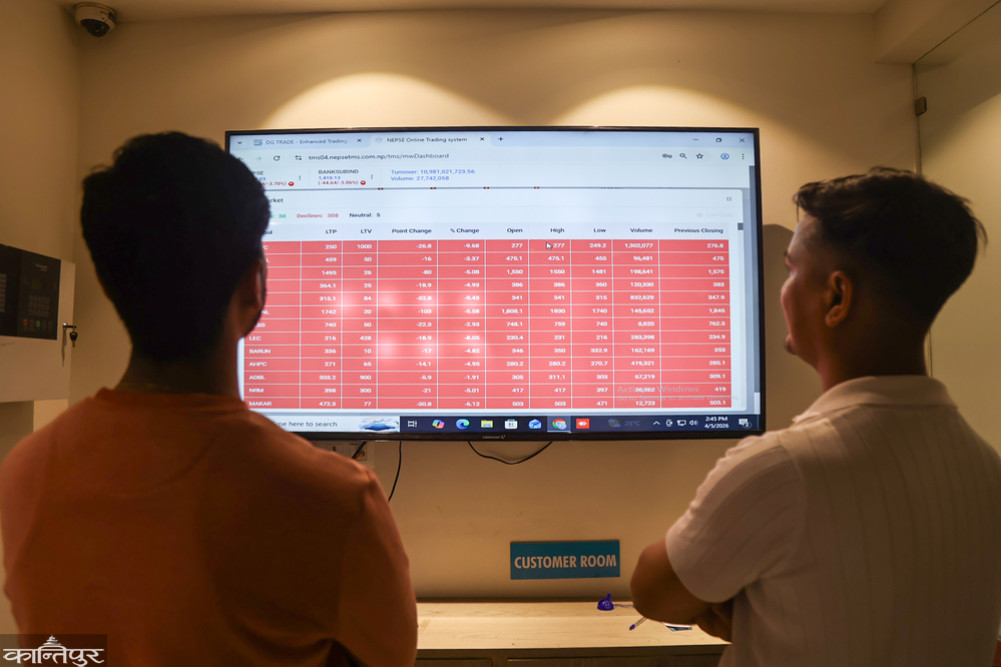
Or have companies with weak fundamentals been given unnatural prices through listing and speculation?
We use Google Cloud Translation Services. Google requires we provide the following disclaimer relating to use of this service:
This service may contain translations powered by Google. Google disclaims all warranties related to the translations, expressed or implied, including any warranties of accuracy, reliability, and any implied warranties of merchantability, fitness for a particular purpose, and noninfringement.
Today, the number of demat accounts has crossed 7.9 million. When companies issue shares, more than 2 million applications are received in the primary market. The turnover is increasing every year, the government collects taxes in the billions. From the outside, Nepal's capital market seems to be flourishing. However, behind this hustle and bustle, an intractable question is hidden - is the market really giving priority to companies that can give strong and long-term returns? Or are companies with weak foundations being valued at unnatural prices solely through listing and speculation?
This question is not new and is not a question that is asked only in the Nepali capital market. However, the debate that has arisen in recent years regarding the IPOs of some weak companies and their post-listing transactions has brought it to the surface. An even bigger problem is that, taking a similar example, shares of companies whose names and addresses are not disclosed in the name of pre-IPO are being bought and sold in a market that is not regulated by the rules at a premium price after 3-4 years. Millions of investors are getting trapped in this. The problem is not with any one company, but with a big question related to the regulatory structure and market psychology.
A lesson that history repeats
If we look at the world history of capital markets, a pattern is found to have repeated itself over and over again. When regulation is weak, information is unbalanced, and crowd psychology dominates, the market becomes a playground of confusion and temptation rather than a place of investment. The South Sea Bubble and the Mississippi Bubble of the eighteenth century are considered classic examples of this, where companies and plans with weak foundations were sold at high prices. And, the general public who entered later suffered huge losses.
This three-four hundred year old trend is not limited to Western markets but can still be seen in many countries around the world in various forms. In the 1710s, the temptation of companies that ‘extract silver from lead’, ‘sell hair’ or ‘make perpetual wheels’ was seen in Britain. Whether it is the story of Nigeria’s Afri Bank and Intercontinental Bank in 2008-09 or the 400-fold increase in the share price of Bangladesh’s ‘City Vegetable Company’ in 2010-11 or the unnatural increase in the share price of ‘GameStop’ in the US market during the Covid pandemic, all of these confirm the same thing. There has been a serious debate around the world about the overvaluation of companies with weak foundations in the market, trading based on rumors and ultimately the structure that ultimately defrauds small investors. This does not mean that all markets are the same, but where regulatory vigilance is weak, the risk of capital market information becoming a game of powerful groups is greater.
The credibility of the capital market is not measured by rising indices or increasing trading volume alone. Its real test is when the ordinary citizen who comes to the market with small savings feels safe and the state or regulator protects him from being a victim of powerful players. When a company goes public, the general public generally expects the company to have the ability to generate income, proper management, and the potential to deliver long-term returns. However, in some cases, the company's infrastructure is weak, good governance is questionable, profit potential is limited, and the main attraction of the issuance is not commercial strength but the psychology of 'getting shares' or 'getting a high price in the secondary market'.
In such a situation, the question arises - who ultimately benefits from such an IPO, the company and the promoters or the small investors? This question also includes some companies that have IPOed in the Nepali capital market in the past (such as Nepal Republic Media, National Hydropower Ltd., Nepal Warehousing Company), which are continuously in losses or have not been able to give any return to investors for decades or are not in a position to give any return in the next 5-7 years. Analysts have repeatedly raised questions about the business potential of such companies and their ability to create long-term value for investors. Rather than blaming any one company with prejudice, the main question here is whether Nepal's IPO approval system is rigorous enough in terms of investor interest.
Secondary market confusion
A more worrying aspect is that the shares of relatively weak companies that have come out of IPOs are starting to trade at very high prices in the secondary market. At such times, the general public has a convenient but misleading idea, 'Even though the company is weak, the market value is high, so what's the problem?'
A high secondary market price is not proof that the company is strong. In many cases, that price may be based on expectations, rumors, limited float, group trading, or artificial demand rather than actual earnings, assets, or cash flows. Shares bought by small investors may appear to be at a high price for a while, but if there is no commercial basis behind that price, the price will eventually not hold. In such a situation, the benefits are often reaped by informed or influential players at the initial stage, while the general public who enter later are forced to live with the illusion of a high price.
The cases of sudden increases in the share prices of institutions such as Gorkha Finance, Narayani Development Bank, and Karnali Development Bank due to rumors on social media and limited float are also frequently cited as examples of this. If the price increase is driven only by rumors and speculation, rather than by the actual improvement of the company, then such a market encourages an increase in the burden of risk on small investors rather than a culture of risk management and investment flow. Such a trend discourages the entry of good companies into the market and in the long run, capital flight instead of capital mobilization in such a market.
Two sides of the same problem
These problems of the primary market and the secondary market are not actually separate, they are two sides of the same structural problem . The first side is the process of allowing weak companies to enter the public market, while the second side is the environment in which the shares of such companies can bounce unnaturally in the secondary market . When these two issues are combined, small investors are exposed to double risks . First, the risk of investing money in an IPO with a weak foundation . Second, the risk of falling victim to artificial price play after listing .
Responsibility of the regulator
The preamble to the Securities Act-2063 has placed the protection of the interests of small investors as the main responsibility of the regulator . If this sentiment is taken as a basis, the Nepal Securities Board cannot be seen only as an IPO approval body . It is the 'gatekeeper' of the market, which must examine the quality, information flow, risk and commercial reality of the companies entering the market . If this check is weak, the opportunity to prevent many subsequent distortions will be lost.
The regulator's job is not to stop the market, but to prevent weak companies from being sold as strong. It is not to discourage entrepreneurship, but to create an environment where the right companies can raise capital at the right price. If a weak company gets an unnatural price based on publicity and games, but strong companies do not get a fair price, the market cannot allocate resources properly. And, the capital market becomes a means of distorting resources rather than a means of economic development.
Four questions that need to be raised
From the above analysis, it seems that four questions need to be raised seriously. First, are the criteria for IPO approval strict enough? Is it enough to simply complete the legal documents, or should the company's actual earning capacity, quality of good governance, and long-term sustainability also be rigorously tested?
Second, what is the quality of information provided by the issue manager, auditor and related companies and how accountable are those bodies ? If the company is found to be unprofitable or contrary to expectations for a long time after the public offering, it should be examined to see how real the initial information flow was .
Third, how effective is the monitoring of the secondary market ? Has the regulator's attention reached the rumors spread on social media and the transactions carried out by a limited number of people and the unnatural price increases seen in a small number of shares ? The initial trading prices in the secondary market after the IPO have scattered the weak regulatory landscape of the Nepali market .
Fourth, why is investor education still weak ? Even though a large number of new investors have entered the market, many still perceive IPOs as 'sure profits' and the rise of the secondary market as 'a sign that the company is doing well' . Since the capital market is a market with risks, there should be no situation where there is a sure profit . Until financial literacy is strengthened, the general public is at risk of becoming the easiest victim of such confusion.
What can be done?
At what price will IPO be approved? Should good companies also have to IPO at the paid-up price? Should companies whose directors have not been able to operate or are continuously making losses be allowed to issue IPOs at the paid-up price? Should companies with poor financial condition and governance in the secondary market be provided with the same liquidity and capital availability as good companies? These questions can only be answered through policy reforms, and only through its solutions can proper capital mobilization and risk reduction be achieved.
Strict quality checks in IPO approval, a system that makes it mandatory to provide information about the company's real condition and risks in simple language, strict monitoring of promoters' share sale or pledge-related activities and the company's fund utilization, high vigilance towards companies with weak governance, monitoring of price manipulation through social media, and a comprehensive financial literacy campaign for small investors - all these work should be started immediately. In the secondary market, the correct price can be determined in the secondary market through policy arrangements such as margin and intraday trading facilities based on financial and governance conditions, additional equipment availability for good companies, separate determination of circuit breakers based on good and bad companies, provision of margin settlement for good companies and cash settlement for bad companies. Such policy arrangements have now become a necessity rather than an option.
Conclusion
The credibility of the capital market is not measured only by the increase in the index or the increase in the transaction amount. The real test of this is when the common citizen who comes to the market with small savings feels safe, can make decisions based on facts, and the state and regulators protect him from falling prey to powerful players.
In addition, an environment should be created where good and promising companies can easily mobilize long-term capital at low cost and industrialists and businessmen can get the right value for their investments. This is also the spirit of the Securities Act-2063.
SEBON, NEPSE, issue managers, auditors, merchant bankers, company directors and economic policymakers – everyone should now take this question seriously – are the general public being given a real investment opportunity, or are risks being sold under attractive guises? If protecting the interests of small investors is truly a priority, then ‘IPO lotteries and secondary swaps’ cannot be ignored as normal market behavior. Otherwise, Nepal will repeat the same lesson that history has repeated around the world – when market prices deviate from reality, it is not prices that ultimately collapse, but public trust.